Engender blog
Guest Blog: How the rising cost of living is affecting older women in Scotland
In this guest blog, Louise Brady from Independent Age shares what we can learn from the Older People’s Economic Wellbeing Index, and the need for change to tackle the impact on women.
While media and political attention on the high cost of living seems to come and go, the crisis hasn’t gone anywhere. Older people across Scotland, particularly older women, continue to be affected at scale.
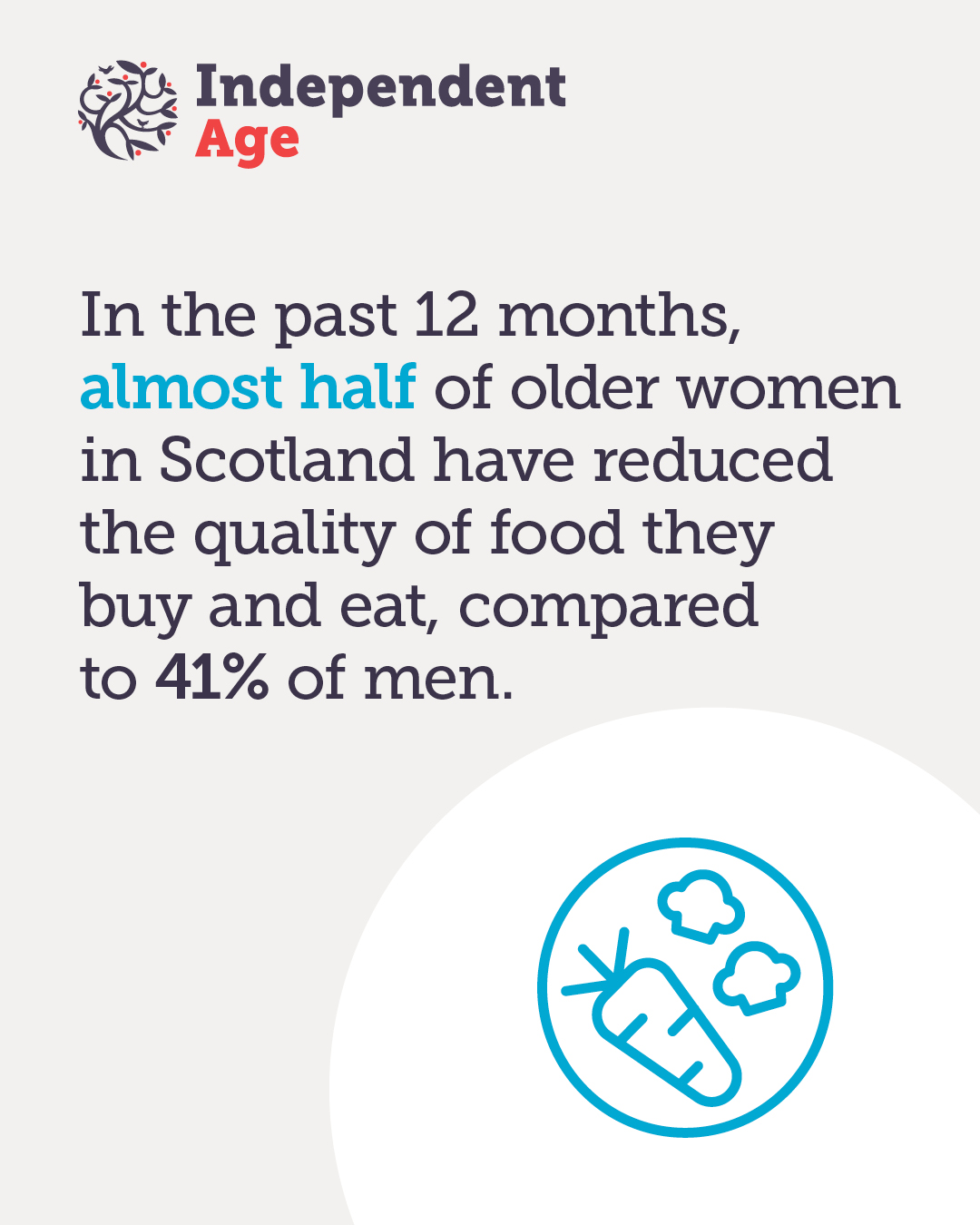 In 2026, almost a third of older women skipped meals at some point, half reduced the quality of food they bought, and 6 in 10 cut back on their heating – all because of financial difficulties.
These shocking statistics come from the second edition of Independent Age’s annual Older People’s Economic Wellbeing Index, where we track the income, costs, housing issues, quality of life and feelings of political representation experienced by people over State Pension age in Scotland.
The State Pension as the sole source of income
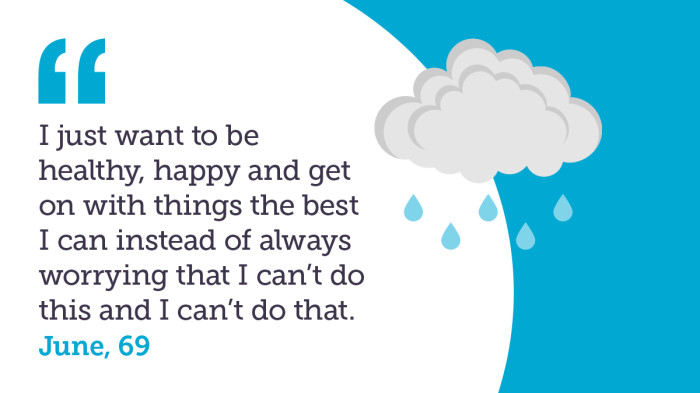
Our Index also shares the stories of older people, like June who is 69 and lives by herself. June shares the impact that rising supermarket costs have on whether she can eat healthy food, and how she often stocks up on instant noodles as a back-up option. She is behind on paying bills and is in arrears with rent and Council Tax. June doesn’t have any savings and, because she’s not eligible for Pension Credit, the State Pension is her only income. Behind every number in the Index are real people like June.
And it’s not uncommon for older people in Scotland - including June - to live on the State Pension as their only income, with women more likely to be in this position. The 2026 Index found that while over a third of older women don’t receive any income from workplace pensions, this drops to a quarter of men. Women are also less likely to receive any income from personal pensions, with less than 1 in 5 doing so compared to more than 1 in 4 men.
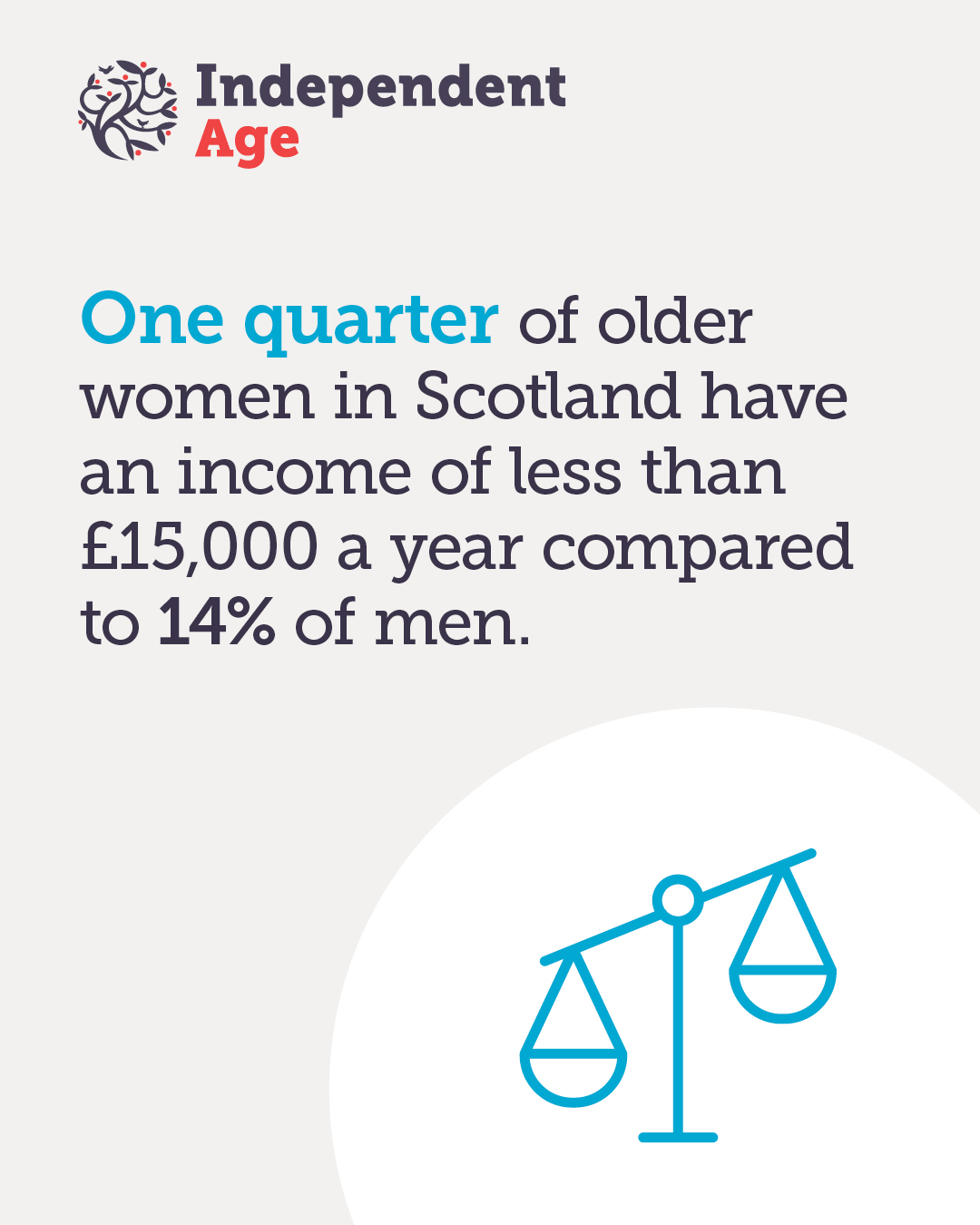
When it comes to the income levels of older women, the 2026 Index found 1 in 4 older women live on an income of less than £15,000 a year, compared to 1 in 7 men.
You can read more about why women experience pension inequality in this previous blog, which also discusses the inaugural findings of this research series.
 Millions of pounds are going unpaid
There is more to be done to ensure that the systems we have in place are accessible to people who are above current eligibility thresholds, but who are on a low income, like June. We also know that there is much more that both the UK and Scottish Governments could be doing to improve access to and take-up of payments like Pension Credit and the winter heating payments.
Later this year, the Scottish Government will publish its refreshed strategy on how it will increase take-up of devolved social security payments. It’s welcome that Scotland has such a strategy. The equivalent doesn’t exist at a UK level. But as the figures show, there is much more to do. Currently over £150 million in Pension Credit goes unpaid and unclaimed every year – it’s vital to note Pension Credit is used to decide on eligibility to other payments administered by Social Security Scotland, such as Winter Heating Payment.
For Scotland’s pensioners, it’s crucial the strategy recognises the links between take-up of UK and Scottish administered payments and takes a holistic approach to increasing take-up of all payments available to older people. Later this year, we’ll publish new research that shows the scale of unpaid social security in Scotland, covering Pension Credit, Housing Benefit and Council Tax Reduction, alongside the preventative spending impacts of maximising take-up.
Next steps for reducing pensioner poverty
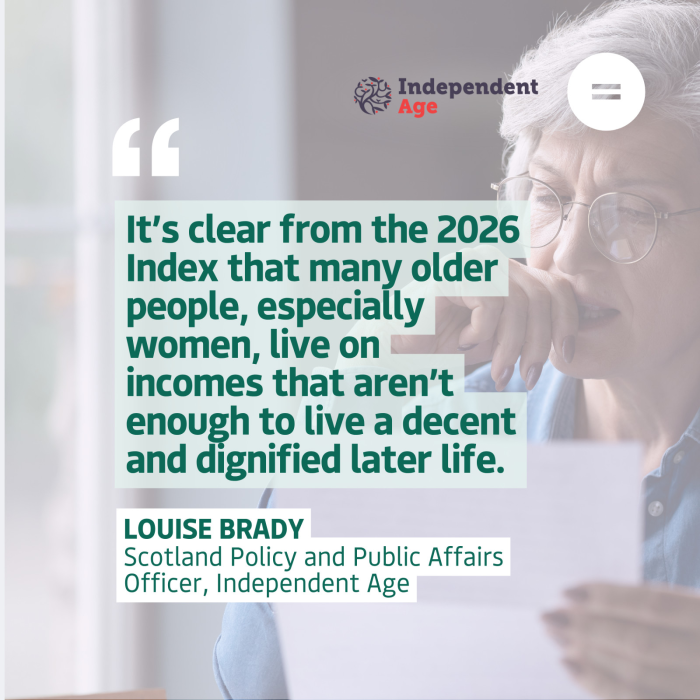
It’s clear from the 2026 Index that many older people, especially women, live on incomes that aren’t enough to live a decent and dignified later life. There are concerns about the years to come too, with just 6% of pensioners in Scotland today confident that the State Pension will cover basic living expenses in the future.
While the UK Government must ensure that the State Pension and Pension Credit are set at adequate rates, there are devolved powers that can be used to help older people who live on low incomes. For example, more financial support should be given to older carers, who often lose any additional support when they reach State Pension age. The 2026 Index shows that 1 in 5 older women provide unpaid care, and around half of this group do so for over 20 hours per week.
The urgent need for action to improve the economic wellbeing of older women in Scotland is clear. We’re calling on the Scottish Government to act on the evidence and introduce a pensioner poverty strategy in their first Programme for Government of the parliamentary session.
You can read the Older People’s Economic Wellbeing Index: Scotland 2026 from Independent Age here.
If you’re over State Pension age and struggling financially, you can find information from Independent Age on their website or you can call their Helpline on 0800 319 6789. To hear more about Independent Age’s policy and public affairs work in Scotland, please contact Scotlandpublicaffairs@independentage.org
Guest posts do not necessarily reflect the views of Engender, and all language used is the author’s own. Bloggers may have received some editorial support from Engender, and may have received a fee from our commissioning pot. We aim for our blog to reflect a range of feminist viewpoints, and offer a commissioning pot to ensure that women do not have to offer their time or words for free.
Interested in writing for the Engender blog? Find out more here.
Holyrood 2026 - Calling on candidates to invest in women
We’re calling on candidates to commit to taking action on three key areas for women if elected – and we need your help!
A decade of austerity policies, the pandemic, and the ongoing cost-of-living crisis have all impacted women disproportionately. Far too many women in Scotland report that their lives are increasingly impacted by financial insecurity, that the disproportionate burden of caring responsibilities they carry continues to go unrecognised and be undervalued, and that their fundamental rights increasingly feel at risk.
We’re calling on candidates to commit to policies that will transform women’s lives by raising 3 of the key asks from our manifesto, which focus on tackling women’s deep financial insecurity head-on. These are realistic steps that political parties can take to ensure that policy and public investment translate into real change for the most marginalised in our communities.
Gender inequality is not inevitable in Scotland, and the Holyrood 2026 elections on 7th May can be a hopeful moment of change for women in Scotland, but we need parties and candidates to commit to making women’s voices heard.
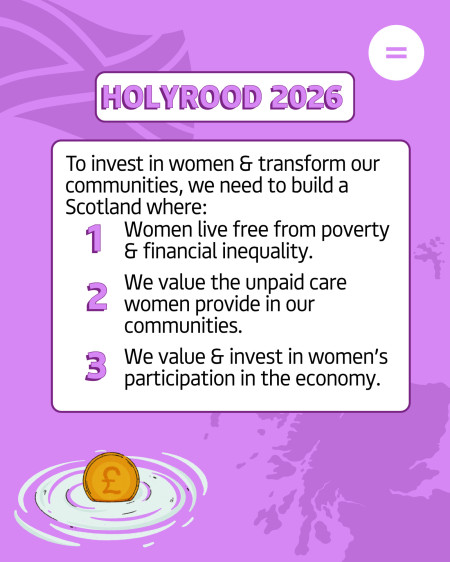 We’re asking candidates to commit to making Scotland a place where…
1. Women live free from poverty and financial inequality.
We’re calling on candidates to commit to supporting the creation of a ‘Women’s Equality Fund’ designed to provide targeted crisis financial support for marginalised groups of women, with a focus on unpaid carers, women with experience of domestic abuse, women with No Recourse to Public Funds, and disabled women.
2. We value the unpaid care women provide in our communities.
We’re calling on candidates to commit to providing vital financial assistance for unpaid carers, including improving the Carers Support Payment, increasing its value and extending access for young carers, older carers, those in education and employment, and those with multiple caring roles, and to support the introduction of a well-structured pilot scheme of the ‘Minimum Income Guarantee’ by 2029, with a focus on unpaid carers, including carers from a diverse range of ages, employment and education statuses.
3. Women’s participation in the economy is valued and invested in.
We’re calling on canddiates to commit to supporting the designation of childcare and social care as crucial economic growth sectors by recognising and investing in the care economy as key infrastructure, including in Scotland’s National Strategy for Economic Transformation (NSET).
Use the tool at the top of this page to write to your local candidates and ask them to commit to investing in women and transforming our communities.
Building an intersectional feminist future for Scotland
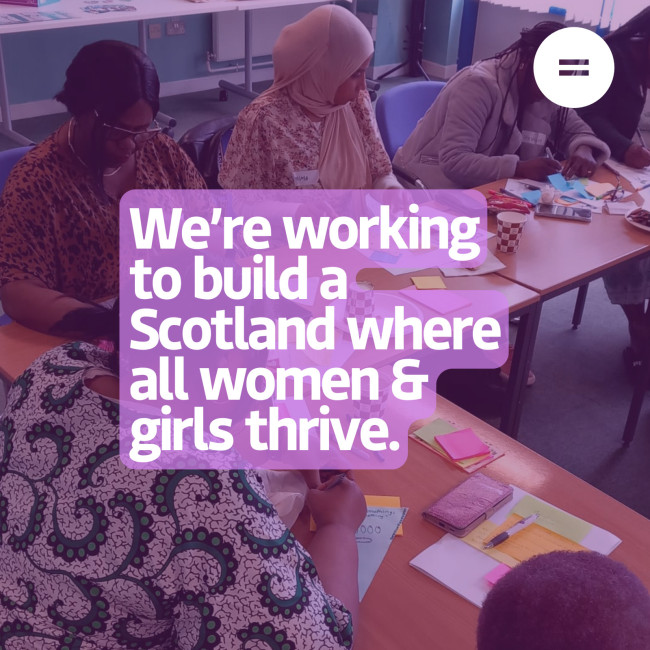
Earlier this month, our membership came together for our Annual General Meeting and to consider our Annual Report 2025, which you can read here.
It gave us a rare opportunity to take stock of our work and what we’ve managed to achieve in the last year.
We’d like to say a huge thank you to our members, followers, and everyone we’ve collaborated with. We’re grateful to the hundreds of women from across Scotland who have responded to our consultations and surveys or who joined our workshops in person. Your support and engagement enrich our work, help us understand the challenges women face, and what the priorities for change need to be - thank you.
It’s been a busy year...
We’ve worked across issues including women’s:
-
Poverty and the impacts on unpaid carers, single mums, migrant and refugee women.
-
Health, securing phase two of the groundbreaking Women’s Health Plan and a renewed focus on mental health.
-
Reproductive Rights, launching a major partnership campaign on abortion: Lets change the Act.
-
Safety: focusing on how violence against women can be prevented using policy changes across transport, housing and planning.
-
Equal Representation in Politics, Media and Culture, publishing in-depth research on the increasing hostility and pressure women face in these spaces and what government and organisations can do to improve things.
We’ve engaged with hundreds of women through our research, surveys and events, including in-person workshops across the country. We captured powerful personal testimony and positive feedback:
“Diverse, respectful, and inclusive workshop space”
“Felt heard, valued, and respected”
“Really excellent event and well run”
“Amazing, so engaging and freedom for chat”
We produced a wide range of briefings, evidence and analysis highlighting 14 vital areas for women’s equality in Scotland today.
We collaborated directly with 130 different organisations.
We contributed to 22 advisory bodies, sharing our expertise and advocating for change.
We hosted 28 in-person and online events, conferences and webinars.
We could not do this without you, thank you.
Engender statement on the weaponisation of violence against women and girls
-450.png) We are increasingly alarmed at the way women’s rights and safety are being weaponised to demonise minorities across the UK. This kind of distortion of the facts only causes harm to individuals and communities and does nothing to end violence against women and girls.
We are increasingly alarmed at the way women’s rights and safety are being weaponised to demonise minorities across the UK. This kind of distortion of the facts only causes harm to individuals and communities and does nothing to end violence against women and girls.
As Engender, we want to add our voice to calls for action against the spread of hate and misinformation, and for protection and safe and legal routes to be provided for people fleeing war and crisis to the UK. We also want to express our solidarity with racialised and other minority communities who are being made to feel unsafe by hate speech, incitement of violence and far-right protests, including here in Scotland.
Men’s violence against women and girls is endemic in our society and is caused by gender inequality. Spreading inaccurate and hateful rhetoric only generates more violence and creates a distraction from the political commitments that are needed to address it. Improvements to our social security system, investment in childcare, social care, education, housing and community resources, are the things that make a real difference to women.
The false and racist narratives these groups are promoting ignore the fact that violence against women and girls is most commonly perpetrated by someone close to the victim. Last year, the UN reported that the home is the most dangerous place for women, with 60% of women killed by men globally in 2023 dying at the hands of a partner or family member. Two out of every five people arrested during far-right riots in summer 2024 had previously been reported to the police for domestic abuse.
Racism, Islamophobia and anti-migrant attitudes play a major role in the increased risk of violence that women of colour, asylum-seeking and refugee women face.
The UK’s asylum and immigration systems compound this harm, particularly through the brutal No Recourse to Public Funds (NRPF) condition, which increases women’s risk of gender-based violence and restricts access to support, including refuge accommodation.
Invitation to Tender: Equal Representation 2025/26 Candidate Research.
-750.png)
Engender’s Equal Representation in Politics Project aims to help create a Scotland where there is sustainable equal representation of women in all their diversity in politics, ensuring women’s perspectives shape decision-making, reducing gender inequality, and creating better outcomes for women and society.
The project seeks to create change by encouraging all those who hold power to shape the political landscape, including political parties, councils, government, and parliament, to take action to increase the representation of women and improve levels of diversity among women’s representation.
We are seeking a consultant:
- To review and collate a list of women MSPs who have publicly stated that they intend to stand down before the Holyrood 2026 elections.
- To review and collate the reasons given publicly by these MSPs for reaching the decision to stand down.
- To compile a list of candidates for each major party for the Holyrood 2021, broken down by protected characteristic where possible.
- To compile a list of candidates for each major party for the Holyrood 2026, broken down by protected characteristic where possible.
- To create and circulate a survey, and analyse and collate findings, of all women MSPs standing down on the factors that influenced their decision.
The deadline for tenders to be submitted is 5pm, Monday 15th September.
Please find all the details and how to apply, here.
 RSS
RSSDownloads
 Engender Briefing: Pension Credit Entitlement Changes
From 15 May 2019, new changes will be introduced which will require couples where one partner has reached state pension age and one has not (‘mixed age couples’) to claim universal credit (UC) instead of Pension Credit.
Engender Briefing: Pension Credit Entitlement Changes
From 15 May 2019, new changes will be introduced which will require couples where one partner has reached state pension age and one has not (‘mixed age couples’) to claim universal credit (UC) instead of Pension Credit.
 Engender Parliamentary Briefing: Condemnation of Misogyny, Racism, Harassment and Sexism
Engender welcomes this Scottish Parliament Debate on Condemnation of Misogyny, Racism, Harassment and Sexism and the opportunity to raise awareness of the ways in which women in Scotland’s inequality contributes to gender-based violence.
Engender Parliamentary Briefing: Condemnation of Misogyny, Racism, Harassment and Sexism
Engender welcomes this Scottish Parliament Debate on Condemnation of Misogyny, Racism, Harassment and Sexism and the opportunity to raise awareness of the ways in which women in Scotland’s inequality contributes to gender-based violence.
 Gender Matters in Social Security: Individual Payments of Universal Credit
A paper calling on the Scottish Government to automatically split payments of Universal Credit between couples, once this power is devolved to the Scottish Parliament.
Gender Matters in Social Security: Individual Payments of Universal Credit
A paper calling on the Scottish Government to automatically split payments of Universal Credit between couples, once this power is devolved to the Scottish Parliament.
 Gender Matters Manifesto: Twenty for 2016
This manifesto sets out measures that, with political will, can be taken over the next parliamentary term in pursuit of these goals.
Gender Matters Manifesto: Twenty for 2016
This manifesto sets out measures that, with political will, can be taken over the next parliamentary term in pursuit of these goals.
 Scottish NGO Briefing for UN Special Rapporteur on Violence Against Women
Joint briefing paper for the UN Rapporteur on Violence Against Women.
Scottish NGO Briefing for UN Special Rapporteur on Violence Against Women
Joint briefing paper for the UN Rapporteur on Violence Against Women.

Newsletter
Sign up to receive our newsletter here:
Sign up to our mailing list
Receive key feminist updates direct to your inbox: