Engender blog
Research shows record number of women MSPs standing down ahead of election
Ahead of the upcoming Scottish Parliament elections on 7th May, today Engender is publishing our new paper exploring why women MSPs are stepping down, and what we can do to tackle this.
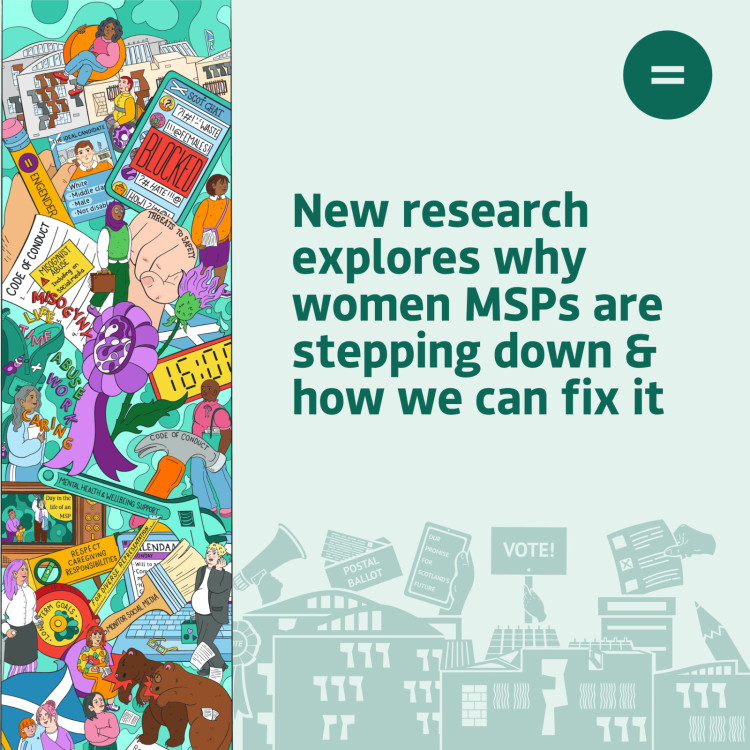
The upcoming elections are a crucial moment to ensure that our next intake of MSPs furthers women’s representation at the highest levels of decision-making, but our research shows that an unprecedented number of women MSPs are not seeking re-election.
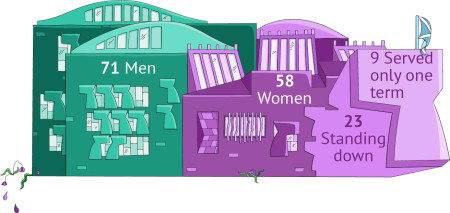 Out of 129 MSPs serving in the Scottish Parliament until March 2026, over a third announced that they would not stand for re- election in May 2026. Of the 40 MSPs who stood down, 23 were women (58%). Women made up 45% of the Scottish Parliament in March 2026. With 23 out of a total of 58 women MSPs standing down, this meant that 40% of women MSPs decided not to run again. Nine out of the 23 women who stood down were elected for the first time in 2021 meaning they served only one term in Parliament.
Understanding why women are standing down from elected office is essential in addressing persistent gender inequalities within democratic institutions and to ensuring that women’s perspectives continue to inform the decision-making that impacts their lives. We surveyed the women MSPs who had announced their intention to stand down to find out what factors were motivating their decision.
5 Reasons for women MSPs to stand down from elected office (from our survey)
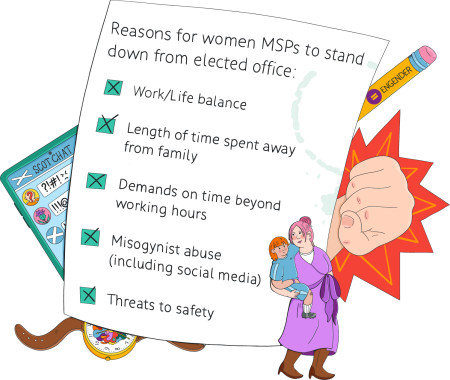 1. Work/Life balance
2. Length of time spent away from family
3. Demands on time beyond working hours
4. Misogynist abuse (including on social media)
5. Threats to safety
Women MSPs told us about their difficulty balancing work with caring responsibilities and the parliament’s lack of offering support to the barriers and misogyny women face on top of the busy lifestyle of a politician. These compounding impacts leave women vulnerable, and ultimately contribute to their decision to quit politics altogether.
Using input from women MSPs and building on work from Engender’s Equal Representation project, our paper contains recommendations for political parties, Scottish Government and the Scottish Parliamentary Corporate Body to increase women’s participation and retention, tackle violence against women, misogyny and abuse in politics, balance family life and work, and build long term culture change.
5 Key Recommendations
-
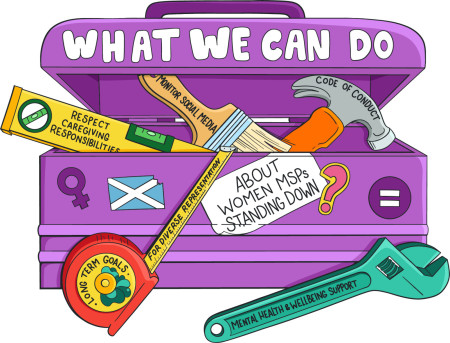 Ensure there is a Code of Conduct and bespoke policies for all members that prohibit gender-based violence and discrimination, and set out clear and transparent reporting processes.
 -
Together with Police Scotland, continue to raise awareness about Operation Ford and increase capacity so that all MSPs are adequately supported in monitoring their social media abuse and violence.
-
Provide access to mental health and wellbeing support for members who have experienced gender-based violence or discrimination.
-
Adapt party structures and ways of working to better accommodate women’s and caregivers’ needs, respecting family and caregiving responsibilities.
-
Agree long-term goals for diverse representation across local council, Holyrood and Westminster elections. Create accompanying strategies to guide work to achieve them. At all levels, foster a culture that takes proactive steps against sexism, racism, classism, ableism, transphobia and other intersecting discrimination.
Read the full paper including all the recommendations for action here.
Holyrood 2026 - Calling on candidates to invest in women
We’re calling on candidates to commit to taking action on three key areas for women if elected – and we need your help!
A decade of austerity policies, the pandemic, and the ongoing cost-of-living crisis have all impacted women disproportionately. Far too many women in Scotland report that their lives are increasingly impacted by financial insecurity, that the disproportionate burden of caring responsibilities they carry continues to go unrecognised and be undervalued, and that their fundamental rights increasingly feel at risk.
We’re calling on candidates to commit to policies that will transform women’s lives by raising 3 of the key asks from our manifesto, which focus on tackling women’s deep financial insecurity head-on. These are realistic steps that political parties can take to ensure that policy and public investment translate into real change for the most marginalised in our communities.
Gender inequality is not inevitable in Scotland, and the Holyrood 2026 elections on 7th May can be a hopeful moment of change for women in Scotland, but we need parties and candidates to commit to making women’s voices heard.
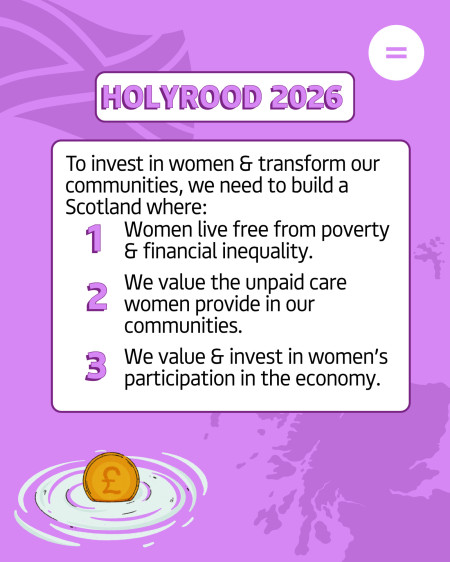 We’re asking candidates to commit to making Scotland a place where…
1. Women live free from poverty and financial inequality.
We’re calling on candidates to commit to supporting the creation of a ‘Women’s Equality Fund’ designed to provide targeted crisis financial support for marginalised groups of women, with a focus on unpaid carers, women with experience of domestic abuse, women with No Recourse to Public Funds, and disabled women.
2. We value the unpaid care women provide in our communities.
We’re calling on candidates to commit to providing vital financial assistance for unpaid carers, including improving the Carers Support Payment, increasing its value and extending access for young carers, older carers, those in education and employment, and those with multiple caring roles, and to support the introduction of a well-structured pilot scheme of the ‘Minimum Income Guarantee’ by 2029, with a focus on unpaid carers, including carers from a diverse range of ages, employment and education statuses.
3. Women’s participation in the economy is valued and invested in.
We’re calling on canddiates to commit to supporting the designation of childcare and social care as crucial economic growth sectors by recognising and investing in the care economy as key infrastructure, including in Scotland’s National Strategy for Economic Transformation (NSET).
Use the tool at the top of this page to write to your local candidates and ask them to commit to investing in women and transforming our communities.
Building an intersectional feminist future for Scotland
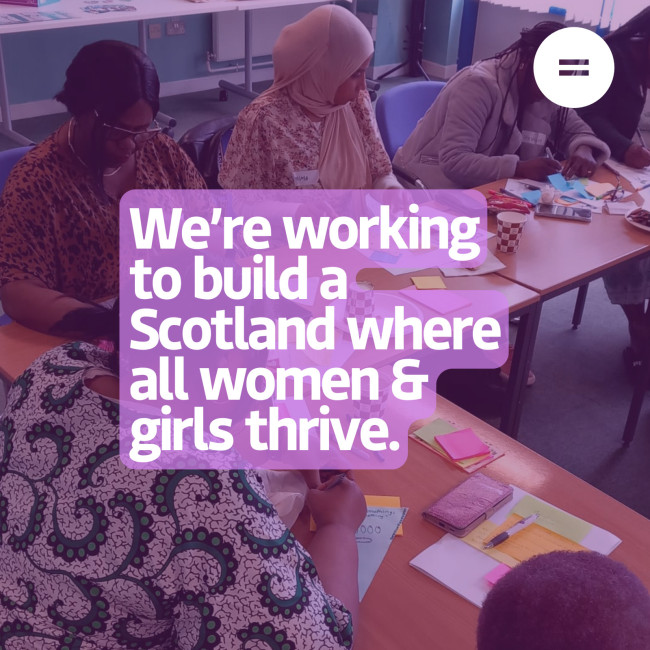
Earlier this month, our membership came together for our Annual General Meeting and to consider our Annual Report 2025, which you can read here.
It gave us a rare opportunity to take stock of our work and what we’ve managed to achieve in the last year.
We’d like to say a huge thank you to our members, followers, and everyone we’ve collaborated with. We’re grateful to the hundreds of women from across Scotland who have responded to our consultations and surveys or who joined our workshops in person. Your support and engagement enrich our work, help us understand the challenges women face, and what the priorities for change need to be - thank you.
It’s been a busy year...
We’ve worked across issues including women’s:
-
Poverty and the impacts on unpaid carers, single mums, migrant and refugee women.
-
Health, securing phase two of the groundbreaking Women’s Health Plan and a renewed focus on mental health.
-
Reproductive Rights, launching a major partnership campaign on abortion: Lets change the Act.
-
Safety: focusing on how violence against women can be prevented using policy changes across transport, housing and planning.
-
Equal Representation in Politics, Media and Culture, publishing in-depth research on the increasing hostility and pressure women face in these spaces and what government and organisations can do to improve things.
We’ve engaged with hundreds of women through our research, surveys and events, including in-person workshops across the country. We captured powerful personal testimony and positive feedback:
“Diverse, respectful, and inclusive workshop space”
“Felt heard, valued, and respected”
“Really excellent event and well run”
“Amazing, so engaging and freedom for chat”
We produced a wide range of briefings, evidence and analysis highlighting 14 vital areas for women’s equality in Scotland today.
We collaborated directly with 130 different organisations.
We contributed to 22 advisory bodies, sharing our expertise and advocating for change.
We hosted 28 in-person and online events, conferences and webinars.
We could not do this without you, thank you.
 RSS
RSSDownloads
 Engender Briefing: Pension Credit Entitlement Changes
From 15 May 2019, new changes will be introduced which will require couples where one partner has reached state pension age and one has not (‘mixed age couples’) to claim universal credit (UC) instead of Pension Credit.
Engender Briefing: Pension Credit Entitlement Changes
From 15 May 2019, new changes will be introduced which will require couples where one partner has reached state pension age and one has not (‘mixed age couples’) to claim universal credit (UC) instead of Pension Credit.
 Engender Parliamentary Briefing: Condemnation of Misogyny, Racism, Harassment and Sexism
Engender welcomes this Scottish Parliament Debate on Condemnation of Misogyny, Racism, Harassment and Sexism and the opportunity to raise awareness of the ways in which women in Scotland’s inequality contributes to gender-based violence.
Engender Parliamentary Briefing: Condemnation of Misogyny, Racism, Harassment and Sexism
Engender welcomes this Scottish Parliament Debate on Condemnation of Misogyny, Racism, Harassment and Sexism and the opportunity to raise awareness of the ways in which women in Scotland’s inequality contributes to gender-based violence.
 Gender Matters in Social Security: Individual Payments of Universal Credit
A paper calling on the Scottish Government to automatically split payments of Universal Credit between couples, once this power is devolved to the Scottish Parliament.
Gender Matters in Social Security: Individual Payments of Universal Credit
A paper calling on the Scottish Government to automatically split payments of Universal Credit between couples, once this power is devolved to the Scottish Parliament.
 Gender Matters Manifesto: Twenty for 2016
This manifesto sets out measures that, with political will, can be taken over the next parliamentary term in pursuit of these goals.
Gender Matters Manifesto: Twenty for 2016
This manifesto sets out measures that, with political will, can be taken over the next parliamentary term in pursuit of these goals.
 Scottish NGO Briefing for UN Special Rapporteur on Violence Against Women
Joint briefing paper for the UN Rapporteur on Violence Against Women.
Scottish NGO Briefing for UN Special Rapporteur on Violence Against Women
Joint briefing paper for the UN Rapporteur on Violence Against Women.

Newsletter
Sign up to receive our newsletter here:
Sign up to our mailing list
Receive key feminist updates direct to your inbox: