Engender blog
Women pay the price in an age of crisis
It is outrageous that women still do not have equal access to resources in modern Scotland. Women’s financial inequality has been accepted by our politicians and by our society more broadly. Enough is enough.
Today, we launch our new series, Confronting Women’s Poverty, outlining our 5-point plan of action to eliminate the gender income gap and prevent destitution for women and their children.
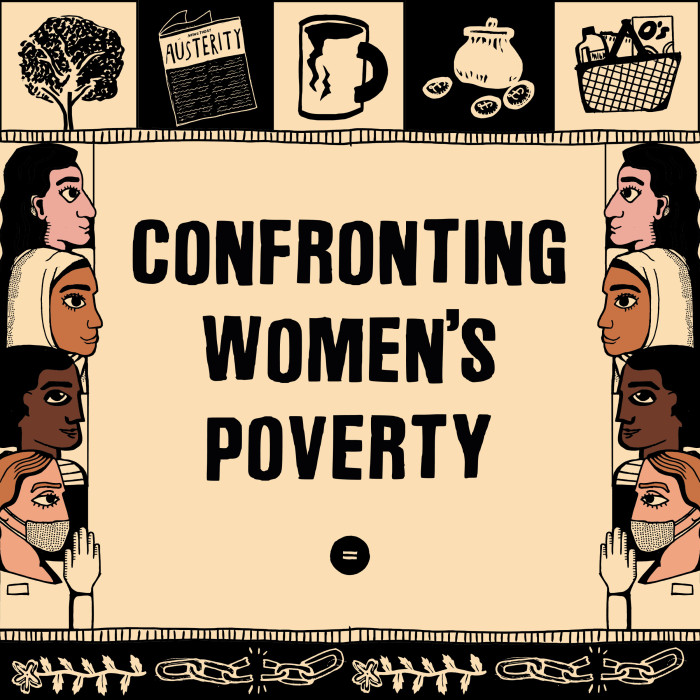
Marginalised women in Scotland are living in worsening poverty and financial insecurity.
Engender has worked for decades on issues affecting women like social security, access to housing, childcare, and unpaid care, all of which are linked to women’s poverty and financial inequality. Some of the drivers of women’s poverty include:
-
 Women tend to manage limited household budgets, often acting as ‘shock absorbers’ of poverty by going without themselves.
-
Women have less access to well-paid and secure work, occupational pensions and savings than men.
-
Domestic abuse and other forms of violence against women creates barriers to financial independence and wider access to resources for women.
-
Women are the majority of lone parents and primary caregivers for children, meaning their poverty is deeply linked with child poverty.
Today we launch Confronting Women’s Poverty, to share research and recommendations for an effective response to tackling women’s poverty in an age of crisis.
Our first paper breaks down what lies behind women’s persistent financial inequality and presents a 5-point plan to eliminate the income gap for women.
 Crisis after crisis: women pay the price
The ‘gender income gap’ refers to women having less access to financial resources and security than men. Progress to close this gap has been undermined by successive crises in recent years, including austerity, the Covid-19 pandemic, and the cost of living crisis. Women have shouldered the burden of these crises, with disabled women, women of colour, migrant women, lone parents and unpaid carers are among those most acutely harmed.
While the impacts of these emergencies on women - and the critical role that women have played in protecting and supporting their communities - have been well documented, the Scottish Government continues to fail women. We need decision-makers to take action to disrupt the broad political and social acceptance of financial inequality between women and men.
Breaking the cycle: taking action in an age of crisis
 Women’s poverty is the consequence of ingrained, systemic failures that uphold and drive forward gender-based discrimination, but it is also preventable. A combination of ineffective policy, decision-making, and crisis responses have entrenched women’s poverty. Commitments to women’s equality and rights are continually deprioritised, forcing more women into greater financial precarity, deepening poverty, and wider harms.
The gender income gap has been normalised in Scotland, but it is a political choice that guarantees harm to women and their children. To close it, decision-makers need to do much more to better understand and respond to the root causes of women’s financial inequality.
Confronting Women’s Poverty offers the new Scottish Government and Scottish Parliament a 5 point plan of action to eliminate the gender income gap and prevent destitution for women and their children.
We call for:
1. A Taskforce on Women’s Poverty
2. A Women’s Equality Fund - Crisis Support for Marginalised Women
3. A Minimum Income Guarantee for Unpaid Carers
4. A Roadmap to Universal Childcare for All
5. Overhaul of the Public Sector Equality Duty
Find our Confronting Women’s Poverty series here.
Guest Blog: How the rising cost of living is affecting older women in Scotland
In this guest blog, Louise Brady from Independent Age shares what we can learn from the Older People’s Economic Wellbeing Index, and the need for change to tackle the impact on women.
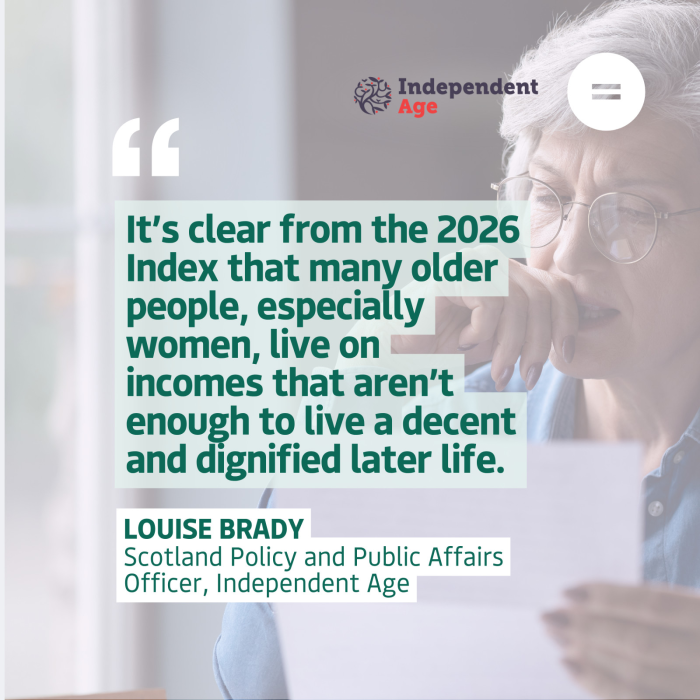
While media and political attention on the high cost of living seems to come and go, the crisis hasn’t gone anywhere. Older people across Scotland, particularly older women, continue to be affected at scale.
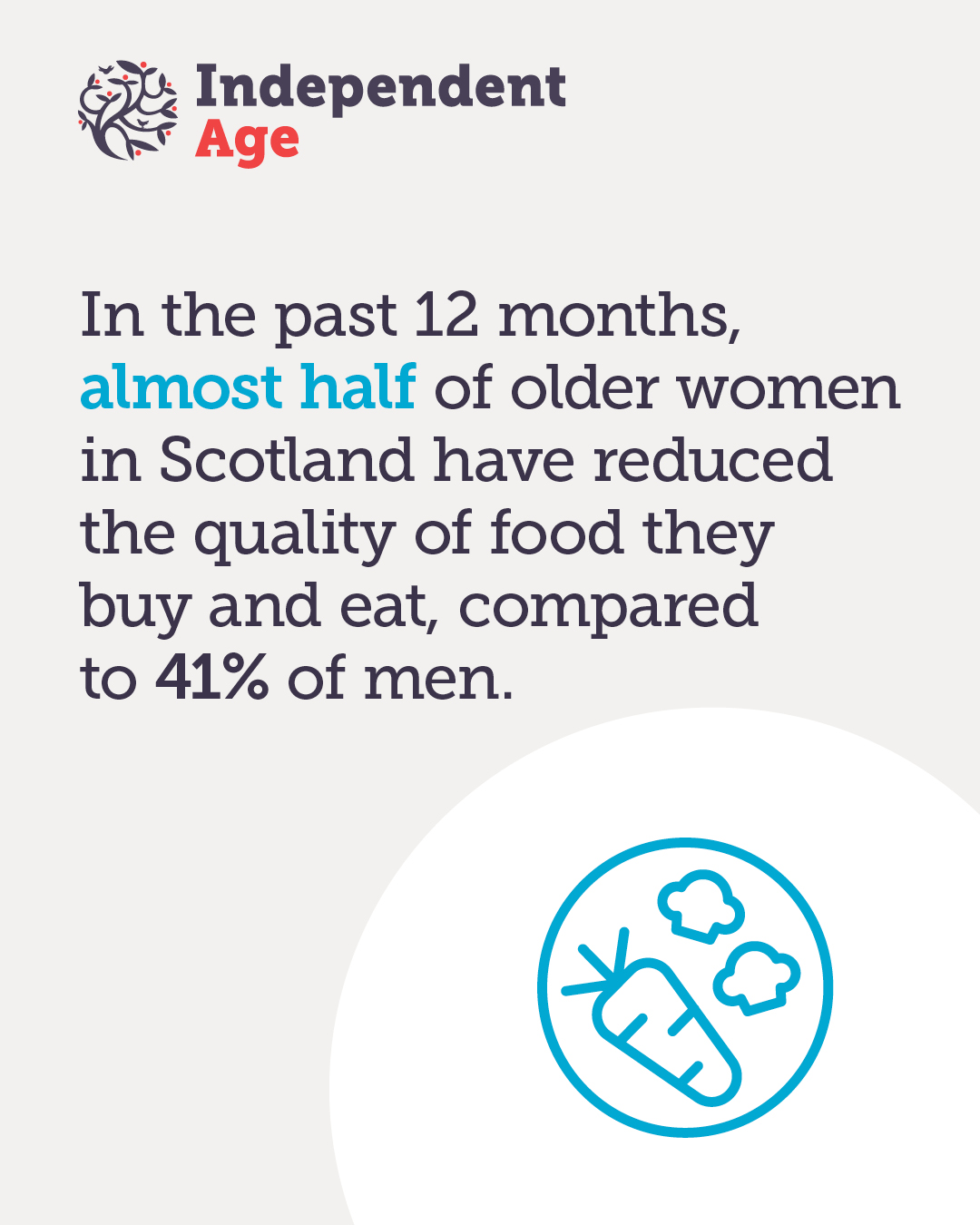 In 2026, almost a third of older women skipped meals at some point, half reduced the quality of food they bought, and 6 in 10 cut back on their heating – all because of financial difficulties.
These shocking statistics come from the second edition of Independent Age’s annual Older People’s Economic Wellbeing Index, where we track the income, costs, housing issues, quality of life and feelings of political representation experienced by people over State Pension age in Scotland.
The State Pension as the sole source of income
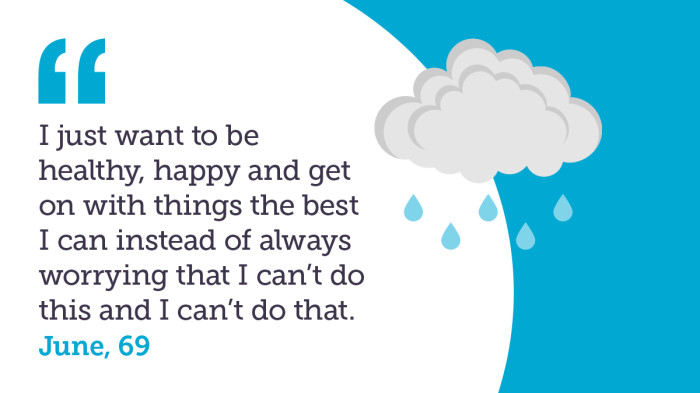
Our Index also shares the stories of older people, like June who is 69 and lives by herself. June shares the impact that rising supermarket costs have on whether she can eat healthy food, and how she often stocks up on instant noodles as a back-up option. She is behind on paying bills and is in arrears with rent and Council Tax. June doesn’t have any savings and, because she’s not eligible for Pension Credit, the State Pension is her only income. Behind every number in the Index are real people like June.
And it’s not uncommon for older people in Scotland - including June - to live on the State Pension as their only income, with women more likely to be in this position. The 2026 Index found that while over a third of older women don’t receive any income from workplace pensions, this drops to a quarter of men. Women are also less likely to receive any income from personal pensions, with less than 1 in 5 doing so compared to more than 1 in 4 men.
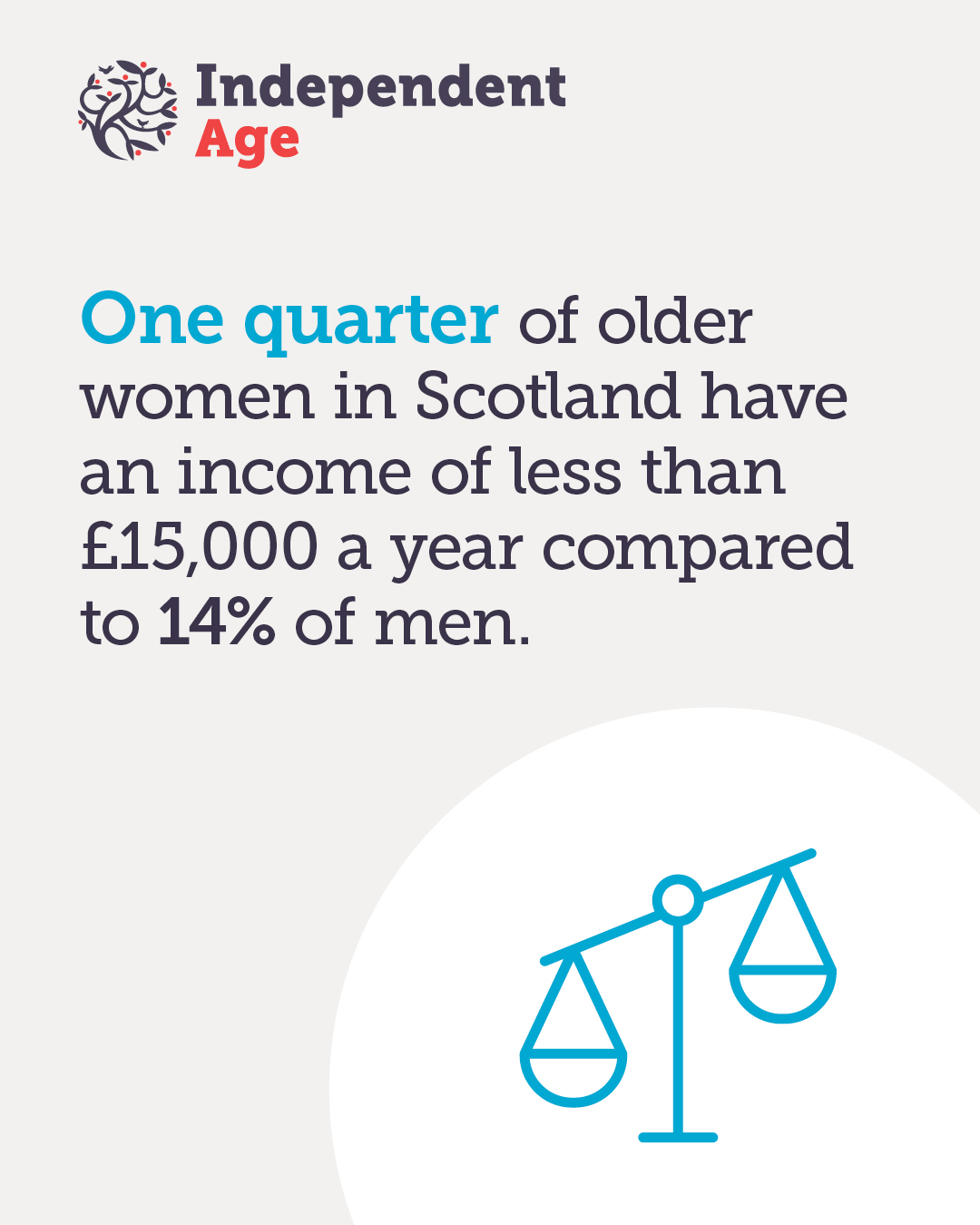
When it comes to the income levels of older women, the 2026 Index found 1 in 4 older women live on an income of less than £15,000 a year, compared to 1 in 7 men.
You can read more about why women experience pension inequality in this previous blog, which also discusses the inaugural findings of this research series.
 Millions of pounds are going unpaid
There is more to be done to ensure that the systems we have in place are accessible to people who are above current eligibility thresholds, but who are on a low income, like June. We also know that there is much more that both the UK and Scottish Governments could be doing to improve access to and take-up of payments like Pension Credit and the winter heating payments.
Later this year, the Scottish Government will publish its refreshed strategy on how it will increase take-up of devolved social security payments. It’s welcome that Scotland has such a strategy. The equivalent doesn’t exist at a UK level. But as the figures show, there is much more to do. Currently over £150 million in Pension Credit goes unpaid and unclaimed every year – it’s vital to note Pension Credit is used to decide on eligibility to other payments administered by Social Security Scotland, such as Winter Heating Payment.
For Scotland’s pensioners, it’s crucial the strategy recognises the links between take-up of UK and Scottish administered payments and takes a holistic approach to increasing take-up of all payments available to older people. Later this year, we’ll publish new research that shows the scale of unpaid social security in Scotland, covering Pension Credit, Housing Benefit and Council Tax Reduction, alongside the preventative spending impacts of maximising take-up.
Next steps for reducing pensioner poverty
It’s clear from the 2026 Index that many older people, especially women, live on incomes that aren’t enough to live a decent and dignified later life. There are concerns about the years to come too, with just 6% of pensioners in Scotland today confident that the State Pension will cover basic living expenses in the future.
While the UK Government must ensure that the State Pension and Pension Credit are set at adequate rates, there are devolved powers that can be used to help older people who live on low incomes. For example, more financial support should be given to older carers, who often lose any additional support when they reach State Pension age. The 2026 Index shows that 1 in 5 older women provide unpaid care, and around half of this group do so for over 20 hours per week.
The urgent need for action to improve the economic wellbeing of older women in Scotland is clear. We’re calling on the Scottish Government to act on the evidence and introduce a pensioner poverty strategy in their first Programme for Government of the parliamentary session.
You can read the Older People’s Economic Wellbeing Index: Scotland 2026 from Independent Age here.
If you’re over State Pension age and struggling financially, you can find information from Independent Age on their website or you can call their Helpline on 0800 319 6789. To hear more about Independent Age’s policy and public affairs work in Scotland, please contact Scotlandpublicaffairs@independentage.org
Guest posts do not necessarily reflect the views of Engender, and all language used is the author’s own. Bloggers may have received some editorial support from Engender, and may have received a fee from our commissioning pot. We aim for our blog to reflect a range of feminist viewpoints, and offer a commissioning pot to ensure that women do not have to offer their time or words for free.
Interested in writing for the Engender blog? Find out more here.
Holyrood 2026 - Calling on candidates to invest in women
We’re calling on candidates to commit to taking action on three key areas for women if elected – and we need your help!
A decade of austerity policies, the pandemic, and the ongoing cost-of-living crisis have all impacted women disproportionately. Far too many women in Scotland report that their lives are increasingly impacted by financial insecurity, that the disproportionate burden of caring responsibilities they carry continues to go unrecognised and be undervalued, and that their fundamental rights increasingly feel at risk.
We’re calling on candidates to commit to policies that will transform women’s lives by raising 3 of the key asks from our manifesto, which focus on tackling women’s deep financial insecurity head-on. These are realistic steps that political parties can take to ensure that policy and public investment translate into real change for the most marginalised in our communities.
Gender inequality is not inevitable in Scotland, and the Holyrood 2026 elections on 7th May can be a hopeful moment of change for women in Scotland, but we need parties and candidates to commit to making women’s voices heard.
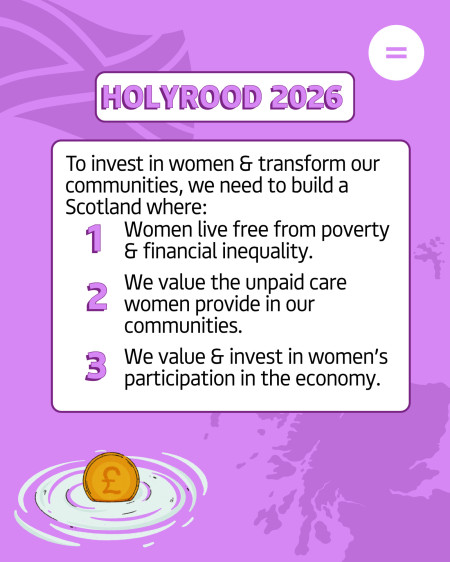 We’re asking candidates to commit to making Scotland a place where…
1. Women live free from poverty and financial inequality.
We’re calling on candidates to commit to supporting the creation of a ‘Women’s Equality Fund’ designed to provide targeted crisis financial support for marginalised groups of women, with a focus on unpaid carers, women with experience of domestic abuse, women with No Recourse to Public Funds, and disabled women.
2. We value the unpaid care women provide in our communities.
We’re calling on candidates to commit to providing vital financial assistance for unpaid carers, including improving the Carers Support Payment, increasing its value and extending access for young carers, older carers, those in education and employment, and those with multiple caring roles, and to support the introduction of a well-structured pilot scheme of the ‘Minimum Income Guarantee’ by 2029, with a focus on unpaid carers, including carers from a diverse range of ages, employment and education statuses.
3. Women’s participation in the economy is valued and invested in.
We’re calling on canddiates to commit to supporting the designation of childcare and social care as crucial economic growth sectors by recognising and investing in the care economy as key infrastructure, including in Scotland’s National Strategy for Economic Transformation (NSET).
Use the tool at the top of this page to write to your local candidates and ask them to commit to investing in women and transforming our communities.
Guest Blog: Gender and precarity in the 21st century workplace – universities and beyond
Even before the pandemic, women’s employment was increasingly precarious. Work from our sisters at Close the Gap shows that women are more likely to be in insecure work, on zero hours or temporary contracts, and are two-thirds of workers earning less than the real living wage. Black and minoritised women are overrepresented in precarious work, and are more likely to be on zero hours contracts.
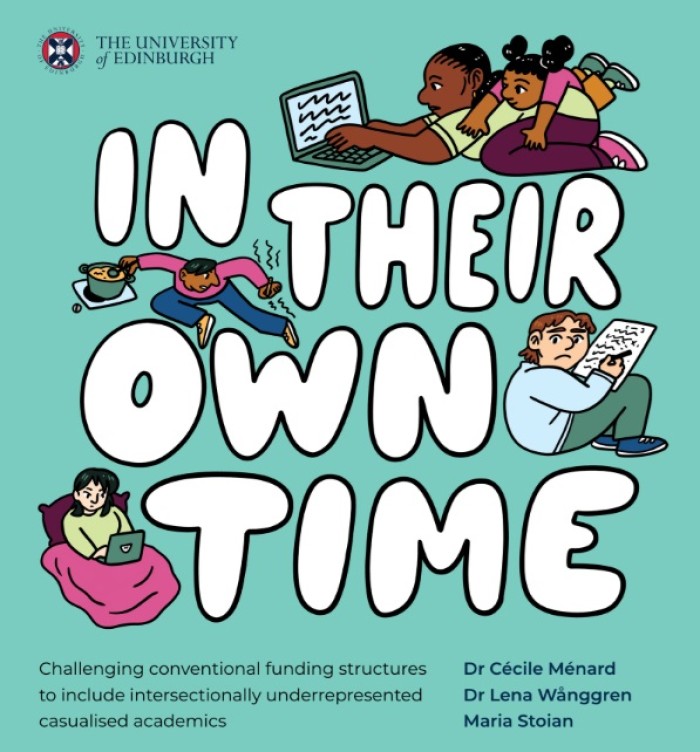
Today on our blog, researchers Dr Lena Wånggren and Dr Cécile Ménard share their work on the gendered impact of job insecurity and precarity, and why we need to make women’s unpaid, unrecognised work visible. Illustrations throughout are by Maria Stoian.
Casualisation – the precarisation of work, in which core business previously done by colleagues in permanent jobs is done on an hourly, fixed-term, sessional, and one-off basis – is a key feature of the 21st-century workplace.
This blog post, written by two long-term insecurely employed feminist researchers at a Scottish university, shares research on job insecurity and inequalities in the UK workplace. Making visible women’s unpaid and invisibilised work and the intersectionally gendered impacts of job insecurity, we highlight what needs to change.
The gendered impact of job security
Job insecurity has become the norm in UK workplaces, especially since the 2008 financial crisis and the austerity measures that followed, when anti-feminist cuts to social infrastructure went hand in hand with anti-worker legislation and policies across sectors. UK Universities, once seen as a prestigious place of privilege, are one of the most casualised (that is to say, reliant on insecure contracts) sectors in the UK: around half of academic staff are employed on insecure contracts, and higher education is the second most casualised sector in the UK after hospitality.
Precarity is not experienced equally. Migrants and racially minoritised persons are more likely to be employed on insecure contracts and, in fact, more likely to be in severely insecure work. While trade unions, feminist researchers and campaign groups have highlighted the detrimental and intersectionally gendered impact of job insecurity, including the exacerbated risk of sexual and racial violence, there is a lack of action among employers and governments to tackle the problem. To address the equalities impact of contractual precarity, we need an intersectional feminist perspective with a focus on workplace justice.
Job security is a workplace issue and a gender equality issue
There are two ways in which we approach gender and precarity in the workplace: from an intersectional feminist framing and from the issue of workplace justice. In the context of our 21st-century precarisation of work across sectors, with gig economy and platform models spreading, and the gendered and intersectional impacts of such an economy, specific problems need tackling. One specific and urgent issue is the financial instability of women in precarious work, with dependency on a partner related to risks of gender-based violence, especially for groups of migrant women who have no recourse to public funds. Family planning is affected when a stable job or living situation is not on the horizon. Job security is both a workplace issue and a gender equality issue.
 The university sector – still seen by many as a prestigious place of privilege – reproduces the same structural inequalities as the broader society. More than 40% of teaching staff are on hourly or zero-hour contracts that often do not pay enough to live on, with some relying on food banks to get by. While hourly workers are underpaid for the amount of work they are contracted to do, and the work is insecure, researchers are usually on fixed-term contracts, and are encouraged to apply for prestigious awards and grants for their careers in their own time. If they are successful, there is no guarantee of job security; the prestige and cashflow benefit the institution while the worker remains expendable.
Women’s unpaid work in universities and beyond
In our current research project, In Their Own Time, we have partnered with our trade union, UCU, to examine a key problem in struggles for gender equality: the undervaluing of women’s work. Unpaid labour has long been at the heart of the feminist struggle. From the Wages for Housework campaign to the work of scholars such as Selma James, Dorothy Smith and Patricia Hill Collins, feminists have shown that defining ‘work’ only as paid labour renders invisible the gendered, racialised labour that keeps institutions—and societies—going. While reproductive work, such as care work, is gendered and racialised, women’s work across society is also underpaid, undervalued, and invisibilised, with the labour market maintaining sexist, racist and ableist structures. This gendered undervaluing of work shows through in expectations of unpaid work and lack of support structures in the academic workplace.
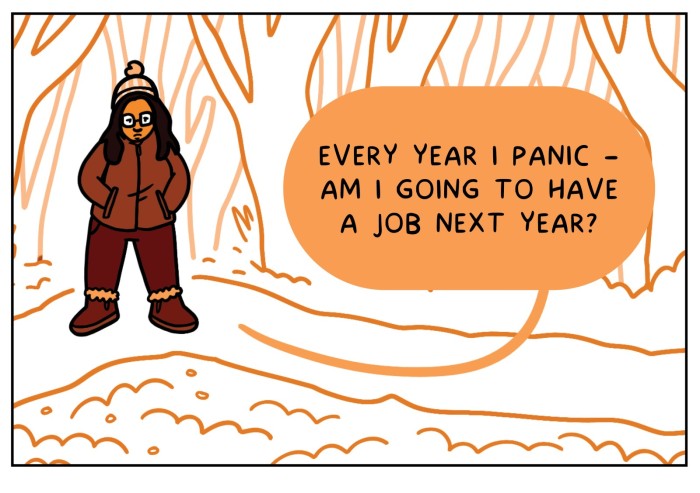
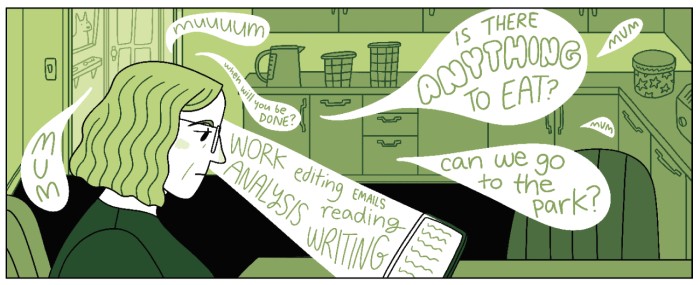
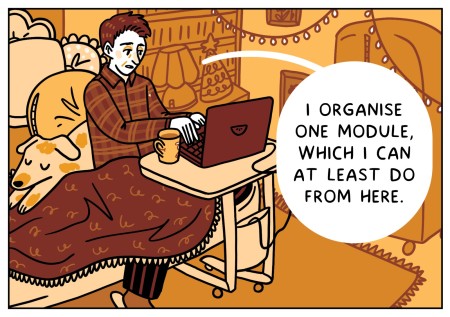
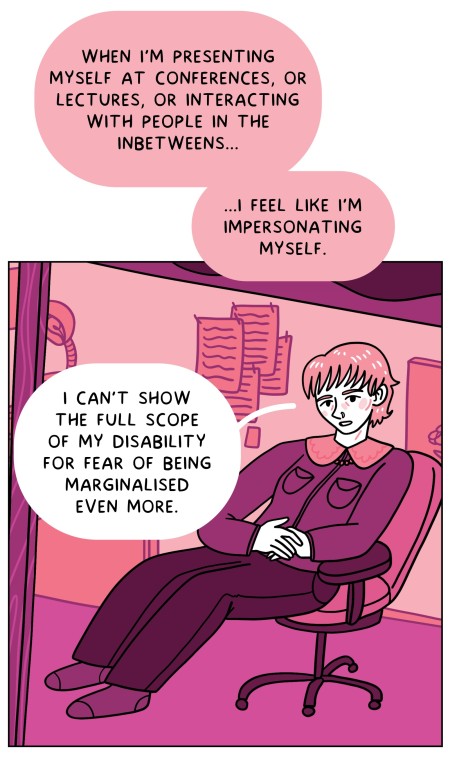 Working with the fantastic feminist illustrator Maria Stoian, the participants in the project tell stories of combining paid and unpaid work, visa applications, health issues, and a range of insecure jobs. Steph, a single mum who juggles housework, childcare, and two insecure jobs, states: ‘Every year I panic – am I going to have a job this year?’ What she calls her ‘own time’ is at night when she does emails for her jobs after her child has gone to bed. Susie, a casualised researcher for 20 years, remarks on the expectation of working unpaid in academia, for example, applying for funding in her own time even when not paid for it: non-academic colleagues think ‘it’s crazy’, but in academia, it’s normalised. She highlights that not everyone can work for free – with childcare responsibilities, she needs flexibility. Alex is a disabled academic whose disability has been made worse by precarity. Another participant, Eimhir, explains that she spends managing her chronic health condition alongside paid work and cannot fit in further unpaid academic work even if this is required to succeed in the university. Olivia, a mum and researcher, keeps her work with her all the time – including marking dissertations by the pool when the kids are at swimming lessons on Saturday morning. Meanwhile, Gwen is a trans academic in precarious part-time jobs: she gives lectures, does research, organises events, and supports her colleagues, all unpaid in her spare time.
As seen in our project, the reliance on intersectionally gendered unpaid labour creates further inequalities because it excludes those whose own time is other people’s time – such as those with caring responsibilities, the majority of whom remain women – or those whose own time is recovery time, as is the case for many disabled individuals.
Job security now!
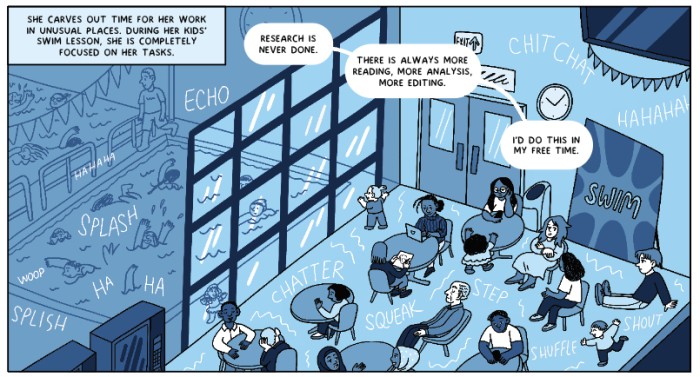
Precarity is everywhere: environmental, geopolitical, and at work. We can make distinct policy changes to address this: we need decent, secure jobs for women and for all - that is key to gender equality. Together with trade unions, workers’ organisations, and feminist organisations, we call for immediate institutional and governmental action on job insecurity, intersectional gender inequality, and an end to the invisibilisation of women’s work. Addressing job insecurity requires more than reforming individual contracts—it demands dismantling the structures that normalise insecure, unpaid labour as inevitable. Such action extends far beyond universities. Across sectors, a renewed feminist politics of labour is urgently needed—one that centres care, builds intersectional solidarity and challenges the exploitation of those whose time has always been devalued.
This project was supported by the UKRI and the British Academy Funding through the Equality, Diversity and Inclusion Caucus (ES/X008444/1)
Recommended viewing: Our Time Is Coming Now (BBC, Selma James & Michael Rabiger, 1970)
Guest posts do not necessarily reflect the views of Engender, and all language used is the author’s own. Bloggers may have received some editorial support from Engender, and may have received a fee from our commissioning pot. We aim for our blog to reflect a range of feminist viewpoints, and offer a commissioning pot to ensure that women do not have to offer their time or words for free.
Interested in writing for the Engender blog? Find out more here.
‘Knowing Me; Knowing You: Is this the best we can do for cohabiting couples?
Engender has responded to the Scottish Law Commission's consultation on reforms to the law governing cohabitation in Scotland. This blog, from Engender's Policy and Parliamentary Manager Eilidh Dickson, sets out why equality in cohabitation is a feminist issue.

Earlier this year, the Scottish Parliament passed into law the Civil Partnerships (Scotland) Act 2020, which equalised the laws governing civil partnerships in Scotland, meaning that both marriage and civil partnership is an option for mixed and same sex couples. For many couples in mixed-sex relationships this new right to choose between forms of legal recognition for their relationship is a radical positive, offering an alternative to marriage with less ‘baggage’.
The state has always had an interest in marriage. Marriage has been and continues to be described as the ‘gold standard’ of relationships. It has historically marked out families as one single unit while governing social hierarchy and social order between the sexes - men as the economic providers and women as caregiver and keepers of the home.
 RSS
RSSDownloads
 Engender Briefing: Pension Credit Entitlement Changes
From 15 May 2019, new changes will be introduced which will require couples where one partner has reached state pension age and one has not (‘mixed age couples’) to claim universal credit (UC) instead of Pension Credit.
Engender Briefing: Pension Credit Entitlement Changes
From 15 May 2019, new changes will be introduced which will require couples where one partner has reached state pension age and one has not (‘mixed age couples’) to claim universal credit (UC) instead of Pension Credit.
 Engender Parliamentary Briefing: Condemnation of Misogyny, Racism, Harassment and Sexism
Engender welcomes this Scottish Parliament Debate on Condemnation of Misogyny, Racism, Harassment and Sexism and the opportunity to raise awareness of the ways in which women in Scotland’s inequality contributes to gender-based violence.
Engender Parliamentary Briefing: Condemnation of Misogyny, Racism, Harassment and Sexism
Engender welcomes this Scottish Parliament Debate on Condemnation of Misogyny, Racism, Harassment and Sexism and the opportunity to raise awareness of the ways in which women in Scotland’s inequality contributes to gender-based violence.
 Gender Matters in Social Security: Individual Payments of Universal Credit
A paper calling on the Scottish Government to automatically split payments of Universal Credit between couples, once this power is devolved to the Scottish Parliament.
Gender Matters in Social Security: Individual Payments of Universal Credit
A paper calling on the Scottish Government to automatically split payments of Universal Credit between couples, once this power is devolved to the Scottish Parliament.
 Gender Matters Manifesto: Twenty for 2016
This manifesto sets out measures that, with political will, can be taken over the next parliamentary term in pursuit of these goals.
Gender Matters Manifesto: Twenty for 2016
This manifesto sets out measures that, with political will, can be taken over the next parliamentary term in pursuit of these goals.
 Scottish NGO Briefing for UN Special Rapporteur on Violence Against Women
Joint briefing paper for the UN Rapporteur on Violence Against Women.
Scottish NGO Briefing for UN Special Rapporteur on Violence Against Women
Joint briefing paper for the UN Rapporteur on Violence Against Women.

Newsletter
Sign up to receive our newsletter here:
Sign up to our mailing list
Receive key feminist updates direct to your inbox: