Engender blog
Women pay the price in an age of crisis
It is outrageous that women still do not have equal access to resources in modern Scotland. Women’s financial inequality has been accepted by our politicians and by our society more broadly. Enough is enough.
Today, we launch our new series, Confronting Women’s Poverty, outlining our 5-point plan of action to eliminate the gender income gap and prevent destitution for women and their children.
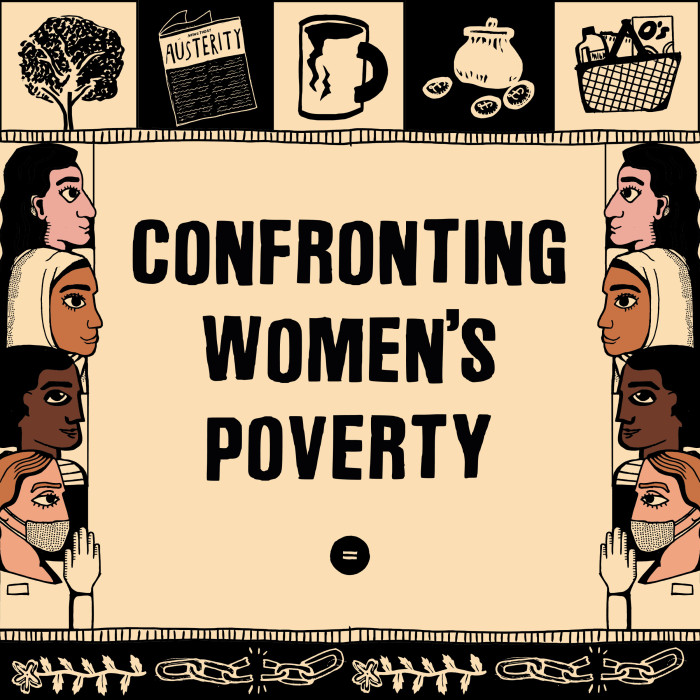
Marginalised women in Scotland are living in worsening poverty and financial insecurity.
Engender has worked for decades on issues affecting women like social security, access to housing, childcare, and unpaid care, all of which are linked to women’s poverty and financial inequality. Some of the drivers of women’s poverty include:
-
 Women tend to manage limited household budgets, often acting as ‘shock absorbers’ of poverty by going without themselves.
-
Women have less access to well-paid and secure work, occupational pensions and savings than men.
-
Domestic abuse and other forms of violence against women creates barriers to financial independence and wider access to resources for women.
-
Women are the majority of lone parents and primary caregivers for children, meaning their poverty is deeply linked with child poverty.
Today we launch Confronting Women’s Poverty, to share research and recommendations for an effective response to tackling women’s poverty in an age of crisis.
Our first paper breaks down what lies behind women’s persistent financial inequality and presents a 5-point plan to eliminate the income gap for women.
 Crisis after crisis: women pay the price
The ‘gender income gap’ refers to women having less access to financial resources and security than men. Progress to close this gap has been undermined by successive crises in recent years, including austerity, the Covid-19 pandemic, and the cost of living crisis. Women have shouldered the burden of these crises, with disabled women, women of colour, migrant women, lone parents and unpaid carers are among those most acutely harmed.
While the impacts of these emergencies on women - and the critical role that women have played in protecting and supporting their communities - have been well documented, the Scottish Government continues to fail women. We need decision-makers to take action to disrupt the broad political and social acceptance of financial inequality between women and men.
Breaking the cycle: taking action in an age of crisis
 Women’s poverty is the consequence of ingrained, systemic failures that uphold and drive forward gender-based discrimination, but it is also preventable. A combination of ineffective policy, decision-making, and crisis responses have entrenched women’s poverty. Commitments to women’s equality and rights are continually deprioritised, forcing more women into greater financial precarity, deepening poverty, and wider harms.
The gender income gap has been normalised in Scotland, but it is a political choice that guarantees harm to women and their children. To close it, decision-makers need to do much more to better understand and respond to the root causes of women’s financial inequality.
Confronting Women’s Poverty offers the new Scottish Government and Scottish Parliament a 5 point plan of action to eliminate the gender income gap and prevent destitution for women and their children.
We call for:
1. A Taskforce on Women’s Poverty
2. A Women’s Equality Fund - Crisis Support for Marginalised Women
3. A Minimum Income Guarantee for Unpaid Carers
4. A Roadmap to Universal Childcare for All
5. Overhaul of the Public Sector Equality Duty
Find our Confronting Women’s Poverty series here.
The largest poverty indicator that no one's talking about
This week (2-7th October) marks Challenge Poverty Week, an annual campaign highlighting the injustice of poverty in Scotland, and to show that collective action based on justice and compassion can create solutions.
We know that women’s poverty is a result of long-standing, deep-rooted, and systemic fault lines in our society. In this blog, our Communications and Engagement Manager Jade Stein explores the need to make visible how poverty & economic inequality are experienced at higher rates by women & marginalised groups across our society.
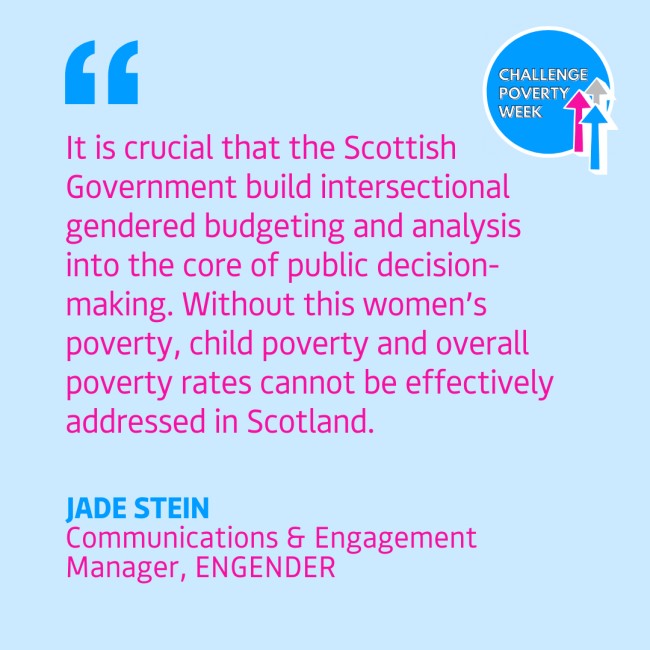
Around one-fifth of Scotland’s people – more than a million of us – live in poverty. For a rich nation, with an abundance of resources, this is simply outrageous. 
Scotland's Programme for Government - what's in it for women?
In the past week there’s been a slight autumn chill in the air in the mornings, and a pleasing back-to-school vibe in genderland that speaks of newly sharpened pencils and fresh notebooks.
Autumn is a season of new beginnings, as well as mellow fruitfulness, and the last few days has seen the launch of Scotland’s Programme for Government as well as Engender’s own Gender Matters Roadmap.
Challenge Poverty Week: Gender Matters in Care
Last week, Engender and the Centre on Constitutional Change held a conference in Glasgow. Called 'Gender Matters: Equality and Inclusion through Care', it explored the issues of both childcare and long-term care, and examined how progressive care policy could help Scotland towards achieving gender equality. Becca, a participant from the Information Service has put together this great infographic of what was discussed.
Guest Post: Challenge Poverty Week: Food for thought from EaRN’s consultation event, A Platform for Positive Change
Guest blog from Roseanna Macdonald, Equality and Rights Network (EaRN)
Well it’s over halfway through Challenge Poverty Week and we are fresh off the back of our consultation event to address poverty and inequality in Edinburgh and surrounding areas (read the first blog about it here). We had a mix of representatives from public services, third sector workers and interested individuals attend, as well as a guest speaker from Fairer Scotland to tell us about the initiatives the Scottish Government is taking to create more equal Scotland by 2030. RSS
RSSDownloads
 Engender Briefing: Pension Credit Entitlement Changes
From 15 May 2019, new changes will be introduced which will require couples where one partner has reached state pension age and one has not (‘mixed age couples’) to claim universal credit (UC) instead of Pension Credit.
Engender Briefing: Pension Credit Entitlement Changes
From 15 May 2019, new changes will be introduced which will require couples where one partner has reached state pension age and one has not (‘mixed age couples’) to claim universal credit (UC) instead of Pension Credit.
 Engender Parliamentary Briefing: Condemnation of Misogyny, Racism, Harassment and Sexism
Engender welcomes this Scottish Parliament Debate on Condemnation of Misogyny, Racism, Harassment and Sexism and the opportunity to raise awareness of the ways in which women in Scotland’s inequality contributes to gender-based violence.
Engender Parliamentary Briefing: Condemnation of Misogyny, Racism, Harassment and Sexism
Engender welcomes this Scottish Parliament Debate on Condemnation of Misogyny, Racism, Harassment and Sexism and the opportunity to raise awareness of the ways in which women in Scotland’s inequality contributes to gender-based violence.
 Gender Matters in Social Security: Individual Payments of Universal Credit
A paper calling on the Scottish Government to automatically split payments of Universal Credit between couples, once this power is devolved to the Scottish Parliament.
Gender Matters in Social Security: Individual Payments of Universal Credit
A paper calling on the Scottish Government to automatically split payments of Universal Credit between couples, once this power is devolved to the Scottish Parliament.
 Gender Matters Manifesto: Twenty for 2016
This manifesto sets out measures that, with political will, can be taken over the next parliamentary term in pursuit of these goals.
Gender Matters Manifesto: Twenty for 2016
This manifesto sets out measures that, with political will, can be taken over the next parliamentary term in pursuit of these goals.
 Scottish NGO Briefing for UN Special Rapporteur on Violence Against Women
Joint briefing paper for the UN Rapporteur on Violence Against Women.
Scottish NGO Briefing for UN Special Rapporteur on Violence Against Women
Joint briefing paper for the UN Rapporteur on Violence Against Women.

Newsletter
Sign up to receive our newsletter here:
Sign up to our mailing list
Receive key feminist updates direct to your inbox: