Engender blog
All of Engender’s latest news. Reports, reviews, books, articles, and information from across Scotland’s women’s sector.
We would love to hear from other feminists around Scotland. Check out our guidelines for more information on how you can blog for us.
Holyrood 2026 - Calling on candidates to invest in women
We’re calling on candidates to commit to taking action on three key areas for women if elected – and we need your help!
A decade of austerity policies, the pandemic, and the ongoing cost-of-living crisis have all impacted women disproportionately. Far too many women in Scotland report that their lives are increasingly impacted by financial insecurity, that the disproportionate burden of caring responsibilities they carry continues to go unrecognised and be undervalued, and that their fundamental rights increasingly feel at risk.
We’re calling on candidates to commit to policies that will transform women’s lives by raising 3 of the key asks from our manifesto, which focus on tackling women’s deep financial insecurity head-on. These are realistic steps that political parties can take to ensure that policy and public investment translate into real change for the most marginalised in our communities.
Gender inequality is not inevitable in Scotland, and the Holyrood 2026 elections on 7th May can be a hopeful moment of change for women in Scotland, but we need parties and candidates to commit to making women’s voices heard.
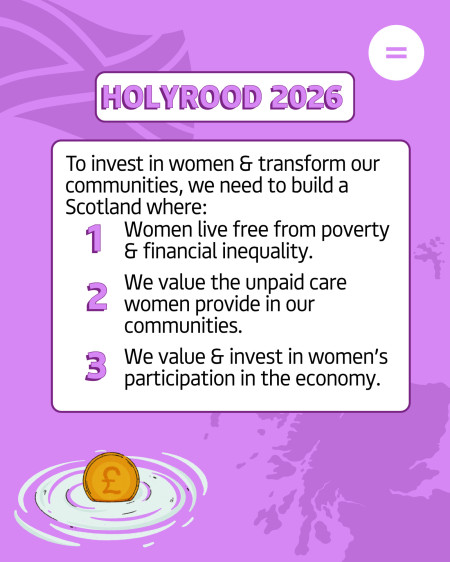 We’re asking candidates to commit to making Scotland a place where…
1. Women live free from poverty and financial inequality.
We’re calling on candidates to commit to supporting the creation of a ‘Women’s Equality Fund’ designed to provide targeted crisis financial support for marginalised groups of women, with a focus on unpaid carers, women with experience of domestic abuse, women with No Recourse to Public Funds, and disabled women.
2. We value the unpaid care women provide in our communities.
We’re calling on candidates to commit to providing vital financial assistance for unpaid carers, including improving the Carers Support Payment, increasing its value and extending access for young carers, older carers, those in education and employment, and those with multiple caring roles, and to support the introduction of a well-structured pilot scheme of the ‘Minimum Income Guarantee’ by 2029, with a focus on unpaid carers, including carers from a diverse range of ages, employment and education statuses.
3. Women’s participation in the economy is valued and invested in.
We’re calling on canddiates to commit to supporting the designation of childcare and social care as crucial economic growth sectors by recognising and investing in the care economy as key infrastructure, including in Scotland’s National Strategy for Economic Transformation (NSET).
Use the tool at the top of this page to write to your local candidates and ask them to commit to investing in women and transforming our communities.
Building an intersectional feminist future for Scotland
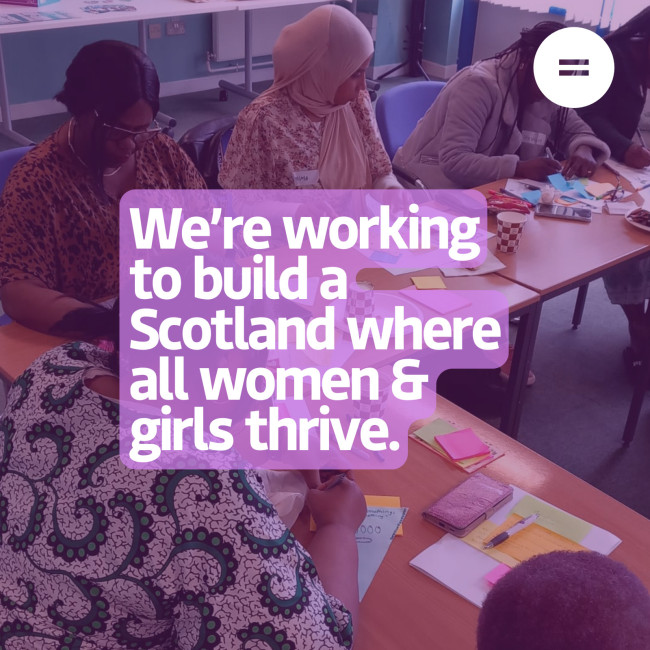
Earlier this month, our membership came together for our Annual General Meeting and to consider our Annual Report 2025, which you can read here.
It gave us a rare opportunity to take stock of our work and what we’ve managed to achieve in the last year.
We’d like to say a huge thank you to our members, followers, and everyone we’ve collaborated with. We’re grateful to the hundreds of women from across Scotland who have responded to our consultations and surveys or who joined our workshops in person. Your support and engagement enrich our work, help us understand the challenges women face, and what the priorities for change need to be - thank you.
It’s been a busy year...
We’ve worked across issues including women’s:
-
Poverty and the impacts on unpaid carers, single mums, migrant and refugee women.
-
Health, securing phase two of the groundbreaking Women’s Health Plan and a renewed focus on mental health.
-
Reproductive Rights, launching a major partnership campaign on abortion: Lets change the Act.
-
Safety: focusing on how violence against women can be prevented using policy changes across transport, housing and planning.
-
Equal Representation in Politics, Media and Culture, publishing in-depth research on the increasing hostility and pressure women face in these spaces and what government and organisations can do to improve things.
We’ve engaged with hundreds of women through our research, surveys and events, including in-person workshops across the country. We captured powerful personal testimony and positive feedback:
“Diverse, respectful, and inclusive workshop space”
“Felt heard, valued, and respected”
“Really excellent event and well run”
“Amazing, so engaging and freedom for chat”
We produced a wide range of briefings, evidence and analysis highlighting 14 vital areas for women’s equality in Scotland today.
We collaborated directly with 130 different organisations.
We contributed to 22 advisory bodies, sharing our expertise and advocating for change.
We hosted 28 in-person and online events, conferences and webinars.
We could not do this without you, thank you.
Guest Post: Why we need an integrated health care strategy for women
Women and girls face significant barriers to good mental and physical health in Scotland. Health issues that disproportionately affect women, or affect women differently to men, have historically lacked funding and professional focus, meaning that women’s health needs are not equally prioritised and understood across health services and more broadly.
Engender Member Linda Gask is a retired psychiatrist and feminist, living in Orkney. In this guest post, they explore the need for a coordinated approach to women’s physical and mental health.
In the Paris suburb of St. Denis, one of the more deprived parts of that city, stands a building called House of Women. Opened in 2016, by an extraordinary obstetrician and gynaecologist called Ghada Hatem-Gantzer, it now has now helped over 30,000 women.
Why do we need to know about this now, in Scotland? Because the House of Women isn’t only a place where women receive reproductive healthcare. It’s an amazing one-stop shop where women who have experienced gendered violence and everything that goes with that: poverty, abuse, racism, injury and illness, contact with the criminal justice system, mental ill-health, can get help in one place. Under one roof. There is nowhere like it in Scotland, or anywhere else in the United Kingdom. If we need help, we must seek out different professionals across our towns and cities. Our minds and bodies are treated as though they too are in separate places.
Women’s Centres can provide some of this holistic support but accessing help for problems that can cause serious harm to both minds and bodies, in one single place like the House of Women, is nigh on impossible. Why?
It’s because our health policymakers are not thinking enough about what women want and need to recover, but instead about ‘disorders’ and where, how and by whom they should be treated.
Yet women’s physical and mental health are closely intertwined.
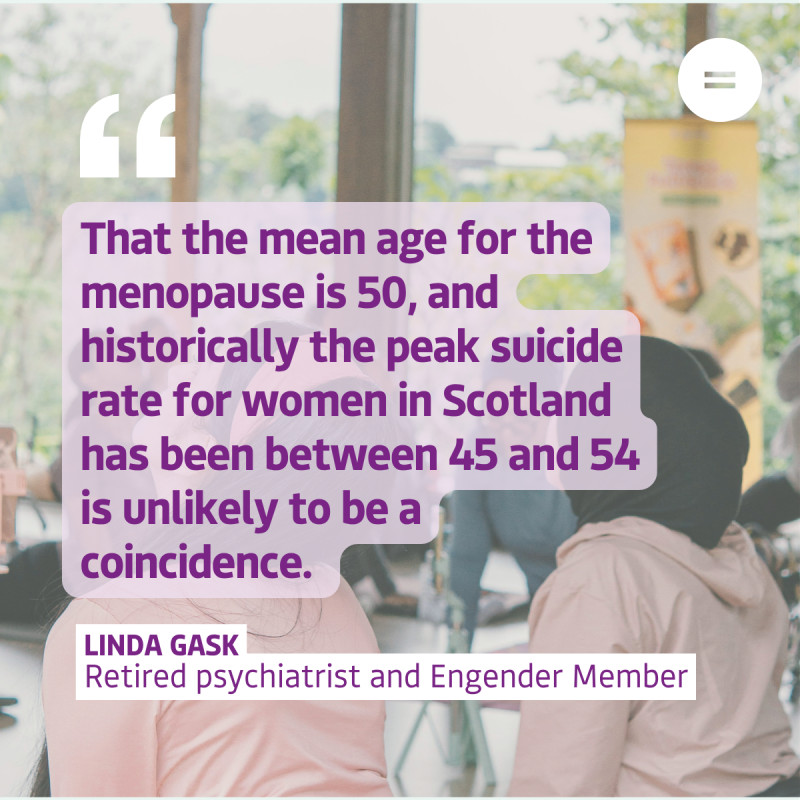
When we have persistent, horrible pelvic pain, it gets us down and may even make us severely depressed. The leading cause of death for women between a month and a year after childbirth continues to be suicide. Not only our lives but our hormones drive us crazy at times. We now know that perimenopause and menopause is a time of risk for women’s mental health. That the mean age for the menopause is 50, and historically the peak suicide rate for women in Scotland has been between 45 and 54 is unlikely to be a coincidence.
 Domestic violence doesn’t only cause physical harm to women, but also psychological trauma too and is finally being recognised as a major cause of suicide. Dementia, which affects both our minds and bodies, is more common in women than men, though we still don’t understand why, because the research hasn’t been done. Women are the ones more likely to be those caring for people with dementia too.
Both poor physical and mental health are closely related to living in poverty, and women are more likely to experience that in our society and suffer the ill-effects. Dr Hatem-Gantzer recognised that her patients who have experienced gendered violence needed much more than just a gynaecologist, so she set about getting everything they needed together in one welcoming space.
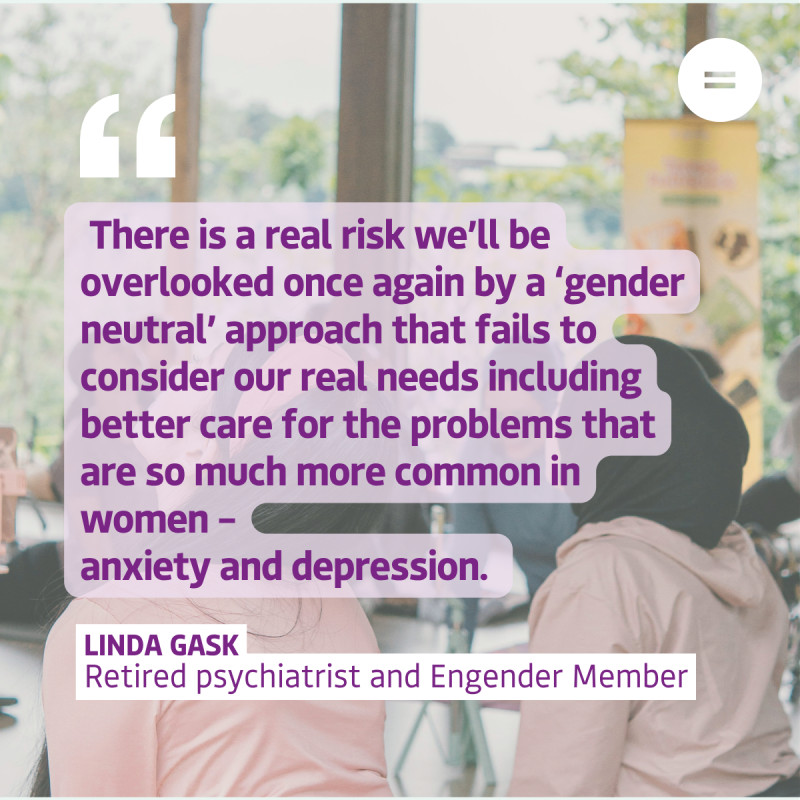
Women’s health is still too often thought of as being about childbearing and its consequences, even though, despite what some politicians may think, we are so much more than wombs. It is pleasing to see that the second phase of the Scottish Women’s Health Plan has a broader perspective than this, covering not only gynaecology but also thinking about women’s brain health – dementia, and other physical health problems such as cardiovascular disease and bone health including risk factors for osteoporosis. However, once again, the specific needs of women’s mental health will be addressed in a separate mental health strategy to be published later in the year. There is a real risk we’ll be overlooked once again by a ‘gender neutral’ approach that fails to consider our real needs including better care for the problems that are so much more common in women – anxiety and depression.
We want faster access to therapies in the community, more investment for eating disorders and the right help for the psychological consequences of early abuse, domestic violence, rape and sexual assault. Too many of us are still ending up with a diagnosis of personality disorder after experiencing violence and abuse. And all of these would benefit from more joined up thinking with physical health. For example, anorexia nervosa is a risk factor for osteoporosis and depression makes it harder to manage your chronic health problems such as diabetes.
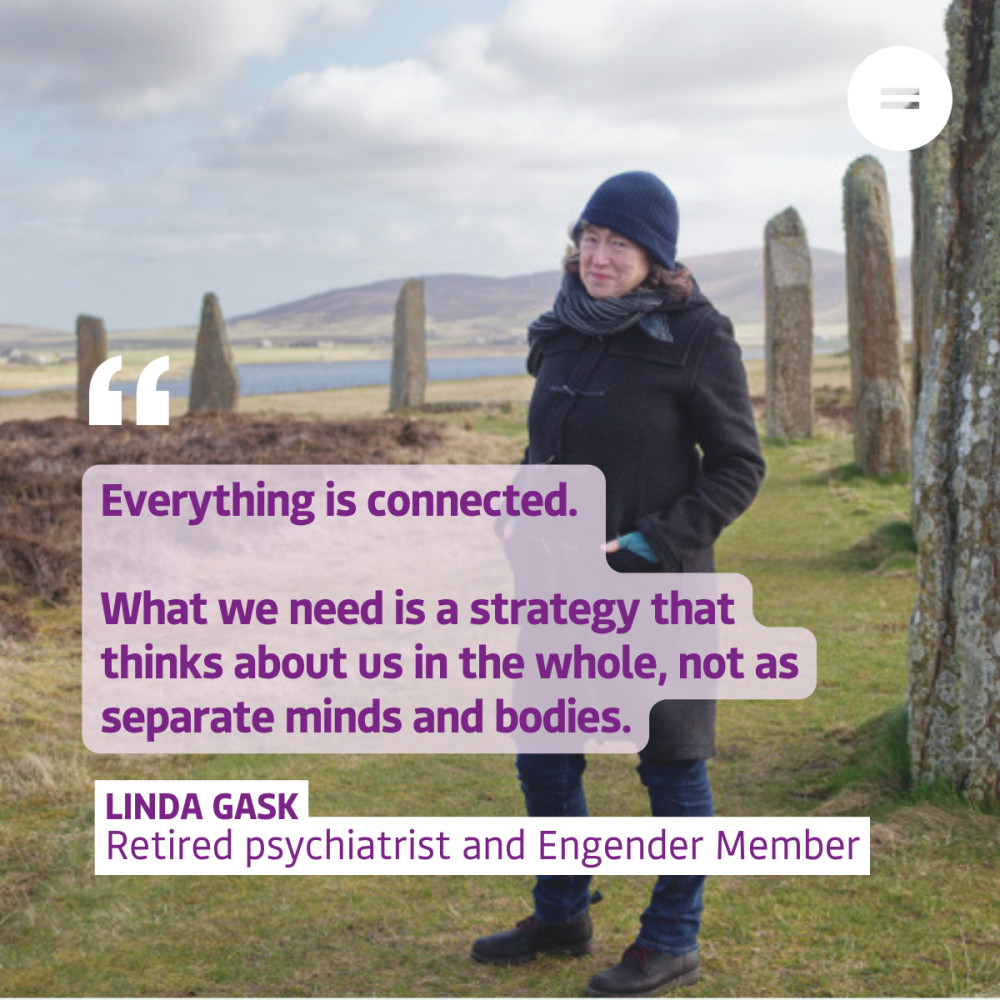
Everything is connected.
What we need is a strategy that thinks about us in the whole – not as separate minds and bodies. Australia has produced a plan just for women – which addresses women’s health across the life course, the factors that contribute to health and health outcomes for women and girls, improving health equity, and the needs of ethnic minority and gender diverse populations. It also talks about getting organisations and professionals to work together more effectively – something that doesn’t always happen here either. There are women’s health centres emerging there which address physical and mental health - something we desperately need.
Dr Hatem-Gantzer’s model for the House of Women is now being copied across France. We could do with an integrated approach to women’s health in Scotland too. We just can’t afford to keep splitting off women’s minds and bodies. It makes no sense.
Engender Member Linda Gask is a retired psychiatrist and feminist, living in Orkney, Scotland. Their latest and award-winning book Out of Her Mind: How We Are Failing Women’s Mental Health and What Must Change is available for purchase. They also regularly blog here.
Guest posts do not necessarily reflect the views of Engender, and all language used is the author’s own. Bloggers may have received some editorial support from Engender, and may have received a fee from our commissioning pot. We aim for our blog to reflect a range of feminist viewpoints, and offer a commissioning pot to ensure that women do not have to offer their time or words for free.
Interested in writing for the Engender blog? Find out more here.
Free International Women’s Day Print
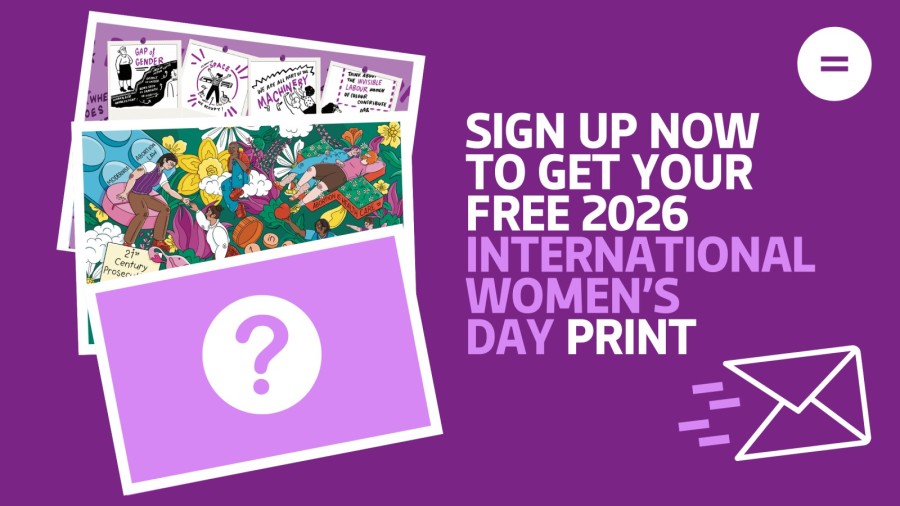
Our Free Feminist Artwork is back for 2026!
We’ve got a treat for Engender members and supporters this International Women’s Day.
We’ve got a limited number of stunning A6 prints available for Engender members and supporters to claim, created by incredible local illustrator, Heedayah Lockman.
We’ve got 250 prints to give away to Engender members, and another 100 up for grabs, so be quick to secure this excellent addition to your feminist art collection.
How to claim yours
It couldn’t be easier - just complete the form below with your details, and we’ll pop one in the post!
Guest Post: Gen Z, the promise of progress, and the persistence of patriarchy
Against the backdrop of the rise in online misogyny and far-right politics, young women are increasingly concerned about a regression in their human rights. In this guest blog, MSc student Matilda Fairgrieve interrogates Gen Z’s socially active image and shares her perspective as part of a digitally divided generation.
-700.png)
Folk are fascinated by Generation Z and our many nuances.
Media outlets fiercely debate our stereotypes; from digital addicts to digital activists, the generation to which I belong is a subject of collective curiosity.
Public commentary often considers our social conscientiousness, ‘changing the workplace and culture as we know it.’ We are viewed as radical, curious and progressive; seldom are we interrogated further. But are we really this way?
Here, I explore this perception of my generation and alert attention to where assumptions of progressive attitudes demand questions – gender equality.
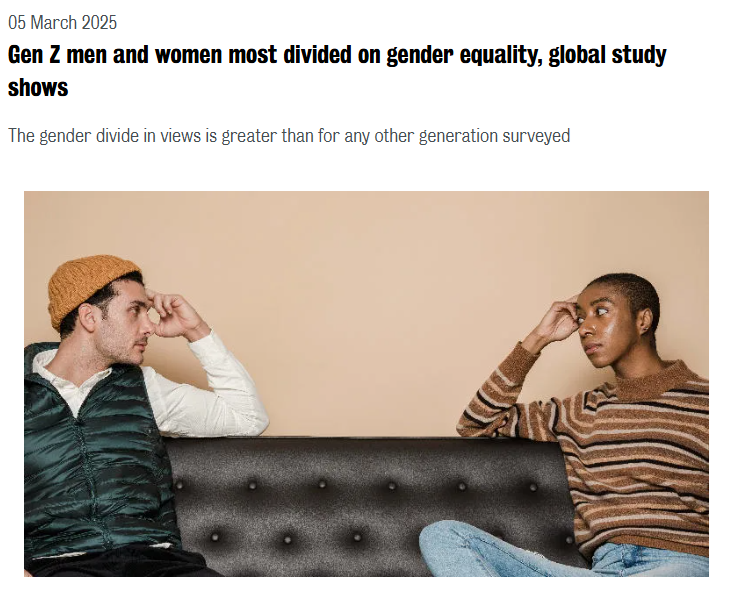 57% of Gen Z men believe women’s equality has gone so far that it discriminates against men. This finding is not in isolation; with another 32% of young men believing gender equality has negatively impacted men. In this context, I position myself among the 59% of my generation who believe there is tension between men and women.
Countless research studies and media outlets will tell you of this “tension” between Gen Z men and women. But how does this tension translate? Trepidation, as Gen Z women ponder these statistics, perplexed. How can it be that such a staggering proportion of young men we share space, workplaces and relationships with hold these views? Despite our disbelief in the percentages, there is no doubt about the problems and pain we’ve experienced as a result. A society entrenched in unequal power, from underrepresentation in politics and leadership, persistent gender pay and pension gaps, disproportionate burden of care as the norm and the violence against women and girls (VAWG) epidemic.
Intergenerationally, there is some difference in how men and women identify as feminists. However, Generation Z’s Millennial, Gen X, and Baby Boomer counterparts are not nearly as divided on the overarching importance of gender equality. Could Gen Z simply grow out of this divide? Debatable when contemplating the socio-cultural realm Gen Z grew into.
Gen Z: The distinct divide
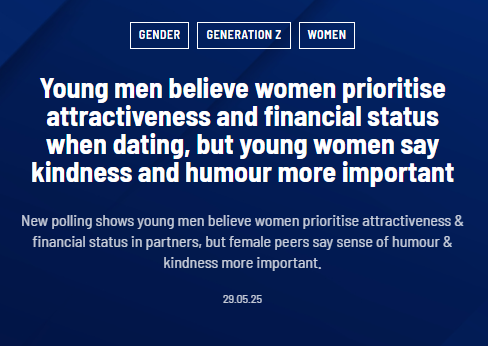 Unique to Gen Z’s divide is the danger lurking in the digital. It is no coincidence that a generation of men aged in a media-fuelled weaponisation of masculinity are threatened by gender equality. Research correlates the self-assessed importance of masculine identity with lower support for gender-equitable policy. Disconcerting political support compounds disconcerting narratives held by young men. Misogynistic and even incel ideologies have crept into dominance, such as 53% of young men believing women are only attracted to a “certain subset of men.”
As manipulative media actors exploit tensions, isolation among young people is accelerating. 19% of young adults reported having no one they can count on socially. The most digitally connected generation exists in a remarkably distrusting, detached state.
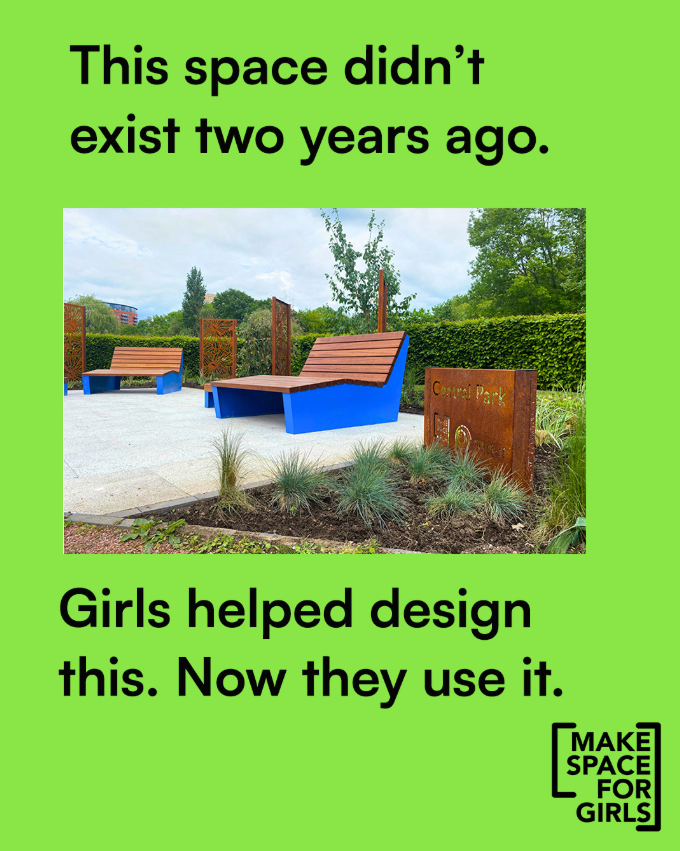
While digitally destructive shifts did not shape the playgrounds of Gen Z’s infancy, I’d argue that a physical shift in our playgrounds set a precedent for disconnect. Gen Z’s early 2000s upbringing coincided with the introduction of Multi-Use Games Areas (MUGAs) in public parks. Open outdoor spaces, a place for equal play, became unprotected from gender roles and division, with boys making up 90% of MUGA usage.
My friends and I shared a similar sentiment to that uncovered in research: “there is nothing stopping us going through the gates of MUGAs, but we don’t feel we should.” From divided children to digital teens – the trajectory of gendered socialisation for Gen Z was fundamentally different.
Reflecting on our unique transition into the digital age with little protection, Gen Z women and I question what this means for present gender equality. With real-world implications of misogynistic digital narratives in corporate and political fields already evident, the time to ask is now.
Building bridges to connect: Real-world gender equity
 If Gen Z’s polarisation is a partial result of our upbringing, there is hope for progress in remedying social disconnection and in intervening with the voices that use it as a weapon. Without minimising the complexity we face, the courage to connect and build a bridge rather than a wall certainly feels like a place to begin.
Of course, bridges must be built from primary prevention. While the ideological divide of Gen Z men and women may have been digitally fuelled, it was made possible by the root cause of gender inequality. The grip of misogynistic media would not be so tight in a gender-equal, real world.
It is promising to see primary and secondary prevention work picking up much-demanded acceleration in Scotland through initiatives such as the Equally Safe at School and Equally Safe at Work programmes, both shaped by a gendered understanding of the root cause of VAWG. Inspiring work to rectify early disconnects is on the rise, too, with the Make Space for Girls campaign ensuring gender mainstreaming in public spaces for play.
However, the current division between Gen Z men and women requires additional tertiary prevention, acknowledging that these attitudes are already abundant.
To my fellow Gen Z men and women, I’d like to meet outside of the digital world. In-person dialogue, focused on listening to lived experiences and restorative approaches to harm, moving from individual fear to collective security.
Do so with enough meaningful intent, and I’d like to believe our perceived progressive nature will not require interrogation. Building a bridge, together, that serves not only to connect once again, but provide an exit pathway from polarisation and a route to a gender-equitable future.
This guest blog was submitted by Matilda Fairgrieve (she/her), a Gen Z intersectional feminist and MSc student in Political Communications and Public Affairs, inspired by the drive to grow into a gender-equitable future in Scotland.
Guest posts do not necessarily reflect the views of Engender, and all language used is the author’s own. Bloggers may have received some editorial support from Engender, and may have received a fee from our commissioning pot. We aim for our blog to reflect a range of feminist viewpoints, and offer a commissioning pot to ensure that women do not have to offer their time or words for free.
Interested in writing for the Engender blog? Find out more here.
 RSS
RSSDownloads
 Engender Briefing: Pension Credit Entitlement Changes
From 15 May 2019, new changes will be introduced which will require couples where one partner has reached state pension age and one has not (‘mixed age couples’) to claim universal credit (UC) instead of Pension Credit.
Engender Briefing: Pension Credit Entitlement Changes
From 15 May 2019, new changes will be introduced which will require couples where one partner has reached state pension age and one has not (‘mixed age couples’) to claim universal credit (UC) instead of Pension Credit.
 Engender Parliamentary Briefing: Condemnation of Misogyny, Racism, Harassment and Sexism
Engender welcomes this Scottish Parliament Debate on Condemnation of Misogyny, Racism, Harassment and Sexism and the opportunity to raise awareness of the ways in which women in Scotland’s inequality contributes to gender-based violence.
Engender Parliamentary Briefing: Condemnation of Misogyny, Racism, Harassment and Sexism
Engender welcomes this Scottish Parliament Debate on Condemnation of Misogyny, Racism, Harassment and Sexism and the opportunity to raise awareness of the ways in which women in Scotland’s inequality contributes to gender-based violence.
 Gender Matters in Social Security: Individual Payments of Universal Credit
A paper calling on the Scottish Government to automatically split payments of Universal Credit between couples, once this power is devolved to the Scottish Parliament.
Gender Matters in Social Security: Individual Payments of Universal Credit
A paper calling on the Scottish Government to automatically split payments of Universal Credit between couples, once this power is devolved to the Scottish Parliament.
 Gender Matters Manifesto: Twenty for 2016
This manifesto sets out measures that, with political will, can be taken over the next parliamentary term in pursuit of these goals.
Gender Matters Manifesto: Twenty for 2016
This manifesto sets out measures that, with political will, can be taken over the next parliamentary term in pursuit of these goals.
 Scottish NGO Briefing for UN Special Rapporteur on Violence Against Women
Joint briefing paper for the UN Rapporteur on Violence Against Women.
Scottish NGO Briefing for UN Special Rapporteur on Violence Against Women
Joint briefing paper for the UN Rapporteur on Violence Against Women.

Newsletter
Sign up to receive our newsletter here:
Sign up to our mailing list
Receive key feminist updates direct to your inbox: