Engender blog
GUEST POST: Stand with the pro-choice voice across the US
Feminist across the world have continued to watch in horror as reproductive rights are under attack in the USA. In this blog, Jane Carnall, an activist with Abortion Rights Edinburgh sets out why we must act in solidarity with those seeking access to abortion in the states.
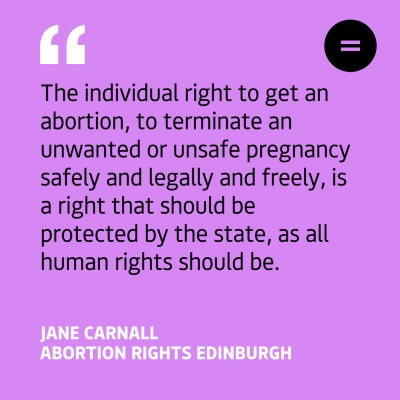
This month, a law passed by the Republican majority governing Texas came into force, and effectively banned all legal abortion in the state of Texas after six weeks gestation - that is, well before most people would even realise they're pregnant.
On 2nd October, Abortion Rights Scotland is taking part in the international day of action against this legislation.
GUEST POST: Bridging the gender health gap
Women and girls face signiï¬cant barriers to good mental and physical health. Historic lack of funding for, or professional focus on, health issues that disproportionately affect women, or affect women differently to men, can mean that these issues are not equally accommodated for in health services or awareness-raising initiatives. This anonymous guest blog explores gendered health inequalities and what progress is being made on bridging the gender health gap.
-400.png)
It took roughly six years of medical appointments before a tentative diagnosis of chronic pain – a condition that, by definition, is pain lasting longer than three months despite treatment. Part of the issue was that the pain, among other symptoms, had never really been treated; it was repeatedly misdiagnosed, from appendicitis to pregnancy, and continuously dismissed as stress or growing pains.
It was a strange relief to eventually be referred to an endometriosis specialist and women’s heath physiotherapist session, though the relief was short-lived – while I did receive some pain management, the former concluded that the pain did not appear severe enough to suggest the presence of the condition, nor warrant further investigation, and the latter prescribed mindfulness. Like many others, until recently I had never heard of endometriosis – despite its high prevalence rate and top ranking in the NHS’ 20 most painful conditions. I also found that, like many other people, my experience of healthcare was not unique. In recent years, there has been increasing awareness and recognition of such experiences as symptomatic of a wider issue: a gender disparity in medical research, knowledge and treatment that has amounted to a gender health gap.
GUEST POST: Sex, Relationships and Parenthood – A Network Supporting Young Women and Girls with a Learning Disability
In this guest blog, Yvonne Kerr, Programme Manager in Sexual Health and Blood Born Viruses at NHS Lothian, discusses the national Relationships, Sexual Health and Parenthood and Learning Disability / Additional Support Needs Network.
Engender’s report, Our Bodies Our Rights, found that a lack of knowledge and access to information acts as a barrier to disabled women’s reproductive rights because of a huge knowledge gap regarding disabled women’s reproductive, sexual and maternal health. It also found that access to inclusive and targeted sex and relationships education for disabled young women and girls is also almost entirely absent from mainstream and specialist education.
![Graphic shows a light pink back ground with dark purple text that reads, "It became apparent early on in the life of the group that young people with additional support needs and/or learning disabilities were a group much more likely to miss out on this [RSHP] education, and that this was particularly the case for young people who had severe and complex additional support needs." The quote is attributed to Yvonne Kerr, Programme Manager in Sexual Health, NHS LOTHIAN. The Engender logo is bright pink circle with an equals sign at the centre of it, in the right hand corner of the graphic.](/siteimages/Blog/resized/yvonne-kerr-guest-blog-quotes-square-1080x1080-400.png)
We therefore recommended that “Scottish Government, Education Scotland and local authorities should work together to create a national network of RHSP workers specialising in disability who can share good practice across Scotland”. We are very pleased to be members and to work with Yvonne and others to help organise the secretariat for the Network to advocate for girls and young women’s rights in RSHP education. We asked Yvonne to write a blog about her work in this area.
--
GUEST POST: Gender-Based Violence Policies at the Local Authority Level Part 2
Today we're publishing the next in a series of blogs from two student placements Engender is hosting from the University of Strathclyde Applied Gender Studies and Research Methods course. These blogs explore women's representation and decision-making around women's equality in local authorities across Scotland. You can see other blogs in the series here.
In 2020 Jennifer Robinson graduated with an honours degree in Society Politics and Policy from the University of the West of Scotland. She is now undertaking a Masters in Applied Gender Studies and Research Methods with a particular interest in feminist disability studies. She has previously written for the Glasgow Women’s Library and you can find her tweeting about feminism and disability on twitter @JenRobinson95.
-400.png)
As part of my Msc Applied Gender Studies and Research Methods I am undertaking a placement with Engender to research gender equality within Renfrewshire Council and Edinburgh Council. In my previous blog post I explored Renfrewshire council’s gender-based violence policies and funding decisions. In my final blog post I will outline Edinburgh Council’s Domestic Abuse Housing Policy, their council budget and transport policies.
GUEST POST: Exploring how local authorities use Equality Impact Assessments
Today we're publishing another post in the series of blogs from two student placements Engender is hosting from the University of Strathclyde Applied Gender Studies and Research Methods course. These blogs explore women's representation and decision-making around women's equality in local authorities across Scotland. You can see other blogs in the series here.
Katie Young graduated from the University of Glasgow with a degree in English Literature in Summer 2020, and is now studying a Master’s degree in Applied Gender Studies and Research Methods at the University of Strathclyde. She is passionate about women’s fiction and empowering girls and young women to fight for gender equality in Scotland through volunteering with Girlguiding, and tweets under @katieeey.
![Graphic with a bright lilac background with left-aligned black quoted text which reads "By taking an approach to gender inequality which is grounded in gender-sensitive data, involving women in decision making and consultation processes and committing to regularly publishing and updating their work [...] councils are able to increase their transparency as well as producing policies that best fit the needs of their local area." The quote is attributed to Katie Young, Student Placement, University of Strarthclyde. In the top right hand corner of the graphic is the Engender logo, a circle with an equals symbol in the centre, in black.](/siteimages/Blog/resized/student-blog-katie-young-quotes-square-1080x1080-(1)-400.png)
Following on from my last blog post on Equality Impact Assessment guidance in West Dunbartonshire and Argyll and Bute councils, I’ve been thinking about what Equality Impact Assessments aim to do, how we can use Equality Impact Assessments as a tool to hold local authorities to account to ensure they consider the impact of gender on their policies and procedures, and what might have to be done to improve equalities work within local authorities. By thinking about policy and procedures in a way that is more gender-sensitive, local authorities are not only able to carry out work that is mindful of and meets the needs of the women and those with other protected characteristics in their communities, but also raise the profile of equalities work in the local authority more generally and highlight the difference that this can make to the lives of local people.
 RSS
RSSDownloads
 Engender Briefing: Pension Credit Entitlement Changes
From 15 May 2019, new changes will be introduced which will require couples where one partner has reached state pension age and one has not (‘mixed age couples’) to claim universal credit (UC) instead of Pension Credit.
Engender Briefing: Pension Credit Entitlement Changes
From 15 May 2019, new changes will be introduced which will require couples where one partner has reached state pension age and one has not (‘mixed age couples’) to claim universal credit (UC) instead of Pension Credit.
 Engender Parliamentary Briefing: Condemnation of Misogyny, Racism, Harassment and Sexism
Engender welcomes this Scottish Parliament Debate on Condemnation of Misogyny, Racism, Harassment and Sexism and the opportunity to raise awareness of the ways in which women in Scotland’s inequality contributes to gender-based violence.
Engender Parliamentary Briefing: Condemnation of Misogyny, Racism, Harassment and Sexism
Engender welcomes this Scottish Parliament Debate on Condemnation of Misogyny, Racism, Harassment and Sexism and the opportunity to raise awareness of the ways in which women in Scotland’s inequality contributes to gender-based violence.
 Gender Matters in Social Security: Individual Payments of Universal Credit
A paper calling on the Scottish Government to automatically split payments of Universal Credit between couples, once this power is devolved to the Scottish Parliament.
Gender Matters in Social Security: Individual Payments of Universal Credit
A paper calling on the Scottish Government to automatically split payments of Universal Credit between couples, once this power is devolved to the Scottish Parliament.
 Gender Matters Manifesto: Twenty for 2016
This manifesto sets out measures that, with political will, can be taken over the next parliamentary term in pursuit of these goals.
Gender Matters Manifesto: Twenty for 2016
This manifesto sets out measures that, with political will, can be taken over the next parliamentary term in pursuit of these goals.
 Scottish NGO Briefing for UN Special Rapporteur on Violence Against Women
Joint briefing paper for the UN Rapporteur on Violence Against Women.
Scottish NGO Briefing for UN Special Rapporteur on Violence Against Women
Joint briefing paper for the UN Rapporteur on Violence Against Women.

Newsletter
Sign up to receive our newsletter here:
Sign up to our mailing list
Receive key feminist updates direct to your inbox: