Engender blog
GUEST BLOG: Maternity and pregnancy services during Covid-19
We've been working with the ALLIANCE and The Health and Social Care Academy to gather information about experiences of pregnancy and maternity services during Covid-19 from women across Scotland. Alongside our work, we're sharing a series of guest blogs reflecting on those experiences. Here, Hannah Tweed reflects on her experience of pregnancy services in 2020.
This month the ALLIANCE and Engender launched a survey on people’s experiences of pregnancy (and everything after) during the Covid-19 pandemic.
To be frank, reading through early drafts of the survey was distinctly uncanny. I was pregnant with my daughter when the pandemic started, and she was a #LockdownBaby of 2020 – which, as a larval human with binary needs, probably did her no real harm. I’m not sure I’d say the same of my experiences as a new parent (and particularly one who spent my second and third trimesters immersed in public health policy).
GUEST POST: “Warning” versus “claiming”: the subtle misogyny in media discourse
Today we're publishing the next in a series of blogs from the current student placements Engender is hosting from the University of Strathclyde Applied Gender Studies and Research Methods course.
Kirsty Rorrison's final post continues research into gender bias in political news reporting during the COVID-19 pandemic. Here, she discusses how male and female politicians are quoted and referenced in the media, and how this language plays into wider patriarchal society. You can read Kirsty's first post here and the second post here.
For my third and final blog post, I want to discuss what my research found about female politicians and their news coverage relating to the pandemic. In my last post, I discussed my findings on journalism and COVID-19 in a more general sense; I showed that the topics reported on and who was writing about them seemed heavily linked with patriarchal gender norms. Now, I want to consider what I learned about women in politics based on their representations in news coverage of the pandemic.
Firstly, I found that male politicians received more mentions than women, and the same men were referenced multiple times. Women received fewer mentions overall and were less likely to be mentioned repeatedly. While I was conducting my research, I realised that it wasn’t sufficient only to employ a quantitative analysis of politicians mentioned according to gender, race, and so on; while this data was certainly helpful, it failed to capture the subtleties and nuance I noticed in the news coverage I was analysing. On the advice of my supervisors, I began to think about the ways in which politicians were being represented when they did appear in the news. Were they quoted directly, indirectly, or not at all? What terminology was used to describe them and their ideas? Just because a politician was mentioned does not mean that they have been mentioned the same way as others.
After consulting Carmen Coulthard’s work on direct and indirect quotations, I realised that men tended to be directly quoted - often extensively. On the other hand, women were directly quoted much less and tended to have their thoughts summarised and shortened by the journalist. For example, I only recorded two instances of First Minister Nicola Sturgeon being directly quoted, while male politicians were consistently given direct quotations. Coulthard argues that we can understand this trend through feminist theory - men’s voices are prioritised, and their opinions are granted respect and trust, and as such, they do not have their ideas rephrased or condensed. On the other hand, women rarely get to express their opinions directly and fully since their authority is not often accepted, and subconsciously it is believed that their ideas can be adequately communicated by others.

In terms of the words used when politicians were mentioned, I found that women were described via less definite terminology than men in politics. For instance, most of the time, men were “saying,” “asserting,” “warning,” and so on. Women, on the other hand, often “claimed,” “suggested,” or “argued.” When I first identified this difference, I didn’t think it was particularly noteworthy. However, as I furthered my reading list, I began to understand the nuances present in this difference. When women are described this way, they are subtly undermined and questioned; a term like “claim” does not indicate certainty but rather a degree of scepticism about what is being said.

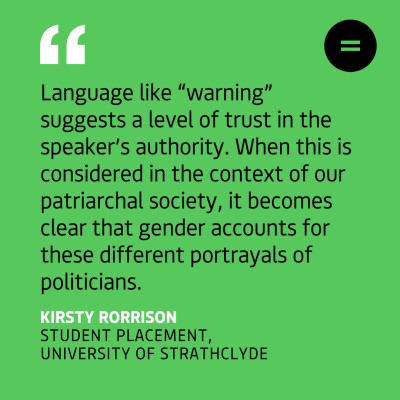
On the other hand, language like “warning” suggests a level of trust in the speaker’s authority. When this is considered in the context of our patriarchal society, it becomes clear that gender accounts for these different portrayals of politicians. Women are described using more uncertain language because they are viewed as less competent and less authoritative as a result of their gender; the fact that I recorded these instances multiple times shows that it was a definite pattern rather than an isolated incident. Inversely, men are granted trust and authority to know because they are men - by virtue of their gender and its position within the patriarchy, they are seen to be knowledgeable in whatever they discuss.
With this blog post, I conclude my placement with Engender. It has been a privilege to work with each of my talented and knowledgeable supervisors, and I’ve gained so much from this experience. My research has shown that Scottish news coverage of the coronavirus pandemic is clearly gendered - this relates to what is written about, who is writing about it, and who is mentioned in news stories. In terms of politicians, I have found that men are mentioned more overall and that people of colour in politics are notably underrepresented. I have also seen that the ways in which male and female politicians appear in news coverage are different; while men tend to be directly quoted, women are often indirectly quoted. There were also differences in the language used when men and women in politics were mentioned; while men “warned,” “stated,” or “said” things, women “claimed” and “suggested.”
Overall, gender plays an undeniable part in the ways female politicians are represented (or not represented) in Scottish news coverage of the pandemic, but in order to understand the extent of this difference, I needed to delve deeper than a simple quantitative analysis of appearances. Further work must be done to explore these findings further, and in the future, an intersectional analysis should be employed to account for factors like race and sexuality.
GUEST POST: Who says what? A breakdown of gender bias in news topics and reporting
 Today we're publishing the next in a series of blogs from the current student placements Engender is hosting from the University of Strathclyde Applied Gender Studies and Research Methods course.
In the second of three posts, Kirsty Rorrison continues research into gender bias in political news reporting during the COVID-19 pandemic. Here, she looks specifically at the breakdown of bias in topics and authors, as well as whose voices are missing in the reporting of the pandemic. You can read Kirsty's first post here.
As my placement with Engender is nearing its end, I have finally completed my research on gender, COVID-19 and media. In this blog post, I’m going to discuss what I found out in my investigation and why it was crucial that I delved a bit deeper into this topic. As I mentioned in my previous post, my main area of interest in this research has always been the ways in which women in politics are represented. However, I also wanted to look at how other women, and more broadly gender, appeared in news coverage of coronavirus. For this research, I ended up coding 108 news stories. I took note of the topic, the gender of the journalist, and the identity markers of every person mentioned in each article. I wanted to see where gender appeared in news coverage, whether this related to the kinds of topics being discussed, the journalists who wrote about them or the people mentioned in articles. In this blog post, I will outline what my analysis revealed about journalists and news topics - in other words, who is writing, and what are they writing about?
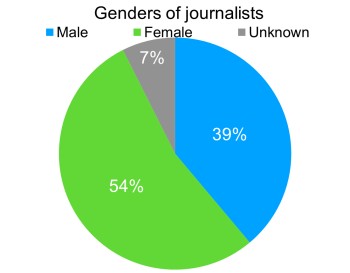
[Figure 1]
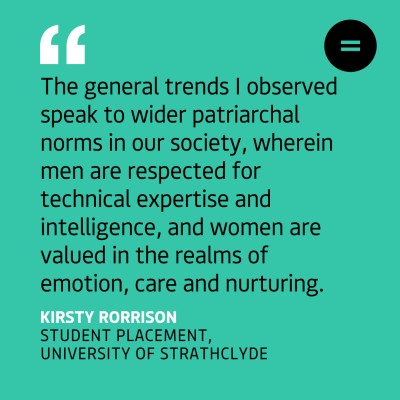
I was surprised to find a fairly even split between male and female journalists in my sample [Figure 1]; in fact, women were actually writing about COVID-19 more than men. At first glance, I thought this might suggest that journalism has become more equal in terms of gender. However, upon closer inspection, I realised that things weren’t as progressive as they seemed. While men and women were both reporting on the COVID-19 pandemic, the topics assigned to journalists varied significantly with gender. I found that women were far more likely to cover stories on public health and the NHS than their male counterparts, whereas reporting of politics and economics was often carried out by men. This is consistent with previous work on women in journalism - ‘hard’ news stories relating to industry and politics tend to be given to men, while women are relegated to covering so-called ‘softer’ topics like health, social care and education. This is not true in every case, and I did record instances of women writing about politics and business. However, the general trends I observed speak to wider patriarchal norms in our society, wherein men are respected for technical expertise and intelligence, and women are valued in the realms of emotion, care and nurturing. A breakdown of the article topic by gender of the journalist is shown below [Figure 2].

[Figure 2]
I’d spent quite a while exploring what journalists had been reporting on when I suddenly thought to myself, “what about the topics which aren’t being written about?”. I’d combed through 121 news stories over a seven day period, but I hadn’t encountered anything about domestic violence or caring responsibilities. While these topics hadn’t come up, I’d read multiple articles about planning holidays around travel restrictions. It’s a well-known fact that domestic violence, for instance,
GUEST POST: Women’s Representation in the Scottish Local Council Elections 2022: What We Know So Far
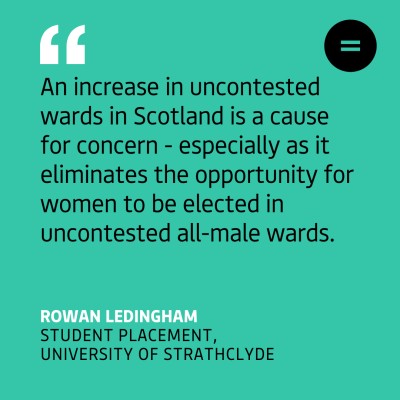
Today we're publishing the next in a series of blogs from the current student placements Engender is hosting from the University of Strathclyde Applied Gender Studies and Research Methods course.
In this post, Rowan analyses women's representation in the upcoming local council elections, and explores issues around uncontested wards, re-standing rates, and press coverage of the elections. You can read Rowan's first blog here.
With the local council elections just around the corner, it is a good time to reflect on what we know so far before people across Scotland head to the polls. As part of my ongoing research and placement with Engender I have analysed a number of areas related to the upcoming elections including candidate selections, re-standing rates among incumbent councillors, and press coverage. This blog will address each of these areas in turn.
Trapped: the call for a more flexible world
Fran Macilvey is an Edinburgh-based author. Her memoir ‘Trapped’ tells the story of her life with cerebral palsy. She has also published two self-help books which she thinks of as ‘gleaning something valuable from forty years of making mistakes’ and has recently finished writing three novels about women’s experiences with the law.
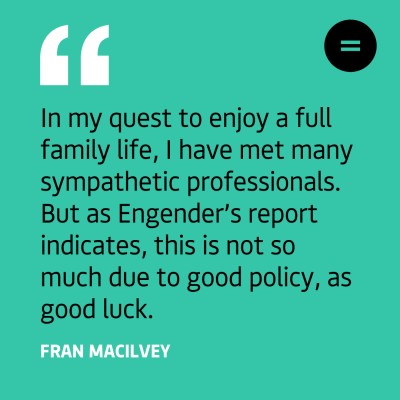
As part of a series of events being organised by Edinburgh Libraries to mark International Women’s Day on 8th March 2022, I was asked to take part in a panel discussion. Our brief, to publicise the life and work of an Edinburgh-based woman (or group of women, why not?) brought me to Engender, who invited me to contribute a guest post to ‘On the Engender’. I’m delighted and honoured to have this opportunity.
Reading Engender’s 2018 report, Our Bodies, Our Rights has been a vindicating – and at times, depressing – experience. It is a brave and realistic assessment (at last!) of the gaps in health and social provision that hinder disabled women in exercising their private and reproductive choices; in effect, their most basic human rights. Whether to have intimate relationships – read that again – whether to get married and have children, and how to bring them into adulthood while running the gamut of inconsistent and unpredictable help from professionally-minded others with rather mixed agendas. Thorny personal decisions which, as often as not, we have to navigate alone, in the face of fairly generalised ignorance and many misplaced good intentions. But this is only one aspect of the price that I, and countless others, continue to pay in our efforts to participate in mainstream life.
 RSS
RSSDownloads
 Engender Briefing: Pension Credit Entitlement Changes
From 15 May 2019, new changes will be introduced which will require couples where one partner has reached state pension age and one has not (‘mixed age couples’) to claim universal credit (UC) instead of Pension Credit.
Engender Briefing: Pension Credit Entitlement Changes
From 15 May 2019, new changes will be introduced which will require couples where one partner has reached state pension age and one has not (‘mixed age couples’) to claim universal credit (UC) instead of Pension Credit.
 Engender Parliamentary Briefing: Condemnation of Misogyny, Racism, Harassment and Sexism
Engender welcomes this Scottish Parliament Debate on Condemnation of Misogyny, Racism, Harassment and Sexism and the opportunity to raise awareness of the ways in which women in Scotland’s inequality contributes to gender-based violence.
Engender Parliamentary Briefing: Condemnation of Misogyny, Racism, Harassment and Sexism
Engender welcomes this Scottish Parliament Debate on Condemnation of Misogyny, Racism, Harassment and Sexism and the opportunity to raise awareness of the ways in which women in Scotland’s inequality contributes to gender-based violence.
 Gender Matters in Social Security: Individual Payments of Universal Credit
A paper calling on the Scottish Government to automatically split payments of Universal Credit between couples, once this power is devolved to the Scottish Parliament.
Gender Matters in Social Security: Individual Payments of Universal Credit
A paper calling on the Scottish Government to automatically split payments of Universal Credit between couples, once this power is devolved to the Scottish Parliament.
 Gender Matters Manifesto: Twenty for 2016
This manifesto sets out measures that, with political will, can be taken over the next parliamentary term in pursuit of these goals.
Gender Matters Manifesto: Twenty for 2016
This manifesto sets out measures that, with political will, can be taken over the next parliamentary term in pursuit of these goals.
 Scottish NGO Briefing for UN Special Rapporteur on Violence Against Women
Joint briefing paper for the UN Rapporteur on Violence Against Women.
Scottish NGO Briefing for UN Special Rapporteur on Violence Against Women
Joint briefing paper for the UN Rapporteur on Violence Against Women.

Newsletter
Sign up to receive our newsletter here:
Sign up to our mailing list
Receive key feminist updates direct to your inbox: