Engender blog
GUEST BLOG: Gender-Based Violence Policies at the Local Authority Level Part 1
Today we're publishing the fourth in a series of blogs from two student placements Engender is hosting from the University of Strathclyde Applied Gender Studies and Research Methods course. These blogs explore women's representation and decision-making around women's equality in local authorities across Scotland. You can see other blogs in the series here.
In 2020 Jennifer Robinson graduated with an honours degree in Society Politics and Policy from the University of the West of Scotland. She is now undertaking a Masters in Applied Gender Studies and Research Methods with a particular interest in feminist disability studies. She has previously written for the Glasgow Women’s Library and you can find her tweeting about feminism and disability on twitter @JenRobinson95.
As part of my Msc Applied Gender Studies and Research Methods degree I have been on placement with Engender to investigate gender representation at the local authority level. My previous blog post highlighted the number of women councillors within Renfrewshire Council and Edinburgh Council. Since then I have been exploring key policies within each council designed to address gender-based violence (GBV). In this blog post I will outline some of Renfrewshire’s key gender-based violence policies.
Renfrewshire Council’s GBV Strategy
In 2014 the Scottish government published “Equally Safe: Scotland's Strategy to prevent and eradicate violence against women and girls”. This strategy conveys the responsibility that all levels of society, including the local authority level, have in tackling violence against women and girls. In response to Equally Safe, Renfrewshire launched “Equally Safe in Renfrewshire: Renfrewshire’s No to Gender-Based Violence Strategy 2018-2021”. The strategy details the aim to establish Renfrewshire as a place where GBV is not tolerated and those affected by GBV are provided with support.
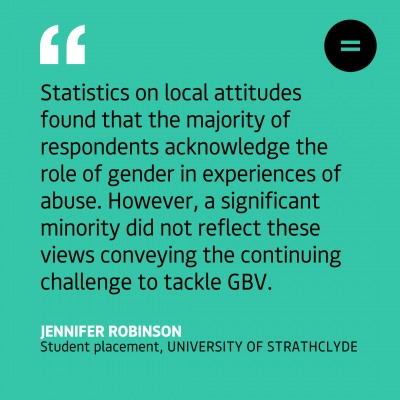
Key GBV statistics outlined in the document demonstrate the prevalence of domestic abuse and sexual crimes in Renfrewshire. Statistics on local attitudes found that the majority of respondents acknowledge the role of gender in experiences of abuse. However, a significant minority did not reflect these views conveying the continuing challenge to tackle GBV. Furthermore, a “ChildrenCount Wellbeing Survey” uncovered the prevalence of emotional control in teenage intimate relationships. Importantly, the strategy takes an intersectional approach by recognising the diverse impact of GBV on BME women, LGBT people, people with disabilities, refugee women, women with no recourse to public funds and women with complex needs.
A progress report of the GBV strategy is published annually during the 16 Days of Action (25th November – 10th December). I was curious to see these annual reports. However, trying to find council reports is challenging. After exploring the Renfrewshire council website, I came across a link which took me to Renfrewshire’s committee and councillor’s website. The website contains the various committees and their members, minutes from committee meetings and council documents and reports. Here, I typed “gender-based violence” into the search bar and found the GBV Strategy year 1 review and the GBV Strategy year 2 mid-year review. While reading these I uncovered an interesting policy. Under the GBV strategy, Renfrewshire launched a Domestic Abuse Policy for staff in 2019:
Renfrewshire’s Domestic Abuse Policy for Staff
Renfrewshire was one of the first local authorities in Scotland to introduce a Domestic Abuse Policy for staff. The purpose of this policy is to demonstrate Renfrewshire’s zero-tolerance approach to domestic abuse. The policy has been developed in line with Equally Safe and complies with the Domestic Abuse (Scotland) Act 2018 which criminalises many forms of abuse, including psychological abuse and coercive control. According to the Human Rights Commission, 75% of people who experience domestic abuse are targeted at work, showing the importance of implementing guidance for staff.
Under the policy, employees experiencing domestic abuse can request up to 10 days paid leave per annum. The policy provides guidance for staff that experience domestic abuse and guidance on how to recognise if a colleague is experiencing domestic abuse. For instance, this could be changes in behaviours, changes in timekeeping, changes in work performance or isolating themselves. The policy also outlines the steps managers should take if they suspect an employee is experiencing domestic abuse.
GUEST POST: Equality Impact Assessments in Local Authorities
Today we're publishing the third in a series of blogs from two student placements Engender is hosting from the University of Strathclyde Applied Gender Studies and Research Methods course. These blogs explore women's representation and decision-making around women's equality in local authorities across Scotland. You can see other blogs in the series here.
Katie Young graduated from the University of Glasgow with a degree in English Literature in Summer 2020, and is now studying a Master’s degree in Applied Gender Studies and Research Methods at the University of Strathclyde. She is passionate about women’s fiction and empowering girls and young women to fight for gender equality in Scotland through volunteering with Girlguiding, and tweets under @katieeey.
I’ve been researching how Equality Impact Assessments are used in both West Dunbartonshire and Argyll and Bute councils, how they may or may not consider the impact of specific policy changes on women, and how they are implemented. To do this, I’ve spent lots of time searching through council websites and reading lots about new policies put forward by both local authorities to find potential gaps in their policies and consider how they might be improved to embed women’s needs within their work.
Under the Equality Act (2010), councils are legally required to publish Equality Impact Assessments to assess and review their policies and procedures. This allows them to:
- Address the potential impacts of a new policy and ensure that they are working to eliminate discrimination towards groups mentioned in the legislation;
- Promote equality of opportunity within the local area;
- Enable individuals with protected characteristics to fully participate in and build relationships within their local community.
In my research, I focused specifically on guidance that should be published by local authorities on their process for conducting Equality Impact Assessments, as well as the assessments themselves and how they measured the impact of policy on women specifically. In West Dunbartonshire, this guidance is relatively easy to find and has a clear explanation of the legislative background for conducting Equality Impact Assessments, detailing what they mean by protected characteristics and their inclusion of the Scottish Government’s Fairer Scotland Duty (2018) that specifically focuses on mitigating socioeconomic inequality. It asks that we consider three main points when undertaking an Equality Impact Assessment:
- Inequality of outcomes;
- Inequality of process;
- Inequality of autonomy.
Here, it asks questions about how policies specifically impact the community, the resources that are needed to ensure that it does not further existing inequalities, and the impact of the policy on other community groups and services. Considering this in relation to protected characteristics requires an evidence-based policy approach, which often consists of further consultation and continuous monitoring to identify required actions that the council must take, and ensure that equalities are addressed should the needs of the community change after the policy is introduced. It also provides some contextual information on the importance of Equality Impact Assessments where legal challenges have proven assessments to be unfit for purpose, such as the Southall Black Sisters’ case against Ealing Council in 2008, where funding for specialist domestic violence services was directed away from specific support for BAME women to an ‘all women’ approach, which found that the council was not following its own equalities guidance and had misunderstood the need for these services to mitigate multiple inequalities.
Argyll and Bute’s guidance, however, was slightly more difficult to find. After sending a Freedom of Information request, I found out that their goals for conducting Equality Impact Assessments were broadly similar to West Dunbartonshire, where they want to enable better opportunities for scrutiny of their decision making processes, enable more informed decision making, and consider the impact of policy and procedural changes on all socio-economic inequalities, including the impact on island communities to take into account the diversity within the council area. They are also part of the Fairer Scotland Duty and have committed to review and update their equalities guidance regularly, most recently in February 2020. They also provide detailed information on the consultation process and how this can best be carried out to ensure that equalities are continuously monitored, an overview of the process for committing to and carrying out an Equality Impact Assessment, and a glossary of key terms within the guidance, which makes the process more accessible and transparent. Unlike West Dunbartonshire, they do not provide any examples of notable Equality Impact Assessments, examples of good practice, or areas where assessments could be improved.
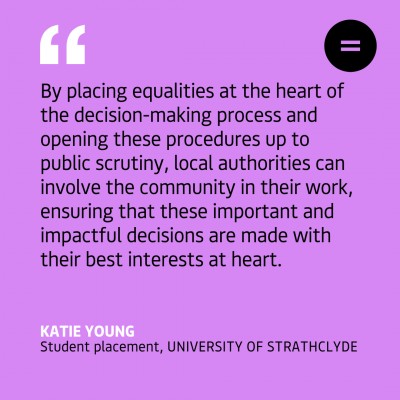
In conclusion, both local authorities do show a commitment to considering equalities within their work, but this is not consistent across the equalities guidance that they publish. Although West Dunbartonshire does well in providing contextual information to stress the importance of considering equalities when devising new policies and procedures, they don’t provide assessments for their most recent decisions. Argyll and Bute’s commitment to continuous review of their own policies suggests that there is a strong commitment to equalities within the local authority, where their guidance is easy to understand and made more accessible through the use of a glossary of key terms and a clear explanation of the procedures in place. Both local authorities do have some work to do to improve their equalities procedures, where Argyll and Bute could make their guidance more accessible and obvious on their website, and West Dunbartonshire should commit to publishing Equality Impact Assessments more regularly and more visibly online. If these small changes are made, this would really make a difference in their work to minimise inequalities within the area by allowing local residents greater opportunity to hold them to account by increasing the amount of information that is available to them. By placing equalities at the heart of the decision-making process and opening these procedures up to public scrutiny, local authorities can involve the community in their work, ensuring that these important and impactful decisions are made with their best interests at heart.
GUEST POST: Empowering women to challenge stalking through technology
![Graphic with a light green background and left-aligned quoted text in dark green which reads "Although increasingly we hear of technology being used to abuse women, technology can also be a powerful tool for victims/survivors to challenge the abuse and find justice. This was the idea behind FollowItApp, a mobile app we created [...] for women experiencing stalking in Scotland." The quote is attributed to Natalia Equihua, Scottish Women's Rights Centre. In the top right hand corner of the graphic is the Engender logo, a circle with an equals sign in the centre, in bright green.](/siteimages/Blog/resized/natalia-followit-blog-square-1080x1080-400.png)
Stalking is form of violence against women that is often hidden and subtle, but is no less devastating and traumatic. This week is National Stalking Awareness Week, and Scottish Women's Rights Centre's Natalia Equihua has written a guest blog for us on the FollowIt app for women affected by stalking.
[CN: mentions of stalking, harassment]
Much like domestic abuse, throughout the pandemic we have seen an increase in stalking incidents; this is not surprising given that stalkers are often partners or ex-partners. Not only that, but according to a recent survey by the Suzy Lamplugh Trust, online/digital stalking has become more common with 75% of victims experiencing both online and offline stalking since the first lockdown.
Although increasingly we hear of technology being used to abuse women, technology can also be a powerful tool for victims/survivors to challenge the abuse and find justice. This was the idea behind FollowItApp, a mobile app we created at the Scottish Women’s Rights Centre in collaboration with media co-op for women experiencing stalking in Scotland.
To understand what led us to create this app, what makes it so unique and how it supports women in Scotland, it’s important to explore the context of stalking in our country.
GUEST POST: Racism - We reject #NotAll, We demand #NotAtAll
The (much delayed) report from the UK Government’s Commission on Race and Ethnic Disparities (CRED) was released last week, and claimed that many of the racial disparities found in the UK do not have their origins in racism. The report was met with incredulity by people and organisations who witness the myriad ways in which racism and white supremacy still impact on all areas of our politics, economy and society. This guest blog from Dr Shridevi Gopi-Firth explores and rejects the idea presented in the report that because ‘not all’ people are racist, institutional racism cannot exist.
Dr Shridevi Gopi-Firth is a Speciality Doctor in Eating Disorders for NHS Scotland, a ChoosePsychiatry 2020 representative, and Board Director of @Saheliya. She has been invited as BAME expert and peer reviewer for various guidelines and organisations including the upcoming Scottish IGN guidelines for Eating Disorders. Follow her on Twitter @Tychitha.
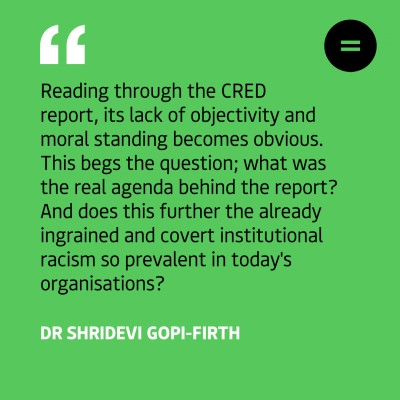
Nearly every healing or therapy starts with acknowledging your illness. Why is it that we as a society are unable to stand up and say ‘yes, the illness of racism exists’? Why does the Government need to come up with whitewashed reports like the CRED in this day and age to convince the public that racism is a thing of the past? It feels like an insult to our collective intelligence, while we BAME people continue to face so many instances of different levels of racism in our day to day lives.
GUEST POST: Gender representation within Local Authorities
Today we're publishing the second in a series of blogs from two student placements Engender is hosting from the University of Strathclyde Applied Gender Studies and Research Methods course. These blogs explore women's representation and decision-making around women's equality in local authorities across Scotland. You can see other blogs in the series here.
In 2020 Jennifer Robinson graduated with an honours degree in Society Politics and Policy from the University of the West of Scotland. She is now undertaking a Masters in Applied Gender Studies and Research Methods with a particular interest in feminist disability studies. She has previously written for the Glasgow Women’s Library and you can find her tweeting about feminism and disability on twitter @JenRobinson95.
I never imagined that I would be studying for a Master’s degree from the comfort of my own home in Paisley. One perk is being wrapped in a big cosy blanket and pouring myself endless cups of tea while I read about various feminist topics. I am also excited to be undertaking a placement with Engender as part of my degree.
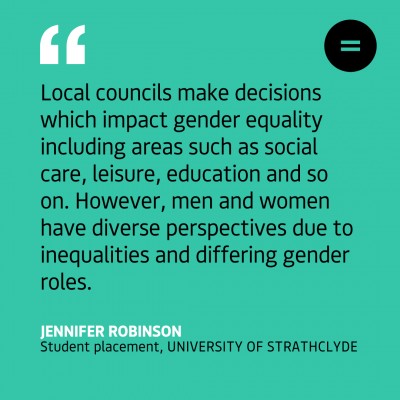
The placement aims to build upon Engender’s Sex & Power report 2020 which showed an overrepresentation of men in positions of power. Particularly, the report found that women made up only 29% of elected councillors at the local authority level. Local councils make decisions which impact gender equality including areas such as social care, leisure, education and so on. However, men and women have diverse perspectives due to inequalities and differing gender roles. Therefore, if councils are dominated by men, they cannot provide diverse representation for their residents. The placement will include a gender audit of representation in local authorities and their policy areas. I will be investigating representation and policy within Renfrewshire Council (my own local authority) and Edinburgh council and documenting my findings through a series of blogs.
Firstly, I wanted to count the number of councillors who were women within Renfrewshire and Edinburgh and compare this to the numbers from the previous council election which took place in 2017. I then looked at the numbers of women in each party and each ward today. Gathering these numbers illustrates the lack of women’s representation within each local. I have broken down these numbers in the following sections.
 RSS
RSSDownloads
 Engender Briefing: Pension Credit Entitlement Changes
From 15 May 2019, new changes will be introduced which will require couples where one partner has reached state pension age and one has not (‘mixed age couples’) to claim universal credit (UC) instead of Pension Credit.
Engender Briefing: Pension Credit Entitlement Changes
From 15 May 2019, new changes will be introduced which will require couples where one partner has reached state pension age and one has not (‘mixed age couples’) to claim universal credit (UC) instead of Pension Credit.
 Engender Parliamentary Briefing: Condemnation of Misogyny, Racism, Harassment and Sexism
Engender welcomes this Scottish Parliament Debate on Condemnation of Misogyny, Racism, Harassment and Sexism and the opportunity to raise awareness of the ways in which women in Scotland’s inequality contributes to gender-based violence.
Engender Parliamentary Briefing: Condemnation of Misogyny, Racism, Harassment and Sexism
Engender welcomes this Scottish Parliament Debate on Condemnation of Misogyny, Racism, Harassment and Sexism and the opportunity to raise awareness of the ways in which women in Scotland’s inequality contributes to gender-based violence.
 Gender Matters in Social Security: Individual Payments of Universal Credit
A paper calling on the Scottish Government to automatically split payments of Universal Credit between couples, once this power is devolved to the Scottish Parliament.
Gender Matters in Social Security: Individual Payments of Universal Credit
A paper calling on the Scottish Government to automatically split payments of Universal Credit between couples, once this power is devolved to the Scottish Parliament.
 Gender Matters Manifesto: Twenty for 2016
This manifesto sets out measures that, with political will, can be taken over the next parliamentary term in pursuit of these goals.
Gender Matters Manifesto: Twenty for 2016
This manifesto sets out measures that, with political will, can be taken over the next parliamentary term in pursuit of these goals.
 Scottish NGO Briefing for UN Special Rapporteur on Violence Against Women
Joint briefing paper for the UN Rapporteur on Violence Against Women.
Scottish NGO Briefing for UN Special Rapporteur on Violence Against Women
Joint briefing paper for the UN Rapporteur on Violence Against Women.

Newsletter
Sign up to receive our newsletter here:
Sign up to our mailing list
Receive key feminist updates direct to your inbox: