Engender blog
Women pay the price in an age of crisis
It is outrageous that women still do not have equal access to resources in modern Scotland. Women’s financial inequality has been accepted by our politicians and by our society more broadly. Enough is enough.
Today, we launch our new series, Confronting Women’s Poverty, outlining our 5-point plan of action to eliminate the gender income gap and prevent destitution for women and their children.
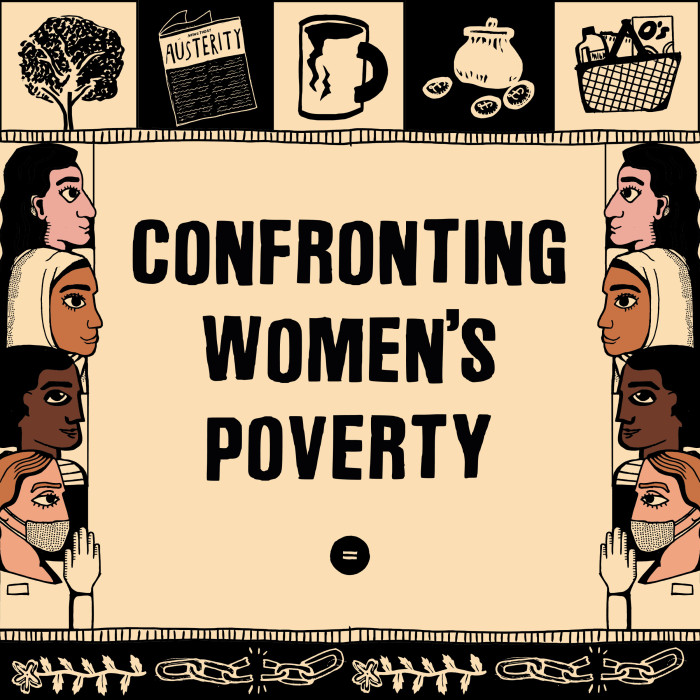
Marginalised women in Scotland are living in worsening poverty and financial insecurity.
Engender has worked for decades on issues affecting women like social security, access to housing, childcare, and unpaid care, all of which are linked to women’s poverty and financial inequality. Some of the drivers of women’s poverty include:
-
 Women tend to manage limited household budgets, often acting as ‘shock absorbers’ of poverty by going without themselves.
-
Women have less access to well-paid and secure work, occupational pensions and savings than men.
-
Domestic abuse and other forms of violence against women creates barriers to financial independence and wider access to resources for women.
-
Women are the majority of lone parents and primary caregivers for children, meaning their poverty is deeply linked with child poverty.
Today we launch Confronting Women’s Poverty, to share research and recommendations for an effective response to tackling women’s poverty in an age of crisis.
Our first paper breaks down what lies behind women’s persistent financial inequality and presents a 5-point plan to eliminate the income gap for women.
 Crisis after crisis: women pay the price
The ‘gender income gap’ refers to women having less access to financial resources and security than men. Progress to close this gap has been undermined by successive crises in recent years, including austerity, the Covid-19 pandemic, and the cost of living crisis. Women have shouldered the burden of these crises, with disabled women, women of colour, migrant women, lone parents and unpaid carers are among those most acutely harmed.
While the impacts of these emergencies on women - and the critical role that women have played in protecting and supporting their communities - have been well documented, the Scottish Government continues to fail women. We need decision-makers to take action to disrupt the broad political and social acceptance of financial inequality between women and men.
Breaking the cycle: taking action in an age of crisis
 Women’s poverty is the consequence of ingrained, systemic failures that uphold and drive forward gender-based discrimination, but it is also preventable. A combination of ineffective policy, decision-making, and crisis responses have entrenched women’s poverty. Commitments to women’s equality and rights are continually deprioritised, forcing more women into greater financial precarity, deepening poverty, and wider harms.
The gender income gap has been normalised in Scotland, but it is a political choice that guarantees harm to women and their children. To close it, decision-makers need to do much more to better understand and respond to the root causes of women’s financial inequality.
Confronting Women’s Poverty offers the new Scottish Government and Scottish Parliament a 5 point plan of action to eliminate the gender income gap and prevent destitution for women and their children.
We call for:
1. A Taskforce on Women’s Poverty
2. A Women’s Equality Fund - Crisis Support for Marginalised Women
3. A Minimum Income Guarantee for Unpaid Carers
4. A Roadmap to Universal Childcare for All
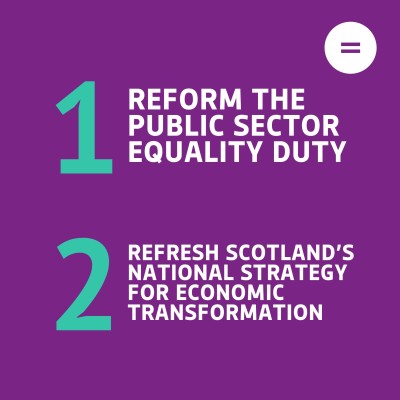
5. Overhaul of the Public Sector Equality Duty
Find our Confronting Women’s Poverty series here.
Holyrood 2026 - Calling on candidates to invest in women
We’re calling on candidates to commit to taking action on three key areas for women if elected – and we need your help!
A decade of austerity policies, the pandemic, and the ongoing cost-of-living crisis have all impacted women disproportionately. Far too many women in Scotland report that their lives are increasingly impacted by financial insecurity, that the disproportionate burden of caring responsibilities they carry continues to go unrecognised and be undervalued, and that their fundamental rights increasingly feel at risk.
We’re calling on candidates to commit to policies that will transform women’s lives by raising 3 of the key asks from our manifesto, which focus on tackling women’s deep financial insecurity head-on. These are realistic steps that political parties can take to ensure that policy and public investment translate into real change for the most marginalised in our communities.
Gender inequality is not inevitable in Scotland, and the Holyrood 2026 elections on 7th May can be a hopeful moment of change for women in Scotland, but we need parties and candidates to commit to making women’s voices heard.
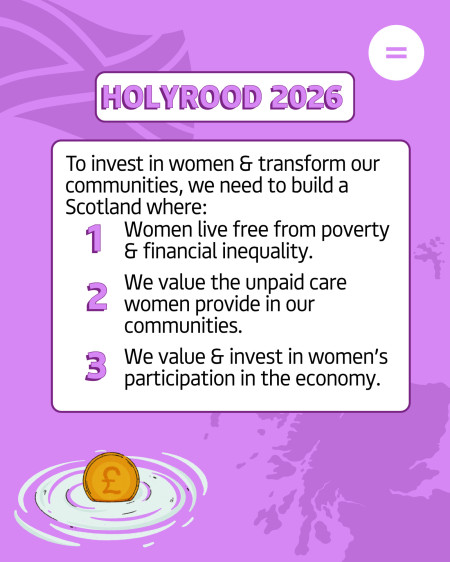 We’re asking candidates to commit to making Scotland a place where…
1. Women live free from poverty and financial inequality.
We’re calling on candidates to commit to supporting the creation of a ‘Women’s Equality Fund’ designed to provide targeted crisis financial support for marginalised groups of women, with a focus on unpaid carers, women with experience of domestic abuse, women with No Recourse to Public Funds, and disabled women.
2. We value the unpaid care women provide in our communities.
We’re calling on candidates to commit to providing vital financial assistance for unpaid carers, including improving the Carers Support Payment, increasing its value and extending access for young carers, older carers, those in education and employment, and those with multiple caring roles, and to support the introduction of a well-structured pilot scheme of the ‘Minimum Income Guarantee’ by 2029, with a focus on unpaid carers, including carers from a diverse range of ages, employment and education statuses.
3. Women’s participation in the economy is valued and invested in.
We’re calling on canddiates to commit to supporting the designation of childcare and social care as crucial economic growth sectors by recognising and investing in the care economy as key infrastructure, including in Scotland’s National Strategy for Economic Transformation (NSET).
Use the tool at the top of this page to write to your local candidates and ask them to commit to investing in women and transforming our communities.
8 Steps Towards Women’s Equality in Scotland
Ahead of the next Programme for Government for 2024-25, we have outlined several important actions we want the Scottish Government to take to protect women’s rights and promote gender equality in Scotland.

Engender advocates for a Scotland where women are involved in all political and economic decisions, both as decision-makers and individuals affected by these decisions. This means recognising the diverse experiences of all women, including those facing multiple forms of discrimination, such as Black and minority ethnic women, younger and older women, disabled women, lesbian, bisexual, and trans women, women from rural areas, and those who are mothers, women who have experienced domestic abuse or men’s violence, and those experiencing poverty.
We have identified eight key actions in three main areas that need change:
 EMBED GENDER EQUALITY ACROSS ALL SCOTTISH GOVERNMENT POLICY
To achieve the Scottish Government’s main goals—eliminating child poverty, boosting the economy, addressing climate change, and improving public services—it’s crucial to improve how gender equality is considered across policymaking. These goals affect women and men differently, especially for women facing additional marginalisation. If policies don’t account for structural inequalities, their benefits for Scotland’s most disadvantaged people will be limited.
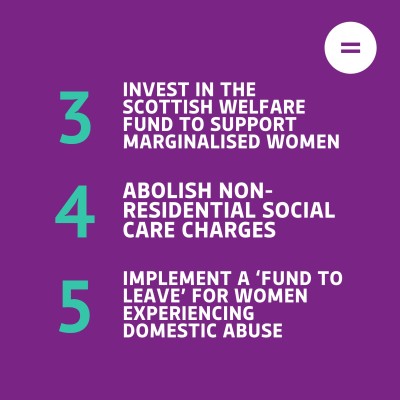 ADDRESS WOMEN’S POVERTY AND FINANCIAL INEQUALITY
Eliminating child poverty is the First Minister’s top priority. To succeed, the Programme for Government must connect women’s poverty with children’s poverty. There’s an urgent need to get financial support to the most vulnerable families in Scotland, and focusing on women’s economic inequality is often the most effective approach. This must include targeted actions which tackle the disproportionately negative impacts that the cost of living crisis is having on women’s lives, especially for women who experience other forms of marginalisation.
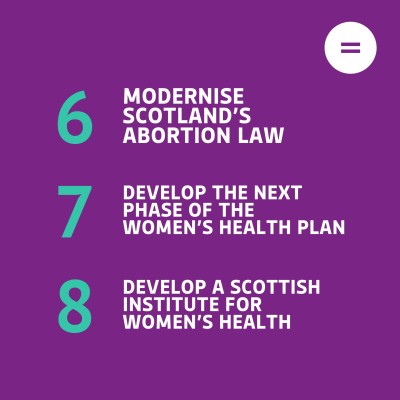 TACKLE WOMEN’S HEALTH INEQUALITIES AND PROTECT REPRODUCTIVE RIGHTS
Women and girls still face inequalities in health and wellbeing and access to services compared to men and boys, mainly due to gender inequality and “medical misogyny.” Marginalised women, including women of colour, disabled women, unpaid carers, LGBTI+ women, younger and older women, and migrant women, experience even wider disparities in health outcomes. We urgently need updated abortion laws that uphold women’s rights and action to advance Scotland’s Women’s Health Plan.
Read more about all our asks here.
Why the proposed Scottish Carer's Assistance must do more to value unpaid care
This week marks Carers Week, and it comes after two years which have shown, more clearly than ever, the vital role that unpaid carers play. The Covid-19 pandemic highlighted what half of the population already knew – that women take on the vast majority of unpaid care work, and that without them our society and economy could not function.
The Scottish Government has been consulting on their proposals to replace Carer's Allowance with a Scottish Carer's Assistance, as part of the devolution of some social security payments to Scotland. The provision of unpaid care, and its interactions with social care, are closely interlinked with systemic and harmful gender roles that constrain women’s lives, with women’s access to paid work, leisure time and power remaining heavily constrained by the provision of care and gendered expectations around its value and delivery.
What do women need from a Scottish Carer’s Assistance?
In this post, we're sharing Engender's guide to filling out the Scottish Government's consultation on Carer's Assistance. You can also access this information as a PDF document here.
The Scottish Government is consulting with people in Scotland about a Scottish Carer’s Assistance, which will replace Carer’s Allowance in Scotland.
Care is a key issue of women’s equality:
- Between 60% and 70% of unpaid carers are women.
- Women are the majority of carers providing over 35 hours of care per week.
- Women are 2x as likely to give up paid work to provide care, rising to 4 x more likely for ‘sandwich care’.
Engender have produced this guide to help carers respond to this consultation. You can find out about the Scottish Government’s plans for Carer’s Assistance by watching this video from the events Engender held with carers here, or taking a look at the detailed proposals here.
How to respond to the consultation
The consultation can be filled out online here by May 23rd.
The consultation asks a number of questions about specific elements of the Scottish Government’s proposals around Scottish Carer’s Assistance, and also some more general questions. There is no need to answer every question.
- Question 1 asks about how Scottish Carer’s Assistance should be designed to suit your needs.
- Question 2 asks about how Scottish Carer’s Assistance should link with other support (for example other social security payments).
- Questions 3-42 ask about specific aspects of a carer’s assistance, whether you agree or disagree with the proposals, and why/why not.
- Question 43 gives you space to share any other thoughts you have about the Scottish Carer’s Assistance.
- Questions 44-48 ask about how the Scottish Carer’s Assistance might impact differently on different groups of people.
What should you say?
It’s really important that as many people as possible with experience of providing care respond to the consultation, and that the Scottish Government recognise that care is an issue of women’s equality. Here are some things, in the bullet points below, to keep in mind when you answer the consultation. Keep in mind that you don’t have to share anything you are not comfortable with.
In the ‘About Me’ section of the consultation, you can choose whether your response is published with a name, without a name, or not published at all. If you select ‘Do Not Publish Response’ it will be treated confidentially. They will still take account of your views for their analysis but will not publish your response, quote anything that you have said or list your name.
- It’s helpful if you can share information about your circumstances to ‘tell the story’ of you as a carer – it can help people understand what unpaid care looks and feels like.
- Think about questions like: When did you start caring? Who do you care for? Why did you start caring?
- If you currently receive Carer’s Allowance, what are the good and bad things about it? You might want to think about things like how much you receive, how flexible it is, whether it is easy to access.
- How does caring impact on your life – on your ability to access paid work, on your financial circumstances, on your opportunities for fun?
- Are there any issues that you experience as carer that you feel women experience differently from men? Do you think that caring interacts with other areas of inequality.
 RSS
RSSDownloads
 Engender Briefing: Pension Credit Entitlement Changes
From 15 May 2019, new changes will be introduced which will require couples where one partner has reached state pension age and one has not (‘mixed age couples’) to claim universal credit (UC) instead of Pension Credit.
Engender Briefing: Pension Credit Entitlement Changes
From 15 May 2019, new changes will be introduced which will require couples where one partner has reached state pension age and one has not (‘mixed age couples’) to claim universal credit (UC) instead of Pension Credit.
 Engender Parliamentary Briefing: Condemnation of Misogyny, Racism, Harassment and Sexism
Engender welcomes this Scottish Parliament Debate on Condemnation of Misogyny, Racism, Harassment and Sexism and the opportunity to raise awareness of the ways in which women in Scotland’s inequality contributes to gender-based violence.
Engender Parliamentary Briefing: Condemnation of Misogyny, Racism, Harassment and Sexism
Engender welcomes this Scottish Parliament Debate on Condemnation of Misogyny, Racism, Harassment and Sexism and the opportunity to raise awareness of the ways in which women in Scotland’s inequality contributes to gender-based violence.
 Gender Matters in Social Security: Individual Payments of Universal Credit
A paper calling on the Scottish Government to automatically split payments of Universal Credit between couples, once this power is devolved to the Scottish Parliament.
Gender Matters in Social Security: Individual Payments of Universal Credit
A paper calling on the Scottish Government to automatically split payments of Universal Credit between couples, once this power is devolved to the Scottish Parliament.
 Gender Matters Manifesto: Twenty for 2016
This manifesto sets out measures that, with political will, can be taken over the next parliamentary term in pursuit of these goals.
Gender Matters Manifesto: Twenty for 2016
This manifesto sets out measures that, with political will, can be taken over the next parliamentary term in pursuit of these goals.
 Scottish NGO Briefing for UN Special Rapporteur on Violence Against Women
Joint briefing paper for the UN Rapporteur on Violence Against Women.
Scottish NGO Briefing for UN Special Rapporteur on Violence Against Women
Joint briefing paper for the UN Rapporteur on Violence Against Women.

Newsletter
Sign up to receive our newsletter here:
Sign up to our mailing list
Receive key feminist updates direct to your inbox: