Engender blog
Exploring the impact of Covid-19 on women's equality in Scotland
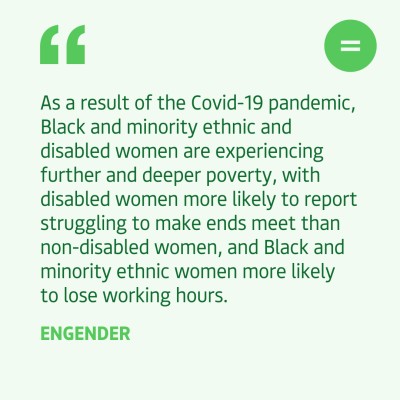
Over the past eighteen months, we’ve seen how the inequalities that existed before Covid-19 have been magnified and intensified by the pandemic. Covid-19 has disproportionately impacted women both at work and at home, with UN Women estimating that the impact for women’s equality could mean a rollback of 25 years of progress on women’s rights.
Women in Scotland face a reduction in paid work both due to increased caring responsibilities and being concentrated in industries hardest hit by the pandemic like hospitality and nursing, which also places women at increased risk of exposure to Covid-19. There is a widening gender gap in unpaid work as women are expected to pick up the slack created by widespread reduction in social care packages, made even more difficult by the persistent inadequacy of social security provision, which has been further compounded by the recent £20 cut in Universal Credit.
Throughout the past year, we’ve joined with organisations across the 4 nations of the UK including Close the Gap, the UK Women’s Budget Group, the Fawcett Society, Women’s Equality Network Wales and the Northern Ireland Women’s Budget Group in a polling project to collect survey data on the impact of Covid-19 on women, funded by the Standard Life Foundation and the Joseph Rowntree Reform Trust. We’ve also worked with Close the Gap to produce joint reports highlighting what this data tells us about the impact of Covid-19 on women in Scotland specifically.
Where are the women in Scottish Government plans for a National Care Service?
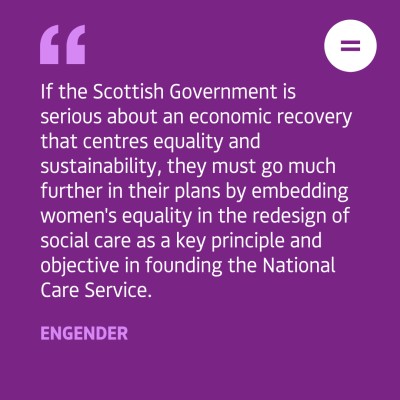
Care is one of the key areas of women’s inequality in Scotland, with women representing the majority of service users, the vast majority of the social care workforce, and the majority of unpaid carers. Care continues to be undervalued and underpaid, precisely because of its long association with ‘women’s work’ and outdated gender norms.
Yet the Scottish Government’s Consultation on a proposed National Care Service for Scotland seems to completely ignore this fact, failing completely to consider gender in their proposals. Equality is not embedded in their plans, and the consultation document does not take into account women’s lives and experiences. The Government has not even published an equality impact assessment as part of the consultation, which would have highlighted the disproportionate impact that failures in social care have on women. In order to be effective, impact assessments should be done as early as possible to actually inform the development of policy.
Covid-19 and Mental Health
Engender has been working with Close the Gap, and other women's organisations across the UK, to carry out some polling work to see how Covid has impacted on women's lives. We published the our first findings from this study - focusing on the impact on women with childcare responsibilities - back in March and you can read it here. Our next report looks at the impact of the Covid-19 pandemic on women's health.
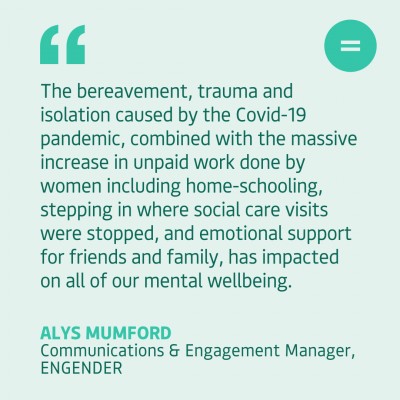
This week marks Mental Health Awareness Week, in a year which has seen women's mental health be challenged like never before. The bereavement, trauma and isolation caused by the Covid-19 pandemic, combined with the massive increase in unpaid work done by women including home-schooling, stepping in where social care visits were stopped, and emotional support for friends and family, has impacted on all of our mental wellbeing.
As part of our work for a gendered recovery, we carried out a survey on the impacts of COVID-19 developed alongside Close the Gap, the UK Women’s Budget Group, Fawcett Society, Women’s Equality Network Wales, and Northern Ireland Women’s Budget Group. The survey was carried out by Survation between 18-27 February 2021 across the four nations in the UK.
Scotland’s economic recovery will fail if it doesn’t think about women’s equality
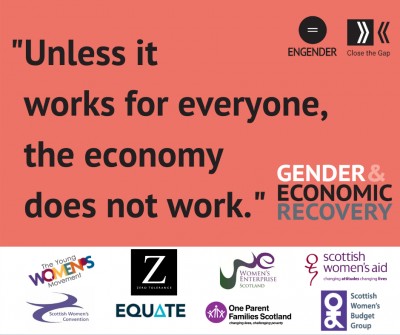
Leading women’s organisations have today called for a radical rethink of how Scotland’s economy can recover from the downturn caused by Covid-19. Nine principles for economic recovery, produced by Engender and Close the Gap and endorsed by national women’s and parenting organisations, call for a shift in the way that Scotland’s pursues inclusive growth. Ranging from investment in social care as infrastructure to the use of gendered economic indicators in place of GDP, the paper argues that unless it works for everyone, the economy does not work.
They also highlight that many of the frontline jobs which are now seen as vital, and which also bear the greatest infection risk, are dominated by Black and minority ethnic women. Disabled women are also shown to be particularly at risk from an ungendered economic recovery, bearing the brunt of a decade of austerity and social care cuts. The organisations are calling for participatory economic decision-making which benefits all women.
Engender’s Executive Director Emma Ritch said:
“As Scotland enters Phase 1 of lockdown measures easing, economic recovery is a long way off. But in order for that recovery to work for women as well as men, we can’t rely on the traditional stimulus measures that create ‘jobs for the boys’. Covid-19 has been a wake-up call for many about how much we separate the unpaid care our society relies on from our understanding of what the economy is. In fact, care is an economic issue.
“The recovery gives us an opportunity to think about what truly matters to people – wellbeing, community, and solidarity. We need to create the demand for goods and services that will sustain our local economies by investing in public services and putting money directly in women’s pockets. Decision-makers must recognise that the economy and women’s equality go hand in hand.”
Anna Ritchie Allan, Executive Director of Close the Gap said:
“Women’s work is systematically undervalued in the economy, including work that is critical to the Covid-19 response such as health and social care, retail and cleaning. Public investment is central to increasing pay in these sectors. 50 years on from the Equal Pay Act, pay equality remains elusive for many women. Scotland has a plan to close the gender pay gap, but we need bold action on what Covid-19 has exposed, that women’s work is undervalued, underprotected, and underpaid.
“Scottish Government is committed to inclusive economic growth, but there’s a lack of detail about what that means for women. These principles provide a foundation for a model of inclusive growth which will ensure women aren’t left behind.”
#MakingWorkVisible for International Women's Day 2020
Every International Women's Day, we ask women across Scotland to share their days with us, to highlight the unpaid, undervalued, and invisible work done by women in Scotland.
This includes the low-paid (and falsely-named 'unskilled') work which is dominated by women, the unpaid care work happening in houses across the country, household chores which are unevenly distributed (even if men think they are equally shared), and all of the mental labour which women are - say it with me now - "just naturally better at".
While the irony of asking women to live-tweet their days, thus adding to their to-do list, isn't lost on us, it's important to take the time to reflect on the gendered nature of what we see as 'work'. Not to call out partners who aren't pulling their weight (although that can be a pleasing side-effect), or to humblebrag about how much work we are doing, but because work which is vital to the wellbeing of all of us - volunteering, kinship care, marking celebrations, raising children - is still widely done by women.
This year, tweets highlighted the work that goes in to caring - the practical tasks and admin, the emotional cost of supporting a loved one, the additional strain which fears over coronavirus cause; the mental work which has to happen on a Sunday to make sure everyone goes to work or school with clean clothes, completed homework, and a packed lunch; the effort which goes into being social, into hosting friends, remembering birthdays, and keeping track of who's going where. Check out the #MakingWorkVisible hashtag to see more.
 RSS
RSSDownloads
 Engender Briefing: Pension Credit Entitlement Changes
From 15 May 2019, new changes will be introduced which will require couples where one partner has reached state pension age and one has not (‘mixed age couples’) to claim universal credit (UC) instead of Pension Credit.
Engender Briefing: Pension Credit Entitlement Changes
From 15 May 2019, new changes will be introduced which will require couples where one partner has reached state pension age and one has not (‘mixed age couples’) to claim universal credit (UC) instead of Pension Credit.
 Engender Parliamentary Briefing: Condemnation of Misogyny, Racism, Harassment and Sexism
Engender welcomes this Scottish Parliament Debate on Condemnation of Misogyny, Racism, Harassment and Sexism and the opportunity to raise awareness of the ways in which women in Scotland’s inequality contributes to gender-based violence.
Engender Parliamentary Briefing: Condemnation of Misogyny, Racism, Harassment and Sexism
Engender welcomes this Scottish Parliament Debate on Condemnation of Misogyny, Racism, Harassment and Sexism and the opportunity to raise awareness of the ways in which women in Scotland’s inequality contributes to gender-based violence.
 Gender Matters in Social Security: Individual Payments of Universal Credit
A paper calling on the Scottish Government to automatically split payments of Universal Credit between couples, once this power is devolved to the Scottish Parliament.
Gender Matters in Social Security: Individual Payments of Universal Credit
A paper calling on the Scottish Government to automatically split payments of Universal Credit between couples, once this power is devolved to the Scottish Parliament.
 Gender Matters Manifesto: Twenty for 2016
This manifesto sets out measures that, with political will, can be taken over the next parliamentary term in pursuit of these goals.
Gender Matters Manifesto: Twenty for 2016
This manifesto sets out measures that, with political will, can be taken over the next parliamentary term in pursuit of these goals.
 Scottish NGO Briefing for UN Special Rapporteur on Violence Against Women
Joint briefing paper for the UN Rapporteur on Violence Against Women.
Scottish NGO Briefing for UN Special Rapporteur on Violence Against Women
Joint briefing paper for the UN Rapporteur on Violence Against Women.

Newsletter
Sign up to receive our newsletter here:
Sign up to our mailing list
Receive key feminist updates direct to your inbox: