Engender blog
All of Engender’s latest news. Reports, reviews, books, articles, and information from across Scotland’s women’s sector.
We would love to hear from other feminists around Scotland. Check out our guidelines for more information on how you can blog for us.
Tell us your experiences of pregnancy and maternity during Covid-19
We know that the COVID-19 pandemic, and the subsequent public health measures, had a disproportionate impact on women. Just one of the ways this is true was the impacts on women accessing fertility treatment, those who were pregnant or trying to conceive, and on people giving birth.
Engender and the Health and Social Care Alliance Scotland (the ALLIANCE) want to hear about your experiences of pregnancy or trying to become pregnant during the COVID-19 pandemic. The purpose of this survey is to gather information about experiences of maternity and pregnancy services in Scotland during COVID-19. This survey will be used to support our work on the COVID-19 independent inquiry and our work to improve women’s health and wellbeing.
Scottish Government’s Emergency Budget Review runs the risk of making women’s lives worse
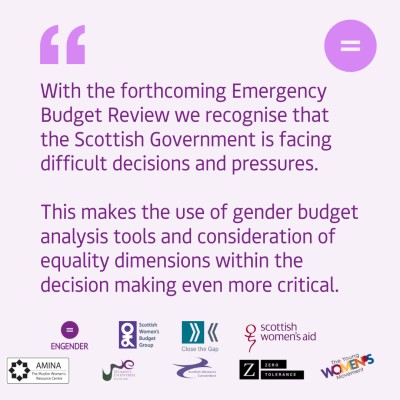
We've joined with other national women’s equality organisations to write to Deputy First Minister John Swinney urging the Scottish Government to undertake comprehensive intersectional gender analysis of budget proposals to understand how they affect women and men differently. Without this, Scottish Government spending could deepen women’s inequality in Scotland, and have a particularly damaging impact on disabled and BME women.
The letter, signed by organisations including Scottish Women’s Aid and Amina the Muslim Women’s Resource Centre, calls on the Scottish Government to consider the diverse realities of women’s lives when making budget decisions, and to target funds where they are needed most.
Making it Happen for 2027: Transforming Local Democracy for Women
Today Engender, Elect Her and Women 50:50 are launching a campaign to build a future where women’s equal representation in councils is realised. “Making it Happen for 2027: Transforming Local Democracy for Women” is a call to action aimed at all of those who have the power to shape this outcome – including councils, councillors, government, political parties and the news media.
At the May 2022 election, the number of women councillors increased from 29 per cent to 35 per cent, an increase of just 6 per cent. Women have long been excluded within Scotland’s local councils, and although we do not have the data we need to clearly understand the diversity of our representatives, what we do know tells us that Black and minority ethnic women, disabled women and LBTI women experience this exclusion on even greater scales. For instance, Scotland’s capital city has only one woman of colour councillor, despite being one of the most diverse areas of the country. And, despite the small increase in the number of women councillors nationally, Women 50:50 have found that if this rate of change is allowed to continue, we will not see gender equality in our local councils until 2037.
Cost of Living Crisis: Another Catastrophe, The Same Shoulders
-400.png)
As part of our blog series on the cost of living, unpaid carer Lynn Williams reflects on the crisis and why government responses bake in further inequality and marginalization. The same shoulders bear the burdens of economic and public policy failures and we cannot allow this to continue, she writes.
It’s hard to know where to start when everything seems so devastatingly awful and overwhelming.
Covid is not over – despite what you might be hearing. And running alongside that ongoing, hellish crisis, there’s another public health and societal disaster in the making.
The “cost of living crisis” is such a misnomer – it’s not a crisis, it’s catastrophic. It’s not a future event – it’s ripping lives apart now.
As I write this, I’m trying not to hyperventilate at the prospect of five figure energy bills; as you read this, you’re probably working out what the heck you cut or stop doing as price rises continue to annihilate your monthly budget. You’re wondering how to keep your disabled child safe and warm; you’re wondering what you can cut back on to ensure that the person you care for has food and the care they need to stay at home.
The cost of living crisis is a crisis for women's equality
The cost of living crisis is an issue which is profoundedly gendered. This blog, containing extracts taken from our submissions to the Scottish Government sets out some of the ways that the cost of living crisis is also a crisis for women's equality.
Women in Scotland are and will be disproportionately impacted by the cost of living crisis, with acute ramifications in terms of economic and physical security, health and wellbeing. This is the result of existing economic inequality that repeatedly sees women, and especially minoritised groups of women, at the sharp end of economic and other crises.
The disastrous forecast for the rate of inflation cannot be divorced from the egregious impact of the Covid-19 pandemic on equality, which has already placed women at greater risk of economic insecurity. A rollback on women’s rights and equality is widely recognised, with specific issues and their ongoing implications manifesting for Black and minority ethnic women, young women, disabled women, unpaid carers, mothers, pregnant women, LGBT women, and women with insecure immigration status, amongst other groups. Against this baseline, the current cost of living crisis will further exacerbate women’s economic inequality, pushing many into poverty. The harm this will cause will resound throughout the course of women’s lives and those of their children.
 RSS
RSSDownloads
 Engender Briefing: Pension Credit Entitlement Changes
From 15 May 2019, new changes will be introduced which will require couples where one partner has reached state pension age and one has not (‘mixed age couples’) to claim universal credit (UC) instead of Pension Credit.
Engender Briefing: Pension Credit Entitlement Changes
From 15 May 2019, new changes will be introduced which will require couples where one partner has reached state pension age and one has not (‘mixed age couples’) to claim universal credit (UC) instead of Pension Credit.
 Engender Parliamentary Briefing: Condemnation of Misogyny, Racism, Harassment and Sexism
Engender welcomes this Scottish Parliament Debate on Condemnation of Misogyny, Racism, Harassment and Sexism and the opportunity to raise awareness of the ways in which women in Scotland’s inequality contributes to gender-based violence.
Engender Parliamentary Briefing: Condemnation of Misogyny, Racism, Harassment and Sexism
Engender welcomes this Scottish Parliament Debate on Condemnation of Misogyny, Racism, Harassment and Sexism and the opportunity to raise awareness of the ways in which women in Scotland’s inequality contributes to gender-based violence.
 Gender Matters in Social Security: Individual Payments of Universal Credit
A paper calling on the Scottish Government to automatically split payments of Universal Credit between couples, once this power is devolved to the Scottish Parliament.
Gender Matters in Social Security: Individual Payments of Universal Credit
A paper calling on the Scottish Government to automatically split payments of Universal Credit between couples, once this power is devolved to the Scottish Parliament.
 Gender Matters Manifesto: Twenty for 2016
This manifesto sets out measures that, with political will, can be taken over the next parliamentary term in pursuit of these goals.
Gender Matters Manifesto: Twenty for 2016
This manifesto sets out measures that, with political will, can be taken over the next parliamentary term in pursuit of these goals.
 Scottish NGO Briefing for UN Special Rapporteur on Violence Against Women
Joint briefing paper for the UN Rapporteur on Violence Against Women.
Scottish NGO Briefing for UN Special Rapporteur on Violence Against Women
Joint briefing paper for the UN Rapporteur on Violence Against Women.

Newsletter
Sign up to receive our newsletter here:
Sign up to our mailing list
Receive key feminist updates direct to your inbox: