Engender blog
Guest Post: Gen Z, the promise of progress, and the persistence of patriarchy
Against the backdrop of the rise in online misogyny and far-right politics, young women are increasingly concerned about a regression in their human rights. In this guest blog, MSc student Matilda Fairgrieve interrogates Gen Z’s socially active image and shares her perspective as part of a digitally divided generation.
-700.png)
Folk are fascinated by Generation Z and our many nuances.
Media outlets fiercely debate our stereotypes; from digital addicts to digital activists, the generation to which I belong is a subject of collective curiosity.
Public commentary often considers our social conscientiousness, ‘changing the workplace and culture as we know it.’ We are viewed as radical, curious and progressive; seldom are we interrogated further. But are we really this way?
Here, I explore this perception of my generation and alert attention to where assumptions of progressive attitudes demand questions – gender equality.
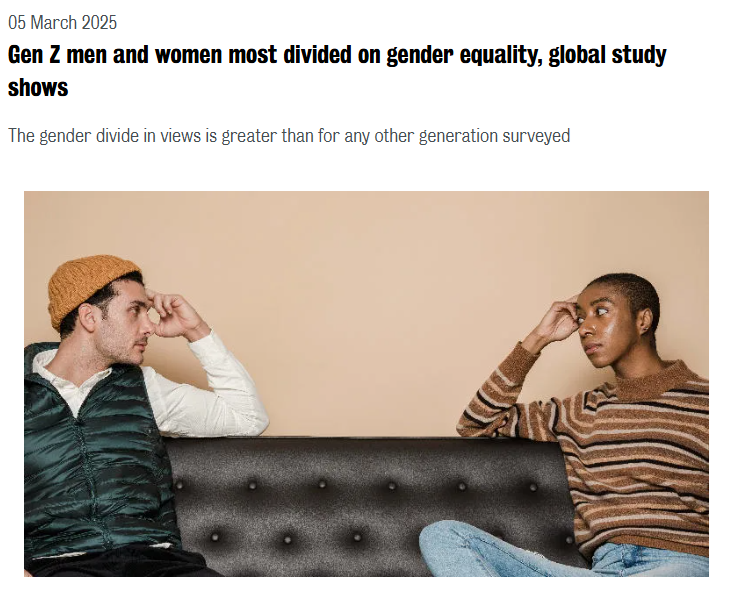 57% of Gen Z men believe women’s equality has gone so far that it discriminates against men. This finding is not in isolation; with another 32% of young men believing gender equality has negatively impacted men. In this context, I position myself among the 59% of my generation who believe there is tension between men and women.
Countless research studies and media outlets will tell you of this “tension” between Gen Z men and women. But how does this tension translate? Trepidation, as Gen Z women ponder these statistics, perplexed. How can it be that such a staggering proportion of young men we share space, workplaces and relationships with hold these views? Despite our disbelief in the percentages, there is no doubt about the problems and pain we’ve experienced as a result. A society entrenched in unequal power, from underrepresentation in politics and leadership, persistent gender pay and pension gaps, disproportionate burden of care as the norm and the violence against women and girls (VAWG) epidemic.
Intergenerationally, there is some difference in how men and women identify as feminists. However, Generation Z’s Millennial, Gen X, and Baby Boomer counterparts are not nearly as divided on the overarching importance of gender equality. Could Gen Z simply grow out of this divide? Debatable when contemplating the socio-cultural realm Gen Z grew into.
Gen Z: The distinct divide
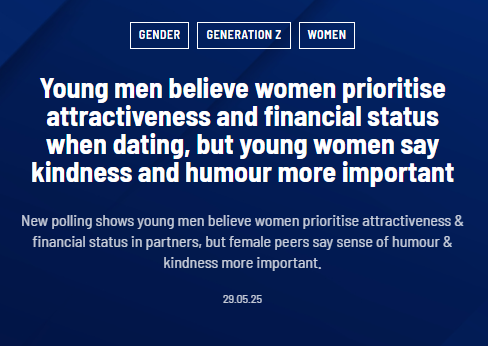 Unique to Gen Z’s divide is the danger lurking in the digital. It is no coincidence that a generation of men aged in a media-fuelled weaponisation of masculinity are threatened by gender equality. Research correlates the self-assessed importance of masculine identity with lower support for gender-equitable policy. Disconcerting political support compounds disconcerting narratives held by young men. Misogynistic and even incel ideologies have crept into dominance, such as 53% of young men believing women are only attracted to a “certain subset of men.”
As manipulative media actors exploit tensions, isolation among young people is accelerating. 19% of young adults reported having no one they can count on socially. The most digitally connected generation exists in a remarkably distrusting, detached state.
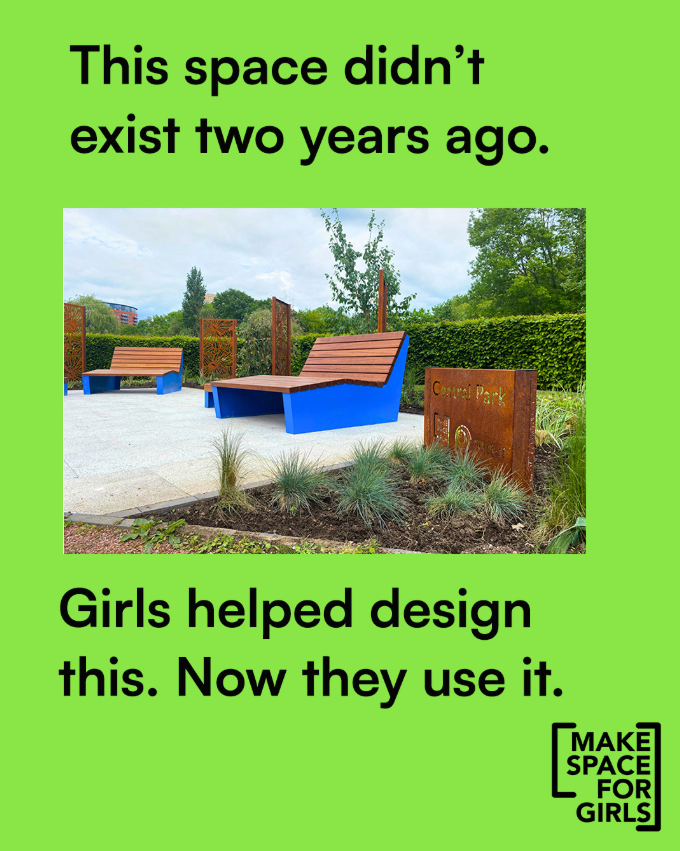
While digitally destructive shifts did not shape the playgrounds of Gen Z’s infancy, I’d argue that a physical shift in our playgrounds set a precedent for disconnect. Gen Z’s early 2000s upbringing coincided with the introduction of Multi-Use Games Areas (MUGAs) in public parks. Open outdoor spaces, a place for equal play, became unprotected from gender roles and division, with boys making up 90% of MUGA usage.
My friends and I shared a similar sentiment to that uncovered in research: “there is nothing stopping us going through the gates of MUGAs, but we don’t feel we should.” From divided children to digital teens – the trajectory of gendered socialisation for Gen Z was fundamentally different.
Reflecting on our unique transition into the digital age with little protection, Gen Z women and I question what this means for present gender equality. With real-world implications of misogynistic digital narratives in corporate and political fields already evident, the time to ask is now.
Building bridges to connect: Real-world gender equity
 If Gen Z’s polarisation is a partial result of our upbringing, there is hope for progress in remedying social disconnection and in intervening with the voices that use it as a weapon. Without minimising the complexity we face, the courage to connect and build a bridge rather than a wall certainly feels like a place to begin.
Of course, bridges must be built from primary prevention. While the ideological divide of Gen Z men and women may have been digitally fuelled, it was made possible by the root cause of gender inequality. The grip of misogynistic media would not be so tight in a gender-equal, real world.
It is promising to see primary and secondary prevention work picking up much-demanded acceleration in Scotland through initiatives such as the Equally Safe at School and Equally Safe at Work programmes, both shaped by a gendered understanding of the root cause of VAWG. Inspiring work to rectify early disconnects is on the rise, too, with the Make Space for Girls campaign ensuring gender mainstreaming in public spaces for play.
However, the current division between Gen Z men and women requires additional tertiary prevention, acknowledging that these attitudes are already abundant.
To my fellow Gen Z men and women, I’d like to meet outside of the digital world. In-person dialogue, focused on listening to lived experiences and restorative approaches to harm, moving from individual fear to collective security.
Do so with enough meaningful intent, and I’d like to believe our perceived progressive nature will not require interrogation. Building a bridge, together, that serves not only to connect once again, but provide an exit pathway from polarisation and a route to a gender-equitable future.
This guest blog was submitted by Matilda Fairgrieve (she/her), a Gen Z intersectional feminist and MSc student in Political Communications and Public Affairs, inspired by the drive to grow into a gender-equitable future in Scotland.
Guest posts do not necessarily reflect the views of Engender, and all language used is the author’s own. Bloggers may have received some editorial support from Engender, and may have received a fee from our commissioning pot. We aim for our blog to reflect a range of feminist viewpoints, and offer a commissioning pot to ensure that women do not have to offer their time or words for free.
Interested in writing for the Engender blog? Find out more here.
Engender statement on the weaponisation of violence against women and girls
-450.png) We are increasingly alarmed at the way women’s rights and safety are being weaponised to demonise minorities across the UK. This kind of distortion of the facts only causes harm to individuals and communities and does nothing to end violence against women and girls.
We are increasingly alarmed at the way women’s rights and safety are being weaponised to demonise minorities across the UK. This kind of distortion of the facts only causes harm to individuals and communities and does nothing to end violence against women and girls.
As Engender, we want to add our voice to calls for action against the spread of hate and misinformation, and for protection and safe and legal routes to be provided for people fleeing war and crisis to the UK. We also want to express our solidarity with racialised and other minority communities who are being made to feel unsafe by hate speech, incitement of violence and far-right protests, including here in Scotland.
Men’s violence against women and girls is endemic in our society and is caused by gender inequality. Spreading inaccurate and hateful rhetoric only generates more violence and creates a distraction from the political commitments that are needed to address it. Improvements to our social security system, investment in childcare, social care, education, housing and community resources, are the things that make a real difference to women.
The false and racist narratives these groups are promoting ignore the fact that violence against women and girls is most commonly perpetrated by someone close to the victim. Last year, the UN reported that the home is the most dangerous place for women, with 60% of women killed by men globally in 2023 dying at the hands of a partner or family member. Two out of every five people arrested during far-right riots in summer 2024 had previously been reported to the police for domestic abuse.
Racism, Islamophobia and anti-migrant attitudes play a major role in the increased risk of violence that women of colour, asylum-seeking and refugee women face.
The UK’s asylum and immigration systems compound this harm, particularly through the brutal No Recourse to Public Funds (NRPF) condition, which increases women’s risk of gender-based violence and restricts access to support, including refuge accommodation.
Engender launches report on women’s experience of the election process
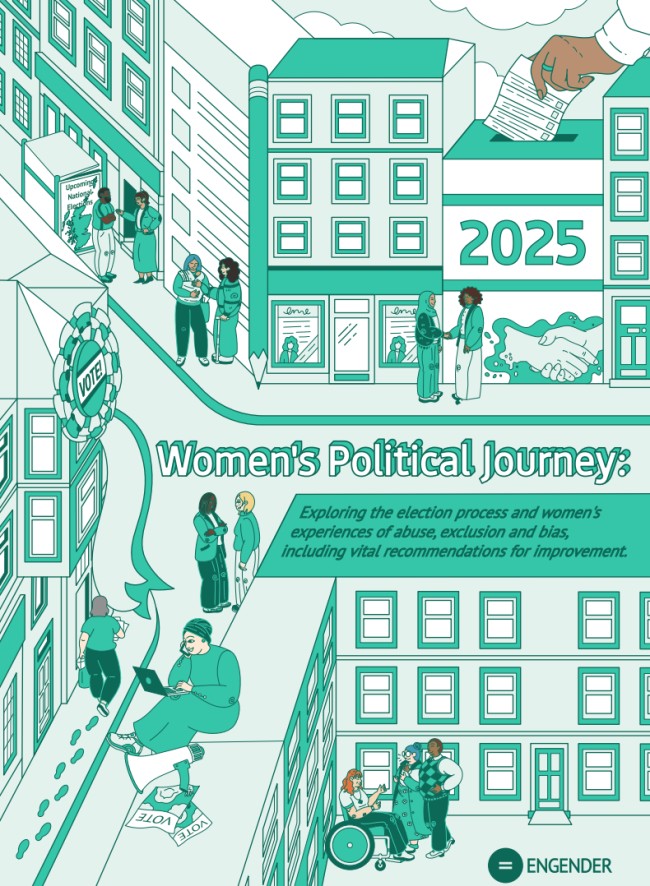
Today, Engender has launched a new report: Women’s political journey: Exploring the election process and women’s experiences of abuse, exclusion and bias, including vital recommendations for improvement. Find out more about the report below.
“Someone said to me [during the election] and I quote, ‘we can’t win here with someone who looks like her.”
The political arena is becoming increasingly hostile, especially for women and marginalised women. 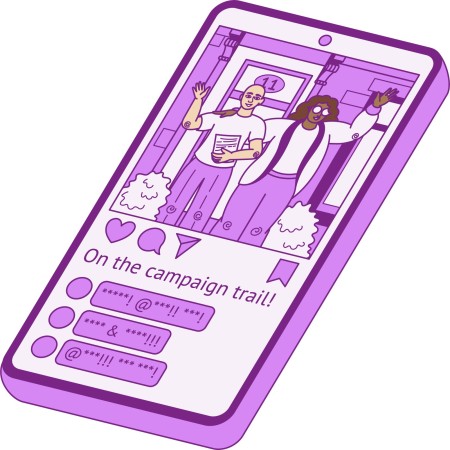 Engender’s new report ‘Women’s Political Journey’ explores the candidate journey—from preparing to stand as a candidate, including all the interview and vetting processes, to being elected and what happens after.
There is still an image of the ideal candidate as white, middle-class, able-bodied, and male. For anyone who falls outside these categories, this means being prepared for additional barriers.
Our report shows that over 70% of respondents to a question on forms of abuse reported experiencing online harassment or trolling during their campaign. Only 11% felt “very safe” during their campaign period.
A survey respondent told us:
“I have been spat on, shouted at, abused and physically shoved countless times.”
Sexist bullying is a persistent problem within some branches and local parties, with findings indicating that disabled and minoritised women may be at increased risk. These experiences can cause women to question their positions and political futures. It is widely recognised that social media presents significant risks for women in politics, with Black and minority ethnic women at greatest risk.
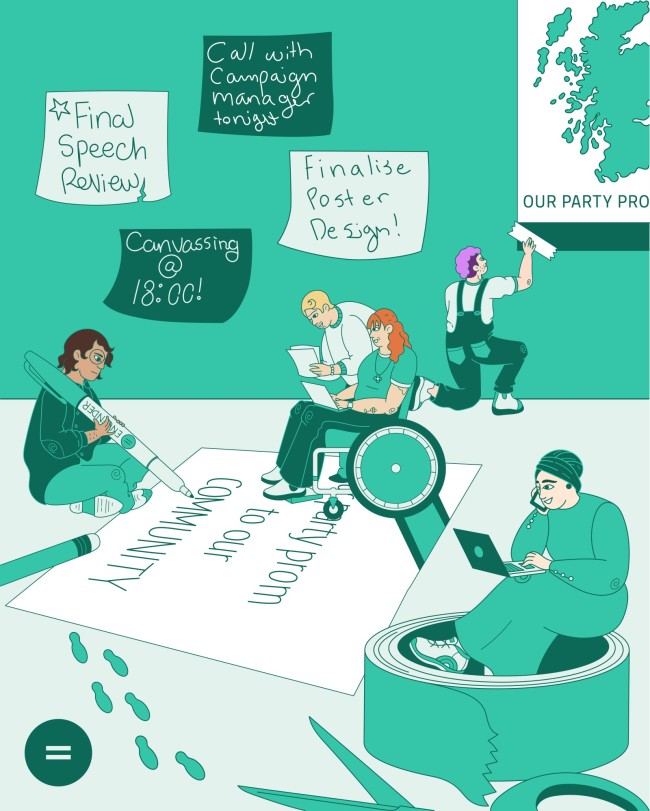
57% of our survey respondents felt that positive action measures (PAMs) like quotas or all-women shortlists are ‘resented’ by some party members who feel their use is unfair or unnecessary. As has been reported to us, white men especially refuse to make space for other groups if it means sharing their privilege. Others reported only tokenistic acceptance of PAMs, reducing the ultimate impact of measures.
Very few parties are consistently collecting equalities monitoring information on prospective candidates. This is vital when it comes to ensuring candidate diversity and proportionate representation of Scotland’s communities.
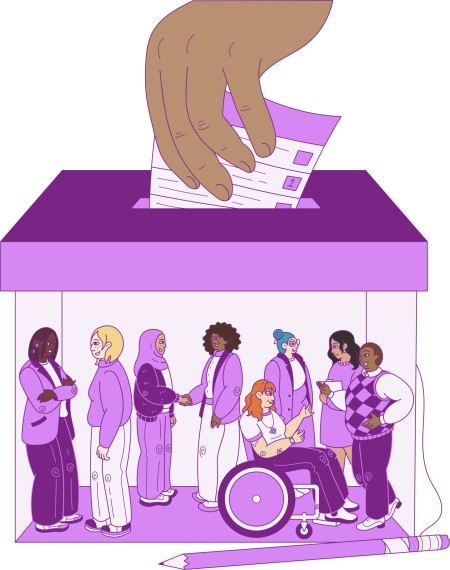 Equal Representation Development Officer Noomi Anyanwu states:
“Abuse, lack of support, and biases were reported widely among our survey participants and interviewees. Nearly 30% would not recommend candidacy to underrepresented groups. It’s understandable considering what women must endure to make it as politicians, but we don’t want to settle for this.”
“Change needs to happen, so we urge political parties, governments, councils, and other stakeholders to implement measures and commit to equal and diverse representation. I want to see at least 50% women in our parliaments—for that to happen, we need to see a real culture change first.”
Read the full report including vital recommendations for action here.
3 Steps to Achieving Primary Prevention in Housing
We’ve published the second in our series of mini-briefings shining a spotlight on how to achieve a primary prevention approach in different areas of public policy with this new briefing highlighting why ensuring women’s access to safe, secure and quality housing is essential for advancing women’s equality and preventing VAWG once and for all.
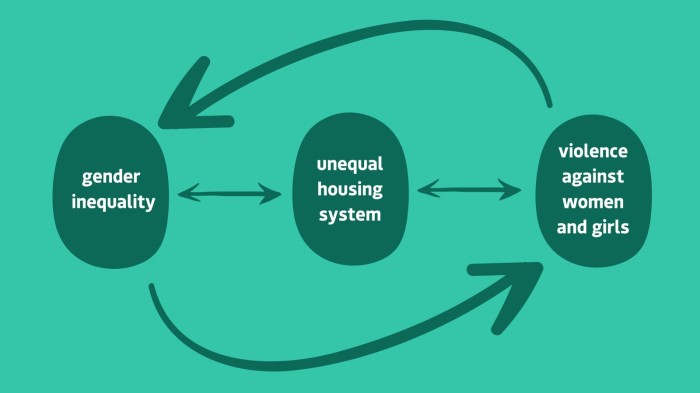
Women’s access to housing is fundamentally shaped by structural gender inequality and other intersectional forms of marginalisation.
 In Scotland, women generally experience less favourable outcomes in the housing system than men. This deepens gender inequality not only in the housing system but also in wider society. These factors can create an enabling environment for VAWG in the home as well as in the public realm, as women participate in it less.
When we talk about primary prevention of VAWG, we’re talking about preventing this violence from happening in the first place. Evidence shows the best way to do this is to tackle the root cause of this violence: gender inequality. Therefore, ensuring women’s access to safe, secure and quality housing is essential for advancing women’s equality and preventing VAWG once and for all.
Without access to safe, secure and affordable housing, women’s living standards, economic and social opportunities - as well as their health and wellbeing are affected - reinforcing gender inequality, which ultimately enables VAWG. The lack of intersectional gender analysis in housing policy undermines women’s safety due to things like lack of affordable housing options, lack of safe housing options, and a lack of gender-sensitive design and planning in housing.
Our new briefing highlights Three Steps Towards Achieving a Primary Prevention Approach in Housing Policy
1. Women are equally and fairly represented in policy-making roles
- Improve women’s pathways and career progression opportunities, particularly for minoritised women, in the housing sector
- Ensure inclusive working environments in the housing sector by implementing flexible working procedures,
anti-discrimination and harassment policies and women’s leadership initiatives
2. Policymakers consistently apply intersectional gender analysis in their work
- Collect and publish intersectional gender-sensitive sexdisaggregated data on women’s experiencing housing,
including for the Scottish Household Survey and Scottish Housing Condition Survey - Ensure Equality Impact Assessments are conducted at the outset of new housing policies and that these are
informed by intersectional gender-sensitive data on housing issues
3. Policymakers mainstream primary prevention in all areas of their work
- Increase opportunities for co-designing housing developments with women, especially those with lived experience of VAWG
- Embed women’s safety considerations into housing planning and design and decisions about the housing system, including on social security, service provision and housing legislation
Find out more in our new briefing here and follow us on social media to get the latest news on other briefings in the series, coming soon!
16 Days of Activism Against Gender-Based Violence
Amplifying Marginalised Perspectives Through Journalism and Storytelling
Migrant Women Press have launched a powerful new initiative dedicated to raising awareness about the specific and often overlooked challenges faced by migrant and ethnically diverse women victims/survivors of gender-based violence.
We are sponsoring this campaign, held within “16 Days of Activism Against Gender-Based Violence” from the 25th of November to the 10th of December. The project will amplify voices and stories too often left out of mainstream narratives, aiming to foster greater understanding, empathy, and change.
16 stories will be shared—one each day during the 16 Days of Activism—authored by migrant and ethnically diverse women journalists and authors from diverse backgrounds and countries. Each piece will explore how factors like class, race, gender, immigration status, disability, and nationality intersect to increase these women’s vulnerability to violence. Additionally, stories will highlight prevention strategies and propose solutions for combating gender-based violence.
Vital pieces released so far include:
- East and/or Southeast Asian women survivors remain excluded and unsupported in the UK
- From Newsroom to Exile: The Hidden Costs of Being an Indian Woman Journalist
- The impact of the UK’s housing crisis on black and minoritised survivors of gender-based violence
- Why Won’t The UK News Media Call Femicide A Public Health Crisis?
Follow along with all posts from Migrant Women Press on their website here.
-1600.png)
 RSS
RSSDownloads
 Engender Briefing: Pension Credit Entitlement Changes
From 15 May 2019, new changes will be introduced which will require couples where one partner has reached state pension age and one has not (‘mixed age couples’) to claim universal credit (UC) instead of Pension Credit.
Engender Briefing: Pension Credit Entitlement Changes
From 15 May 2019, new changes will be introduced which will require couples where one partner has reached state pension age and one has not (‘mixed age couples’) to claim universal credit (UC) instead of Pension Credit.
 Engender Parliamentary Briefing: Condemnation of Misogyny, Racism, Harassment and Sexism
Engender welcomes this Scottish Parliament Debate on Condemnation of Misogyny, Racism, Harassment and Sexism and the opportunity to raise awareness of the ways in which women in Scotland’s inequality contributes to gender-based violence.
Engender Parliamentary Briefing: Condemnation of Misogyny, Racism, Harassment and Sexism
Engender welcomes this Scottish Parliament Debate on Condemnation of Misogyny, Racism, Harassment and Sexism and the opportunity to raise awareness of the ways in which women in Scotland’s inequality contributes to gender-based violence.
 Gender Matters in Social Security: Individual Payments of Universal Credit
A paper calling on the Scottish Government to automatically split payments of Universal Credit between couples, once this power is devolved to the Scottish Parliament.
Gender Matters in Social Security: Individual Payments of Universal Credit
A paper calling on the Scottish Government to automatically split payments of Universal Credit between couples, once this power is devolved to the Scottish Parliament.
 Gender Matters Manifesto: Twenty for 2016
This manifesto sets out measures that, with political will, can be taken over the next parliamentary term in pursuit of these goals.
Gender Matters Manifesto: Twenty for 2016
This manifesto sets out measures that, with political will, can be taken over the next parliamentary term in pursuit of these goals.
 Scottish NGO Briefing for UN Special Rapporteur on Violence Against Women
Joint briefing paper for the UN Rapporteur on Violence Against Women.
Scottish NGO Briefing for UN Special Rapporteur on Violence Against Women
Joint briefing paper for the UN Rapporteur on Violence Against Women.

Newsletter
Sign up to receive our newsletter here:
Sign up to our mailing list
Receive key feminist updates direct to your inbox: