Engender blog
A step forward for women’s equality as two-child limit set to be scrapped
After almost a decade of campaigning by Engender and other women’s and equalities groups, the UK Government has announced that the two-child limit will be scrapped from April 2026.
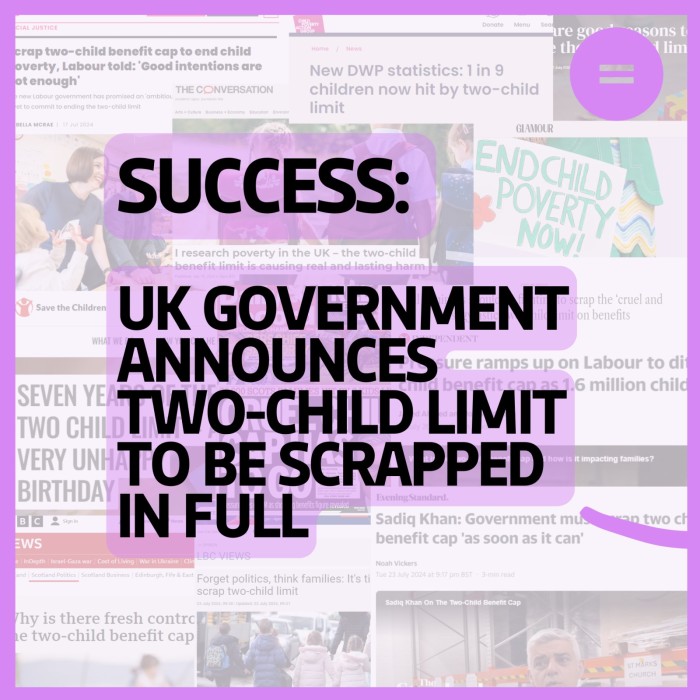
Over 8 years after it was first introduced, the Chancellor announced in the UK’s Autumn 2025 Budget that the two-child limit will finally be scrapped from April 2026. This long-overdue commitment is a victory for equality campaigners, activists and the women and families who have borne the profound harms of this cruel policy since its introduction.
The two-child limit currently restricts support from Universal Credit to two children in a family, leaving women and their families without means-tested support for subsequent children. It also includes the barbaric ‘rape clause’, an exemption to the limit where a pregnancy can be shown to have resulted from rape. This forces women to disclose traumatic experiences at a time and in circumstances not of their choosing, to avoid or minimise poverty for themselves and their children.
Organisations have long called for change
Since the limit was introduced in 2017, Engender and other women’s, anti-poverty and equalities organisations have been calling for it to be removed. We have consistently highlighted how the policy systematically discriminates against women, forcing them to justify their reproductive choices and disclose traumatic experiences to access basic social security. The policy is also internationally recognised to be a form of sexist discrimination in social security design, with the United Nations CEDAW Committee recommending it be repealed in its most recent examination of the UK in 2021.
Evidence has consistently shown the devastating impact of the two-child limit: one in nine children across the UK are affected; thousands of women are required to report their rape to secure an exemption; and families in every local authority area in Scotland are being pushed into deeper poverty. It has a hugely disproportionate impact on women. The most recent figures indicate that over half (54%) of households affected are single-parent households, with the vast majority of these being headed by women.
What next for women’s equality?
Scrapping the limit is a welcome first step toward reversing years of harm. We have waited far too long to see the end of this discriminatory policy. The limit is symbolic of the design flaws that embed and deepen women’s financial inequality within the UK Government’s social security policy. However, it is vital that the UK Government does not stop here. They must also scrap the benefit cap alongside abolishing the two-child limit, as doing so would increase the number of children lifted out of poverty in the UK to 400,000, and reduce the number of children living in deeper poverty to 950,000.
The Scottish Government also no longer needs to mitigate the two-child limit, which means there is a fresh opportunity to prioritise further measures that can lift women and children out of poverty. In our manifesto for the 2026 Holyrood election, we are calling for the next Government to create a ‘Women’s Equality Fund’ designed to provide targeted crisis financial support for marginalised groups of women, with a focus on unpaid carers, women with experience of domestic abuse, women with No Recourse to Public Funds, and disabled women.
Yesterday’s announcement is a significant victory for us and all the women, organisations and activists who have stood shoulder to shoulder to fight this misogynistic policy. Yet, the fight for women’s financial equality must continue. We are looking to next year’s election to secure real commitments that invest in women and will transform our communities. A Scotland where women live free from poverty is possible.
Read more in our manifesto here and join us in campaigning for women’s equality.
General Election 2024 - Reforming social security to fight women's poverty
We’re calling on candidates in the upcoming General Election to commit to taking action on four key areas for women if elected.
In our What’s in it for women? four-part series, we’ll break down each of our key asks covering health, social security, equal representation and immigration.
Today, we’ll focus on social security and why we need reform of household payments of Universal Credit and removal of the two-child limit to fight women’s poverty.
Find and email your local candidates with our pre-written letter here.

The largest poverty indicator that no one's talking about
This week (2-7th October) marks Challenge Poverty Week, an annual campaign highlighting the injustice of poverty in Scotland, and to show that collective action based on justice and compassion can create solutions.
We know that women’s poverty is a result of long-standing, deep-rooted, and systemic fault lines in our society. In this blog, our Communications and Engagement Manager Jade Stein explores the need to make visible how poverty & economic inequality are experienced at higher rates by women & marginalised groups across our society.
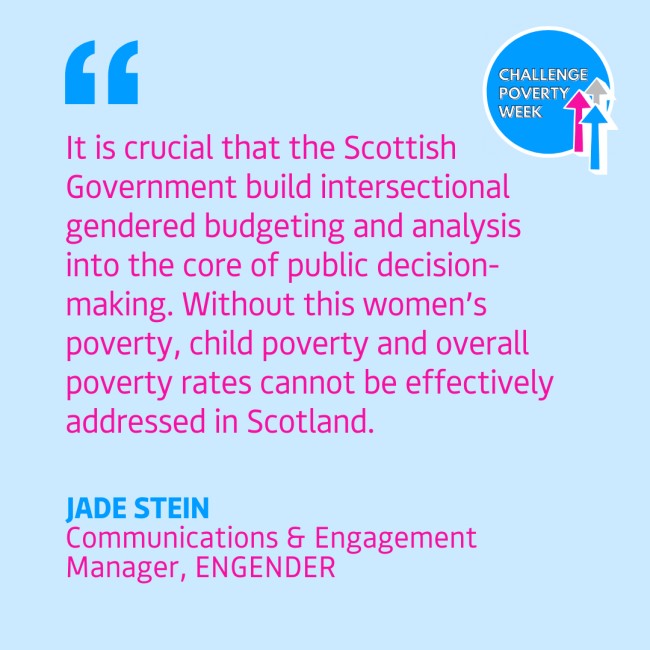
Around one-fifth of Scotland’s people – more than a million of us – live in poverty. For a rich nation, with an abundance of resources, this is simply outrageous. 
Can the DWP's proposed changes to Universal Credit deliver for women?
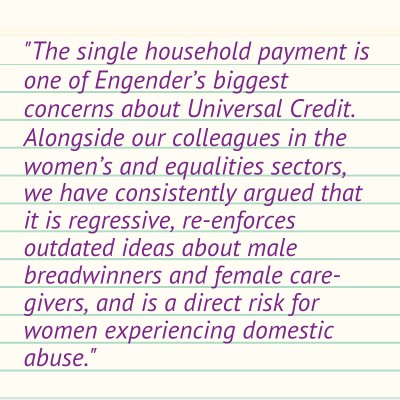
Our Policy and Parliamentary Manager Eilidh Dickson looks at the proposed changes to the implementation of Universal Credit and the impact these changes are likely to have on women in receipt of the credit.
It used to be that “a week was a long time in politics”, but these days, major developments seem to occur daily. It's no surprise then that November 2018 already seems like a very long time ago. But that's how long Amber Rudd MP has been in post as Cabinet Secretary for the Department of Work and Pensions (DWP).
For years, UK Government Ministers have been doggedly committed to the Universal Credit. They've pursued it without regard for the serious concerns from recipients and organisations like Engender. Expectations that a new Minister at the DWP would change track now were low, despite her assertion that she was ready to listen and "learn from errors".10 questions for Damian Hinds on the 'rape clause'
Today Engender, along with Scottish Women's Aid and Rape Crisis Scotland, have written to Damian Hinds, Minister of State for the Department of Work and Pensions asking ten questions about the implementation of the so-called 'rape clause'.
It has long been clear to us that both the ‘rape clause’ and the family cap which underpins it are unworkable policies (see our previous blogs here). We also know, however, that women in Scotland will be seeking information on how the UK Government intends to implement the policies, and how it will impact on their families, so we have written for clarity on a number of issues we don't believe have been fully thought through. You can read the letter below, and we'll be publishing a response as soon as we get one.
 RSS
RSSDownloads
 Engender Briefing: Pension Credit Entitlement Changes
From 15 May 2019, new changes will be introduced which will require couples where one partner has reached state pension age and one has not (‘mixed age couples’) to claim universal credit (UC) instead of Pension Credit.
Engender Briefing: Pension Credit Entitlement Changes
From 15 May 2019, new changes will be introduced which will require couples where one partner has reached state pension age and one has not (‘mixed age couples’) to claim universal credit (UC) instead of Pension Credit.
 Engender Parliamentary Briefing: Condemnation of Misogyny, Racism, Harassment and Sexism
Engender welcomes this Scottish Parliament Debate on Condemnation of Misogyny, Racism, Harassment and Sexism and the opportunity to raise awareness of the ways in which women in Scotland’s inequality contributes to gender-based violence.
Engender Parliamentary Briefing: Condemnation of Misogyny, Racism, Harassment and Sexism
Engender welcomes this Scottish Parliament Debate on Condemnation of Misogyny, Racism, Harassment and Sexism and the opportunity to raise awareness of the ways in which women in Scotland’s inequality contributes to gender-based violence.
 Gender Matters in Social Security: Individual Payments of Universal Credit
A paper calling on the Scottish Government to automatically split payments of Universal Credit between couples, once this power is devolved to the Scottish Parliament.
Gender Matters in Social Security: Individual Payments of Universal Credit
A paper calling on the Scottish Government to automatically split payments of Universal Credit between couples, once this power is devolved to the Scottish Parliament.
 Gender Matters Manifesto: Twenty for 2016
This manifesto sets out measures that, with political will, can be taken over the next parliamentary term in pursuit of these goals.
Gender Matters Manifesto: Twenty for 2016
This manifesto sets out measures that, with political will, can be taken over the next parliamentary term in pursuit of these goals.
 Scottish NGO Briefing for UN Special Rapporteur on Violence Against Women
Joint briefing paper for the UN Rapporteur on Violence Against Women.
Scottish NGO Briefing for UN Special Rapporteur on Violence Against Women
Joint briefing paper for the UN Rapporteur on Violence Against Women.

Newsletter
Sign up to receive our newsletter here:
Sign up to our mailing list
Receive key feminist updates direct to your inbox: