Engender blog
Guest Post: Why we need an integrated health care strategy for women
Women and girls face significant barriers to good mental and physical health in Scotland. Health issues that disproportionately affect women, or affect women differently to men, have historically lacked funding and professional focus, meaning that women’s health needs are not equally prioritised and understood across health services and more broadly.
Engender Member Linda Gask is a retired psychiatrist and feminist, living in Orkney. In this guest post, they explore the need for a coordinated approach to women’s physical and mental health.
In the Paris suburb of St. Denis, one of the more deprived parts of that city, stands a building called House of Women. Opened in 2016, by an extraordinary obstetrician and gynaecologist called Ghada Hatem-Gantzer, it now has now helped over 30,000 women.
Why do we need to know about this now, in Scotland? Because the House of Women isn’t only a place where women receive reproductive healthcare. It’s an amazing one-stop shop where women who have experienced gendered violence and everything that goes with that: poverty, abuse, racism, injury and illness, contact with the criminal justice system, mental ill-health, can get help in one place. Under one roof. There is nowhere like it in Scotland, or anywhere else in the United Kingdom. If we need help, we must seek out different professionals across our towns and cities. Our minds and bodies are treated as though they too are in separate places.
Women’s Centres can provide some of this holistic support but accessing help for problems that can cause serious harm to both minds and bodies, in one single place like the House of Women, is nigh on impossible. Why?
It’s because our health policymakers are not thinking enough about what women want and need to recover, but instead about ‘disorders’ and where, how and by whom they should be treated.
Yet women’s physical and mental health are closely intertwined.
When we have persistent, horrible pelvic pain, it gets us down and may even make us severely depressed. The leading cause of death for women between a month and a year after childbirth continues to be suicide. Not only our lives but our hormones drive us crazy at times. We now know that perimenopause and menopause is a time of risk for women’s mental health. That the mean age for the menopause is 50, and historically the peak suicide rate for women in Scotland has been between 45 and 54 is unlikely to be a coincidence.
 Domestic violence doesn’t only cause physical harm to women, but also psychological trauma too and is finally being recognised as a major cause of suicide. Dementia, which affects both our minds and bodies, is more common in women than men, though we still don’t understand why, because the research hasn’t been done. Women are the ones more likely to be those caring for people with dementia too.
Both poor physical and mental health are closely related to living in poverty, and women are more likely to experience that in our society and suffer the ill-effects. Dr Hatem-Gantzer recognised that her patients who have experienced gendered violence needed much more than just a gynaecologist, so she set about getting everything they needed together in one welcoming space.
Women’s health is still too often thought of as being about childbearing and its consequences, even though, despite what some politicians may think, we are so much more than wombs. It is pleasing to see that the second phase of the Scottish Women’s Health Plan has a broader perspective than this, covering not only gynaecology but also thinking about women’s brain health – dementia, and other physical health problems such as cardiovascular disease and bone health including risk factors for osteoporosis. However, once again, the specific needs of women’s mental health will be addressed in a separate mental health strategy to be published later in the year. There is a real risk we’ll be overlooked once again by a ‘gender neutral’ approach that fails to consider our real needs including better care for the problems that are so much more common in women – anxiety and depression.
We want faster access to therapies in the community, more investment for eating disorders and the right help for the psychological consequences of early abuse, domestic violence, rape and sexual assault. Too many of us are still ending up with a diagnosis of personality disorder after experiencing violence and abuse. And all of these would benefit from more joined up thinking with physical health. For example, anorexia nervosa is a risk factor for osteoporosis and depression makes it harder to manage your chronic health problems such as diabetes.
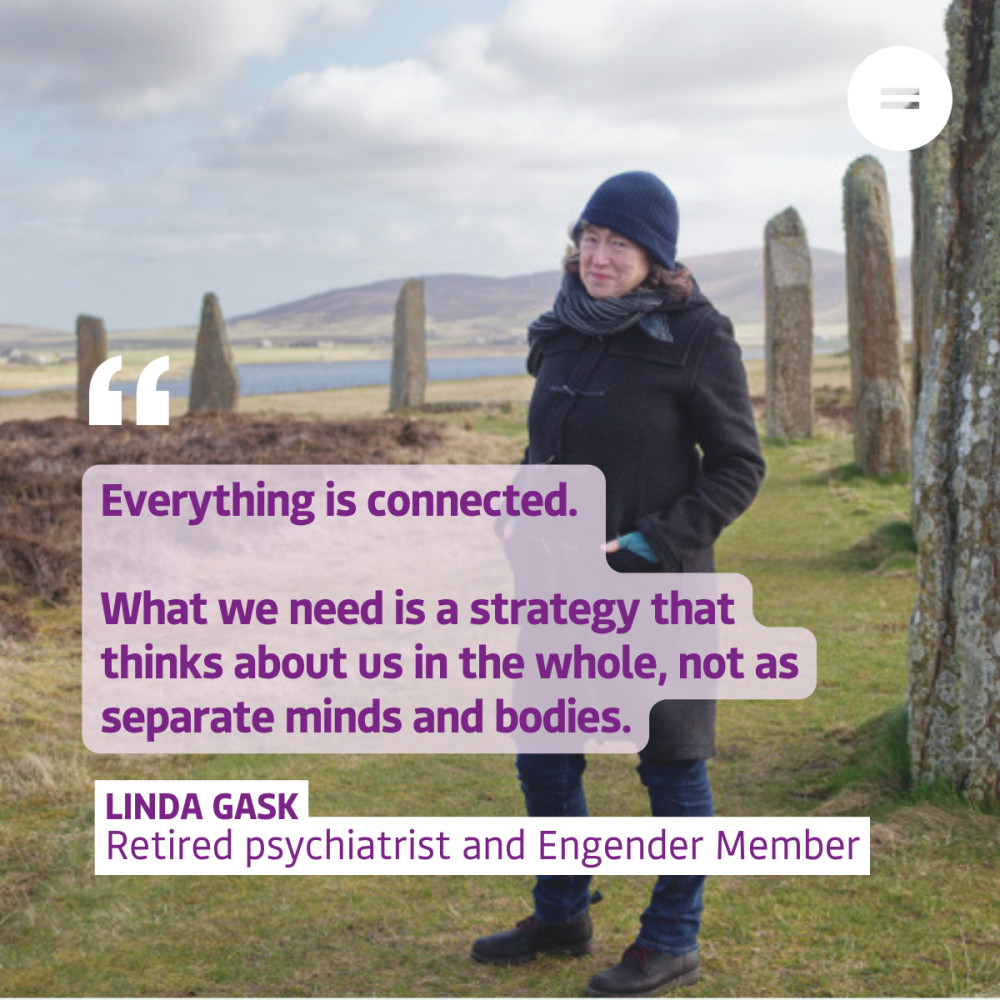
Everything is connected.
What we need is a strategy that thinks about us in the whole – not as separate minds and bodies. Australia has produced a plan just for women – which addresses women’s health across the life course, the factors that contribute to health and health outcomes for women and girls, improving health equity, and the needs of ethnic minority and gender diverse populations. It also talks about getting organisations and professionals to work together more effectively – something that doesn’t always happen here either. There are women’s health centres emerging there which address physical and mental health - something we desperately need.
Dr Hatem-Gantzer’s model for the House of Women is now being copied across France. We could do with an integrated approach to women’s health in Scotland too. We just can’t afford to keep splitting off women’s minds and bodies. It makes no sense.
Engender Member Linda Gask is a retired psychiatrist and feminist, living in Orkney, Scotland. Their latest and award-winning book Out of Her Mind: How We Are Failing Women’s Mental Health and What Must Change is available for purchase. They also regularly blog here.
Guest posts do not necessarily reflect the views of Engender, and all language used is the author’s own. Bloggers may have received some editorial support from Engender, and may have received a fee from our commissioning pot. We aim for our blog to reflect a range of feminist viewpoints, and offer a commissioning pot to ensure that women do not have to offer their time or words for free.
Interested in writing for the Engender blog? Find out more here.
New report reveals devastating impact of Covid-19 on access to pregnancy and maternity services
Engender and the Health and Social Care Alliance Scotland (the ALLIANCE) have today published a new report spotlighting women’s experiences of pregnancy and maternity services during the Covid-19 pandemic.
The report, ‘“Trauma, abandonment and isolation”: Experiences of pregnancy and maternity services in Scotland during Covid-19’, draws on survey responses from over 200 women across Scotland. It documents the profound and negative impact that public health restrictions had on access to vital healthcare across all aspects of these services from antenatal care, fertility treatment, to miscarriage and baby loss, birth and the postnatal period.
Key findings include:
- Confusing, contradictory and limited communication about Covid-19 mitigation measures caused extreme anxiety and distress for pregnant women.
- The shift away from in-person care to remote appointments was a barrier to adequate standards of care.
- Isolation as a result of restrictions negatively affected all aspects of pregnancy and maternity care. Women underwent invasive procedures, gave birth, and suffered miscarriage and baby loss without support, suffering trauma as a result.
- Inflexible and inconsistent application of guidelines across different health board areas and health settings led to uncertainty and perceptions of unfairness.
- A narrow focus on labour and delivery meant wider health needs were overlooked, including mental health and breastfeeding support.
- Gendered health inequalities, such as pain management and the lack of an intersectional approach, were exacerbated by the pandemic.
- Ongoing impacts include gaps in mental health support and experiences of trauma relating to isolation and poor care.
Jill Wood, Policy Manager at Engender, said:
“This research indicates that Covid-19 guidance and its application fundamentally failed to take account of women’s diverse needs and experiences during pregnancy and early motherhood. Confusing and contradictory communication, lack of in-person care and support, inflexible restrictions and inconsistent approaches across health board areas all undermined access to safe, dignified and quality healthcare.”
“The trauma caused by attending procedures and giving birth alone and the subsequent isolation, lack of support and adequate care, will stay with women long into the future."
"Scottish Government must learn from this, improve maternal health more broadly, and deliver on commitments on women’s health.”
Jane Miller, Academy Programme Manager at the ALLIANCE, said:
“Pregnancy and early parenthood can be challenging at the best of times. Our research shows that mitigation measures brought in during the pandemic exacerbated isolation and anxiety for many women in Scotland.”
“There is now an urgent need to centre the experiences and priorities of women in the ongoing Covid-19 Inquiry, and in the development of any future emergency guidance regarding healthcare. We must mitigate the risk of isolation and adopt flexible, person-centred approaches grounded in human rights and gender equality.”
A research participant said:
“It is essential that Scotland learns from people's experiences during the pandemic to improve maternity services and public health messaging. To do otherwise would be to fail, and further compound the trauma, of thousands of parents over the last few years.”
The report concludes with a series of recommendations aimed at the Scottish Covid-19 Inquiry and decision-makers in Scottish Government and health bodies. It highlights the need for a gendered and human rights approach to crisis management regarding healthcare, and for policy and services to take account of women’s particular experiences and needs at all life stages.
The report will be submitted as evidence to the Scottish Covid-19 Inquiry.
Read the report online here.
GUEST BLOG: Agoraphobia and Gender Post Covid-19
Women’s social, economic, cultural and political inequality with men undermines good mental health and wellbeing in a wide range of ways, including the impacts of gender stereotyping, medical misogyny and racism, and of course the disproportionate impact that austerity, Covid-19 and the cost of living crises have on women's mental health.
In this long read, guest author Muna Saeed explores the impact of gender on agoraphobia, and how this affects women in the aftermath of the Covid-19 pandemic.
Imagine a world where the thought of leaving your home fills you with dread and anxiety.
As the world outside continues to spin, you're trapped inside, desperately seeking comfort from the chaos that lies beyond your front door. This is the reality for those diagnosed with agoraphobia, a condition that goes beyond a simple fear of public spaces. It's a suffocating fear of being in situations where escape is difficult, and the fear of panic attacks threatens to consume your every waking moment. But what happens when we introduce gender into this equation? As a mental health worker who works closely with individuals grappling with mental health challenges, including agoraphobia, my aim is to shed light on the intricate and gendered complexities of this condition in a post-Covid-19 world.
The mental health gap for women in Scotland
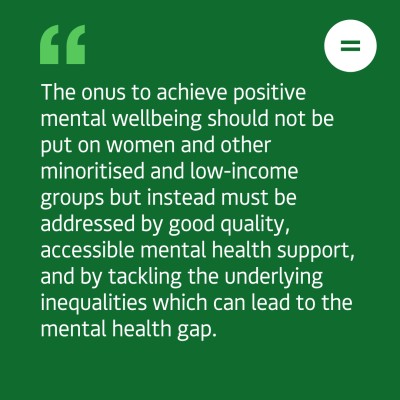
Women’s social, economic, cultural and political inequality with men undermines good mental health and wellbeing in a wide range of ways, including the impacts of gender stereotyping, medical misogyny and racism, and of course the disproportionate impact that austerity, Covid-19 and the cost of living crises have on women's mental health.
Recently Engender was invited to speak to civil servants working in the Scottish Government's Mental Health Strategy and Co-ordination unit, about the ways in which women's ineqaulity and mental health intersect. Here are some of the things we spoke about.
Covid-19 and Mental Health
Engender has been working with Close the Gap, and other women's organisations across the UK, to carry out some polling work to see how Covid has impacted on women's lives. We published the our first findings from this study - focusing on the impact on women with childcare responsibilities - back in March and you can read it here. Our next report looks at the impact of the Covid-19 pandemic on women's health.
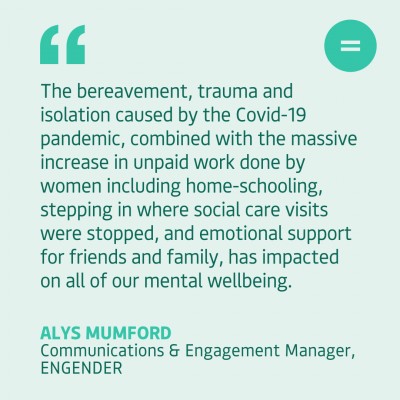
This week marks Mental Health Awareness Week, in a year which has seen women's mental health be challenged like never before. The bereavement, trauma and isolation caused by the Covid-19 pandemic, combined with the massive increase in unpaid work done by women including home-schooling, stepping in where social care visits were stopped, and emotional support for friends and family, has impacted on all of our mental wellbeing.
As part of our work for a gendered recovery, we carried out a survey on the impacts of COVID-19 developed alongside Close the Gap, the UK Women’s Budget Group, Fawcett Society, Women’s Equality Network Wales, and Northern Ireland Women’s Budget Group. The survey was carried out by Survation between 18-27 February 2021 across the four nations in the UK.
 RSS
RSSDownloads
 Engender Briefing: Pension Credit Entitlement Changes
From 15 May 2019, new changes will be introduced which will require couples where one partner has reached state pension age and one has not (‘mixed age couples’) to claim universal credit (UC) instead of Pension Credit.
Engender Briefing: Pension Credit Entitlement Changes
From 15 May 2019, new changes will be introduced which will require couples where one partner has reached state pension age and one has not (‘mixed age couples’) to claim universal credit (UC) instead of Pension Credit.
 Engender Parliamentary Briefing: Condemnation of Misogyny, Racism, Harassment and Sexism
Engender welcomes this Scottish Parliament Debate on Condemnation of Misogyny, Racism, Harassment and Sexism and the opportunity to raise awareness of the ways in which women in Scotland’s inequality contributes to gender-based violence.
Engender Parliamentary Briefing: Condemnation of Misogyny, Racism, Harassment and Sexism
Engender welcomes this Scottish Parliament Debate on Condemnation of Misogyny, Racism, Harassment and Sexism and the opportunity to raise awareness of the ways in which women in Scotland’s inequality contributes to gender-based violence.
 Gender Matters in Social Security: Individual Payments of Universal Credit
A paper calling on the Scottish Government to automatically split payments of Universal Credit between couples, once this power is devolved to the Scottish Parliament.
Gender Matters in Social Security: Individual Payments of Universal Credit
A paper calling on the Scottish Government to automatically split payments of Universal Credit between couples, once this power is devolved to the Scottish Parliament.
 Gender Matters Manifesto: Twenty for 2016
This manifesto sets out measures that, with political will, can be taken over the next parliamentary term in pursuit of these goals.
Gender Matters Manifesto: Twenty for 2016
This manifesto sets out measures that, with political will, can be taken over the next parliamentary term in pursuit of these goals.
 Scottish NGO Briefing for UN Special Rapporteur on Violence Against Women
Joint briefing paper for the UN Rapporteur on Violence Against Women.
Scottish NGO Briefing for UN Special Rapporteur on Violence Against Women
Joint briefing paper for the UN Rapporteur on Violence Against Women.

Newsletter
Sign up to receive our newsletter here:
Sign up to our mailing list
Receive key feminist updates direct to your inbox: