Engender blog
Guest Blog: Intersectionality
In this week's guest blog post Richa Okhandiar writes about her experience of intersectionality in Scotland.
When I first came across the concept of intersectionality – it blew my mind.
I became actively interested in feminism around the age of 15 through being influenced by my older sister, discovering riot grrl and kickass role models in music and art who challenged gender norms a la Kathleen Hanna, Brody Dalle, and Carrie Brownstein. It was a complete age of discovery – I loved that there was this movement that accepted women as people who could be talented, thoughtful, screw-ups and genuine bad asses. Feminism and I just clicked, we were meant to be, it was fated.
There was always one drawback for me – all of the feminist icons I would read about, see in music and be heralded as role models were pretty much always white. It was always a bummer that I never saw anyone that looked like me or that my experience as a women had to be drawn from the Western, middle class part of my identity rather than the second-generation Indian born person born and raised in the UK. Even when I went to university and continued my education into feminism it became evident that the vast majority of accessible mainstream writing was all from one perspective. So I'll say it again, when I first came across intersectionality – it blew my mind!
Guest blog: Women for Independence (Indyref Thursday #8)
 This week's final indyref Thursday is a double page special from two former politicians who have been out on the campaign trail. They describe what they believe their vote will mean for women.
Carolyn Leckie is a former Scottish Socialist Party MSP for Central Scotland.
When I was in the Parliament I got into trouble. For weeks I’d been trying to ask Jack McConnell about the nursery nurses. Nursery nurses who, as women, were deeply skilled but disgracefully paid and striking for better. I’d managed to secure a member’s debate but despite repeated attempts, I was not allowed to ask Jack if he supported them. So, I made a point of order and was overruled. So I stayed standing for the nursery nurses who were thronging the Royal Mile in their hundreds outside. I was chucked out. But I was glad to join the women outside, who were protesting at a parliament that had no control of employment law, equalities, wages or trade union legislation.
Guest blog: Women Saying No (Indyref Thursday #8)
 This week's final indyref Thursday is a double page special from two former politicians who have been out on the campaign trail. They describe what they believe their vote will mean for women.
Maria Fyfe is a former Labour MP for Glasgow Maryhill
I know women who are voting Yes because they want a fairer and more equal society. I completely agree with their aim, but where is the capacity to achieve it? It doesn’t happen just because enough people put a cross against Yes on a ballot paper. We can all be emotionally aroused by stirring speeches. But one of the wisest pieces of advice I ever heard was, “Never mind what politicians say. Look at how they spend the public’s money and then you know what they really care about.” I could add to that, what they tax and who gets tax cuts.
Guest blog: Women and work: what next? (Indyref Thursday #7)
 In the run-up to the referendum, we'll be publishing views on women's equality and Scotland's constitutional futures. This week, Close the Gap development officer Lindsey Millen writes on the implications of the referendum for the women and work.
After months of campaigning, discussion and debate, what is arguably the biggest political event of a generation is almost upon us. With just over two weeks to go until the referendum, Close the Gap launched a new working paper ‘Women and work: What comes next in a post-referendum Scotland?’ at a Constitutional Café event with Engender, Electoral Reform Society Scotland, and Scottish Women’s Aid last Saturday. The aim of this paper is to provide an overview of the implications for women and work in the context of the independence debate, to describe what needs to happen to effect positive change, and to identify the levers that are available in the event of either outcome.
We already know women face a multitude of barriers and inequalities in the labour market. The gender pay gap remains stubbornly high at 13% in a labour market characterised by persistent occupational segregation, with women clustered into low-skilled, low-valued, and low-paid work at one end of the scale, and denied access to the top roles at the other. Women overwhelmingly shoulder the burden of care, for children, older people and disabled people, and often find themselves faced with downward occupational mobility on returning to work after maternity or other care leave.
Guest blog: Indyref, women and politics (Indyref Thursday #5)
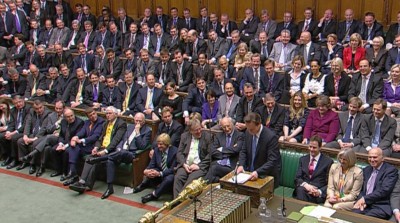 In the run-up to our event on 'gender equality, the referendum and beyond', we'll be publishing a weekly blog to correspond with our 'Scotland's futures' briefing papers series. This week, guest blogger Ann Henderson considers gender implications in terms of politics and power.
When reviewing the statistics for political representation for women in the UK and in Scotland, we have rightly been proud of the progress made when the Scottish Parliament was established. In 1999 our Parliament sat 4th in the world rankings on parliamentary representation, with 37.2% of our new Parliamentarians being female.
 RSS
RSSDownloads
 Engender Briefing: Pension Credit Entitlement Changes
From 15 May 2019, new changes will be introduced which will require couples where one partner has reached state pension age and one has not (‘mixed age couples’) to claim universal credit (UC) instead of Pension Credit.
Engender Briefing: Pension Credit Entitlement Changes
From 15 May 2019, new changes will be introduced which will require couples where one partner has reached state pension age and one has not (‘mixed age couples’) to claim universal credit (UC) instead of Pension Credit.
 Engender Parliamentary Briefing: Condemnation of Misogyny, Racism, Harassment and Sexism
Engender welcomes this Scottish Parliament Debate on Condemnation of Misogyny, Racism, Harassment and Sexism and the opportunity to raise awareness of the ways in which women in Scotland’s inequality contributes to gender-based violence.
Engender Parliamentary Briefing: Condemnation of Misogyny, Racism, Harassment and Sexism
Engender welcomes this Scottish Parliament Debate on Condemnation of Misogyny, Racism, Harassment and Sexism and the opportunity to raise awareness of the ways in which women in Scotland’s inequality contributes to gender-based violence.
 Gender Matters in Social Security: Individual Payments of Universal Credit
A paper calling on the Scottish Government to automatically split payments of Universal Credit between couples, once this power is devolved to the Scottish Parliament.
Gender Matters in Social Security: Individual Payments of Universal Credit
A paper calling on the Scottish Government to automatically split payments of Universal Credit between couples, once this power is devolved to the Scottish Parliament.
 Gender Matters Manifesto: Twenty for 2016
This manifesto sets out measures that, with political will, can be taken over the next parliamentary term in pursuit of these goals.
Gender Matters Manifesto: Twenty for 2016
This manifesto sets out measures that, with political will, can be taken over the next parliamentary term in pursuit of these goals.
 Scottish NGO Briefing for UN Special Rapporteur on Violence Against Women
Joint briefing paper for the UN Rapporteur on Violence Against Women.
Scottish NGO Briefing for UN Special Rapporteur on Violence Against Women
Joint briefing paper for the UN Rapporteur on Violence Against Women.

Newsletter
Sign up to receive our newsletter here:
Sign up to our mailing list
Receive key feminist updates direct to your inbox: