Engender blog
Marking 10 years since the Christie Commission
A decade ago saw the report from the Christie Committee, a ground-breaking inquiry which aimed to usher in a new era in public sector delivery in Scotland. To mark 10 years since the release of the report, our Executive Director Emma Ritch joined sector leaders in a special edition of Third Force News magazine to reflect on the Commission and progress made on its recommendations.
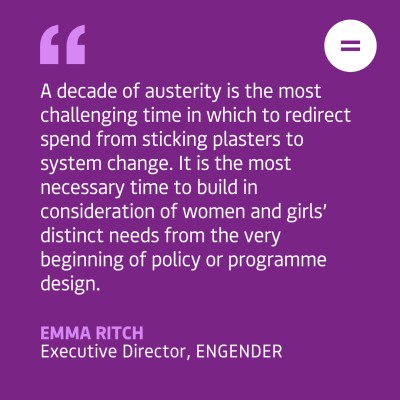
Christie finished its work just after the public sector equality duty came into being, and its critical focus on prevention really aligns with the duty.
So much of the inequality that women experience comes from laws, policy, programmes, and institutions that have missed the opportunity to get it right for women in the first place. Everything from transport systems to parks to health services are designed around the preferences and needs of boys and men. The consequences are dire: women in Scotland have less say in their communities, less power, less safety, and fewer resources.
The Christie report didn’t mention women at all but it did recommend that equality be integrated into the National Performance Framework. It also called for the public sector equality duty to be tooled to establish partnership working on reducing discrimination and advancing equality, and for public bodies to gather sufficient equality data to inform service design. We see relatively little evidence that any of this has been realised. Only two of the 81 NPF indicators relate directly to women and girls. The public sector equality duty has been a damp squib in terms of making change happen.
Apply to our new Board Pioneer Programme
Engender is launching our new Board Pioneer Programme offering an opportunity to get involved in feminist governance and see how a board works. Find out more in this blog from our Communications & Admin Assistant Maxine.
EDIT 23/07/21: Following the unexpected death of Engender's Executive Director, Emma Ritch, earlier this month, we are postponing recruitment for the Board Pioneer Programme. We are still very committed to the scheme, and will be relaunching it in the future, when board members will have more capacity to get involved. Thank you for your understanding.
Today we’re launching Engender’s Board Pioneer Programme, based on the excellent work and success of Stellar Quines, the award-winning Scottish theatre company. Stellar Quines launched their Pioneer programme a few years ago and have created a detailed resource pack for others to use the model which highlights the importance of involving and learning from those whose voices are traditionally underrepresented on boards.
When we think of the stereotypical depiction of boards in films and tv, the image that springs to mind is a foreboding group of greying men in suits prioritising profits. According to the Young Trustees Movement, 1 in 12 trustees is named either John or David, and less than 3% of trustees are under 30 which means that the voices of young people, and young women in particular, are sorely lacking on boards across the country. The image of a board as a homogenous group does a disservice to the wealth of experience and knowledge that people from underrepresented groups can share – young people often have caring experience, or experience of working zero-hours contracts, or are involved in on the ground activism. Intergenerational perspectives enable better decision making for boards, and the widespread practice of filling trustee vacancies through informal networks means that boards tend to recruit in their own image, perpetuating the underrepresentation of carers, disabled women and girls, Black and minority ethnic groups, and LGBTI people.
Engender recommends 2020
Over the past years we've had to privilege of chatting to some brilliant women for our On the Engender podcast. This year, we asked guests to leave us with a recommendation - from further policy reading, to must-follow twitter accounts.
Here's what's been recommended in 2020:
‘Knowing Me; Knowing You: Is this the best we can do for cohabiting couples?
Engender has responded to the Scottish Law Commission's consultation on reforms to the law governing cohabitation in Scotland. This blog, from Engender's Policy and Parliamentary Manager Eilidh Dickson, sets out why equality in cohabitation is a feminist issue.

Earlier this year, the Scottish Parliament passed into law the Civil Partnerships (Scotland) Act 2020, which equalised the laws governing civil partnerships in Scotland, meaning that both marriage and civil partnership is an option for mixed and same sex couples. For many couples in mixed-sex relationships this new right to choose between forms of legal recognition for their relationship is a radical positive, offering an alternative to marriage with less ‘baggage’.
The state has always had an interest in marriage. Marriage has been and continues to be described as the ‘gold standard’ of relationships. It has historically marked out families as one single unit while governing social hierarchy and social order between the sexes - men as the economic providers and women as caregiver and keepers of the home.
 RSS
RSSDownloads
 Engender Briefing: Pension Credit Entitlement Changes
From 15 May 2019, new changes will be introduced which will require couples where one partner has reached state pension age and one has not (‘mixed age couples’) to claim universal credit (UC) instead of Pension Credit.
Engender Briefing: Pension Credit Entitlement Changes
From 15 May 2019, new changes will be introduced which will require couples where one partner has reached state pension age and one has not (‘mixed age couples’) to claim universal credit (UC) instead of Pension Credit.
 Engender Parliamentary Briefing: Condemnation of Misogyny, Racism, Harassment and Sexism
Engender welcomes this Scottish Parliament Debate on Condemnation of Misogyny, Racism, Harassment and Sexism and the opportunity to raise awareness of the ways in which women in Scotland’s inequality contributes to gender-based violence.
Engender Parliamentary Briefing: Condemnation of Misogyny, Racism, Harassment and Sexism
Engender welcomes this Scottish Parliament Debate on Condemnation of Misogyny, Racism, Harassment and Sexism and the opportunity to raise awareness of the ways in which women in Scotland’s inequality contributes to gender-based violence.
 Gender Matters in Social Security: Individual Payments of Universal Credit
A paper calling on the Scottish Government to automatically split payments of Universal Credit between couples, once this power is devolved to the Scottish Parliament.
Gender Matters in Social Security: Individual Payments of Universal Credit
A paper calling on the Scottish Government to automatically split payments of Universal Credit between couples, once this power is devolved to the Scottish Parliament.
 Gender Matters Manifesto: Twenty for 2016
This manifesto sets out measures that, with political will, can be taken over the next parliamentary term in pursuit of these goals.
Gender Matters Manifesto: Twenty for 2016
This manifesto sets out measures that, with political will, can be taken over the next parliamentary term in pursuit of these goals.
 Scottish NGO Briefing for UN Special Rapporteur on Violence Against Women
Joint briefing paper for the UN Rapporteur on Violence Against Women.
Scottish NGO Briefing for UN Special Rapporteur on Violence Against Women
Joint briefing paper for the UN Rapporteur on Violence Against Women.

Newsletter
Sign up to receive our newsletter here:
Sign up to our mailing list
Receive key feminist updates direct to your inbox: