Engender blog
Guest Post: Why we need an integrated health care strategy for women
Women and girls face significant barriers to good mental and physical health in Scotland. Health issues that disproportionately affect women, or affect women differently to men, have historically lacked funding and professional focus, meaning that women’s health needs are not equally prioritised and understood across health services and more broadly.
Engender Member Linda Gask is a retired psychiatrist and feminist, living in Orkney. In this guest post, they explore the need for a coordinated approach to women’s physical and mental health.
In the Paris suburb of St. Denis, one of the more deprived parts of that city, stands a building called House of Women. Opened in 2016, by an extraordinary obstetrician and gynaecologist called Ghada Hatem-Gantzer, it now has now helped over 30,000 women.
Why do we need to know about this now, in Scotland? Because the House of Women isn’t only a place where women receive reproductive healthcare. It’s an amazing one-stop shop where women who have experienced gendered violence and everything that goes with that: poverty, abuse, racism, injury and illness, contact with the criminal justice system, mental ill-health, can get help in one place. Under one roof. There is nowhere like it in Scotland, or anywhere else in the United Kingdom. If we need help, we must seek out different professionals across our towns and cities. Our minds and bodies are treated as though they too are in separate places.
Women’s Centres can provide some of this holistic support but accessing help for problems that can cause serious harm to both minds and bodies, in one single place like the House of Women, is nigh on impossible. Why?
It’s because our health policymakers are not thinking enough about what women want and need to recover, but instead about ‘disorders’ and where, how and by whom they should be treated.
Yet women’s physical and mental health are closely intertwined.
When we have persistent, horrible pelvic pain, it gets us down and may even make us severely depressed. The leading cause of death for women between a month and a year after childbirth continues to be suicide. Not only our lives but our hormones drive us crazy at times. We now know that perimenopause and menopause is a time of risk for women’s mental health. That the mean age for the menopause is 50, and historically the peak suicide rate for women in Scotland has been between 45 and 54 is unlikely to be a coincidence.
 Domestic violence doesn’t only cause physical harm to women, but also psychological trauma too and is finally being recognised as a major cause of suicide. Dementia, which affects both our minds and bodies, is more common in women than men, though we still don’t understand why, because the research hasn’t been done. Women are the ones more likely to be those caring for people with dementia too.
Both poor physical and mental health are closely related to living in poverty, and women are more likely to experience that in our society and suffer the ill-effects. Dr Hatem-Gantzer recognised that her patients who have experienced gendered violence needed much more than just a gynaecologist, so she set about getting everything they needed together in one welcoming space.
Women’s health is still too often thought of as being about childbearing and its consequences, even though, despite what some politicians may think, we are so much more than wombs. It is pleasing to see that the second phase of the Scottish Women’s Health Plan has a broader perspective than this, covering not only gynaecology but also thinking about women’s brain health – dementia, and other physical health problems such as cardiovascular disease and bone health including risk factors for osteoporosis. However, once again, the specific needs of women’s mental health will be addressed in a separate mental health strategy to be published later in the year. There is a real risk we’ll be overlooked once again by a ‘gender neutral’ approach that fails to consider our real needs including better care for the problems that are so much more common in women – anxiety and depression.
We want faster access to therapies in the community, more investment for eating disorders and the right help for the psychological consequences of early abuse, domestic violence, rape and sexual assault. Too many of us are still ending up with a diagnosis of personality disorder after experiencing violence and abuse. And all of these would benefit from more joined up thinking with physical health. For example, anorexia nervosa is a risk factor for osteoporosis and depression makes it harder to manage your chronic health problems such as diabetes.
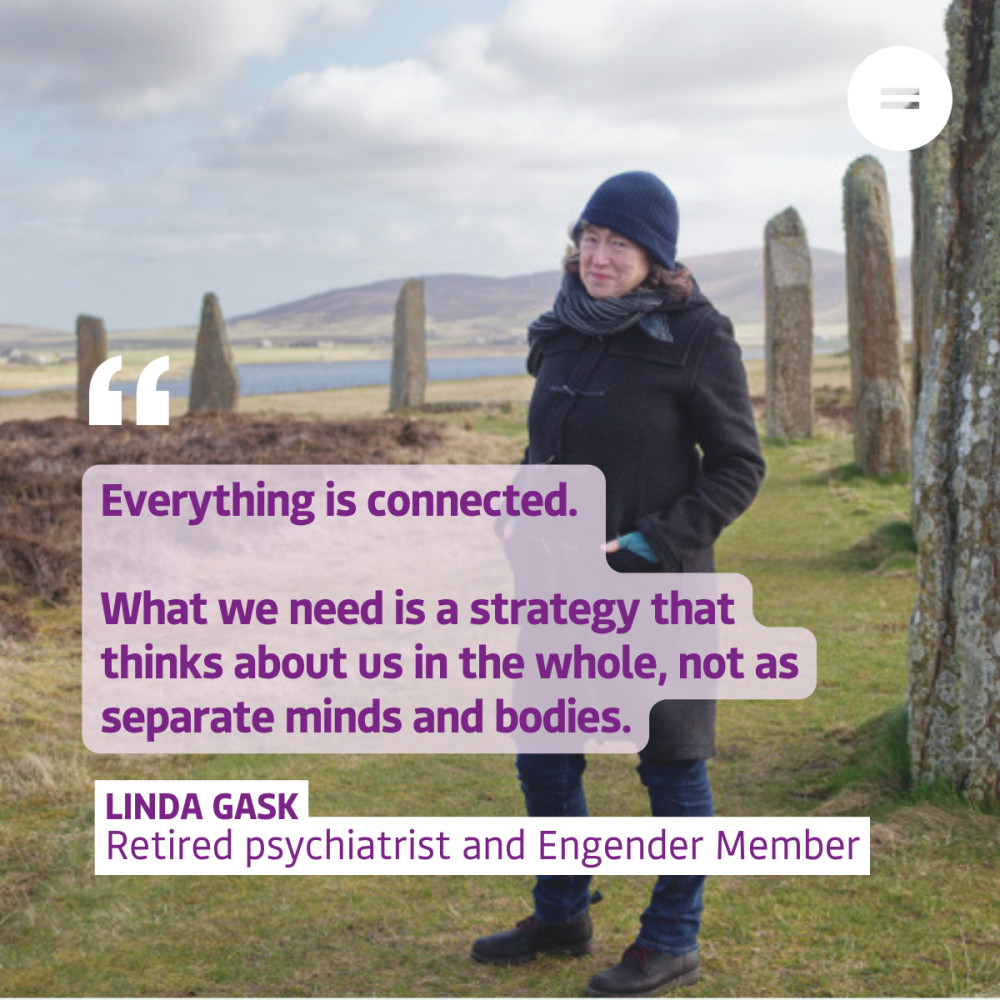
Everything is connected.
What we need is a strategy that thinks about us in the whole – not as separate minds and bodies. Australia has produced a plan just for women – which addresses women’s health across the life course, the factors that contribute to health and health outcomes for women and girls, improving health equity, and the needs of ethnic minority and gender diverse populations. It also talks about getting organisations and professionals to work together more effectively – something that doesn’t always happen here either. There are women’s health centres emerging there which address physical and mental health - something we desperately need.
Dr Hatem-Gantzer’s model for the House of Women is now being copied across France. We could do with an integrated approach to women’s health in Scotland too. We just can’t afford to keep splitting off women’s minds and bodies. It makes no sense.
Engender Member Linda Gask is a retired psychiatrist and feminist, living in Orkney, Scotland. Their latest and award-winning book Out of Her Mind: How We Are Failing Women’s Mental Health and What Must Change is available for purchase. They also regularly blog here.
Guest posts do not necessarily reflect the views of Engender, and all language used is the author’s own. Bloggers may have received some editorial support from Engender, and may have received a fee from our commissioning pot. We aim for our blog to reflect a range of feminist viewpoints, and offer a commissioning pot to ensure that women do not have to offer their time or words for free.
Interested in writing for the Engender blog? Find out more here.
Share this post on …
 RSS
RSS
Newsletter
Sign up to receive our newsletter here:
Sign up to our mailing list
Receive key feminist updates direct to your inbox: