Engender blog
GUEST POST: 'Text me when you're home!'
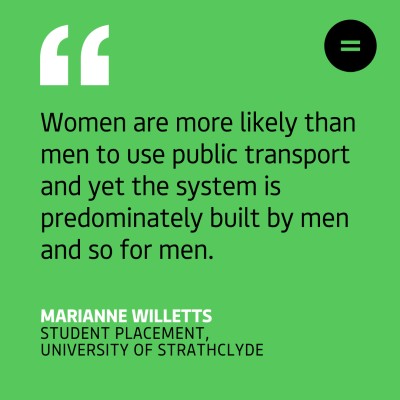
Today we're publishing the first in a series of blogs from the Spring student placements Engender hosted from the University of Strathclyde Applied Gender Studies and Research Methods course.
In this post, Marianne looks at how gender inequality and violence against women affect how women experience public spaces and public transport, and how and when these issues are recognised in the Scottish Parliament.
Keys between knuckles, hair down, earphones out. A routine all too familiar to a woman travelling home after sunset alone.
A male friend once told me that him and his flatmates had a ‘72-hour rule’; if one of them didn’t come home without telling the others where they were, they would wait 72 hours before ‘overthinking’ it and calling the police. I can’t speak for all women, but personally, if it was my female flatmate or friend, it would be at most 12 hours before the panic would set in and a further 12 before I would call the police. Women do not have the luxury of not taking precautions when commuting late at night. Travelling from A to B is necessary in many circumstances, and safety when doing so should be a given, but it is not.
GUEST BLOG: Economic Abuse and the cost of living crisis
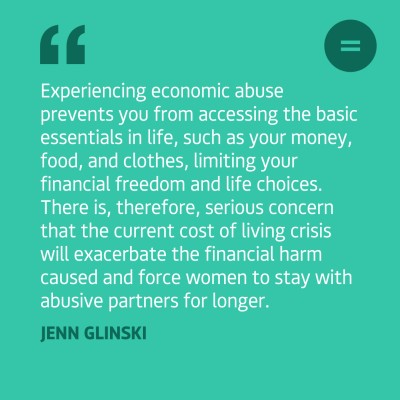
As part of our guest blog series on the cost of living crisis, researcher Jenn Glinski explores how the current rise in costs is impacting victim-survivors of economic abuse.
Content warning: This blog discusses different forms of domestic abuse and their impact.
The current cost of living crisis and the difficult decision to ‘heat or eat’ is one that victim-survivors of economic abuse are all too familiar with. However, unlike the government-imposed crisis that the rest of the country has been subjected to, the daily cost of living crisis victim-survivors experience is deliberately forced upon them by their abusive (ex)partners. Experiencing economic abuse prevents you from accessing the basic essentials in life, such as your money, food, and clothes, limiting your financial freedom and life choices. There is, therefore, serious concern that the current cost of living crisis will exacerbate the financial harm caused and force women to stay with abusive partners for longer.
Delivering Equally Safe: Challenging and eradicating violence against women
-400.png)
To mark the annual 16 Days of Activism campaign, our Policy Officer for Engender's Delivering Equally Safe project, Hannah Brisbane, shares some background on our briefing for MSPs on the importance of primary prevention in challenging and eradicating men's violence against women.
We are currently in the middle of the 16 Days of Activism against Gender-Based Violence. This annual campaign runs from the International Day for the Elimination of Violence against Women on the 25th of November until the 10th of December, which is Human Rights Day.
Delivering Equally Safe: The importance of primary prevention

Last year, Engender was awarded funding from the Delivering Equally Safe fund of the Scottish Government, for work on primary prevention of violence against women. We are now at the end of the first year of this funding and our Policy Officer for the Delivering Equally Safe project, Hannah Brisbane, shares an update about the project so far.
As you may know, Equally Safe is Scotland’s strategy to prevent and eradicate violence against women and girls. The strategy uses a feminist analysis of violence against women and girls (VAWG) by recognising it as a cause and consequence of gender inequality.
Gendered online harassment – what’s law got to do with it?
-400.png)
Claire Kish is currently in the second year of her PhD in Sociology and is based in the University of Glasgow’s Sociology department. Her PhD research explores the online harassment of women in journalism focusing on professional harms and organisational dimensions. Here she writes about a project she has been working on with Engender:
I recently completed a project for Engender which explores the legal responsibilities of employers with respect to the online harassment of workers. I specifically focused on women journalists because they face significant and severe abuse online, often as a result of performing key duties of the role. Yet the results have wider significance - especially as more work shifts online and employers increasingly utilise social media for business purposes. These changes have significant gendered and intersectional impacts as there are risks associated with being online which for women, especially minoritised women, are amplified. Given that women journalists are facing online harassment when carrying out work for their employers, we need to approach this as an employment and workers’ rights issue. So my project examined existing UK employment laws to identify and understand what legal duties employers have to uphold the rights of their women employees.
 RSS
RSSDownloads
 Engender Briefing: Pension Credit Entitlement Changes
From 15 May 2019, new changes will be introduced which will require couples where one partner has reached state pension age and one has not (‘mixed age couples’) to claim universal credit (UC) instead of Pension Credit.
Engender Briefing: Pension Credit Entitlement Changes
From 15 May 2019, new changes will be introduced which will require couples where one partner has reached state pension age and one has not (‘mixed age couples’) to claim universal credit (UC) instead of Pension Credit.
 Engender Parliamentary Briefing: Condemnation of Misogyny, Racism, Harassment and Sexism
Engender welcomes this Scottish Parliament Debate on Condemnation of Misogyny, Racism, Harassment and Sexism and the opportunity to raise awareness of the ways in which women in Scotland’s inequality contributes to gender-based violence.
Engender Parliamentary Briefing: Condemnation of Misogyny, Racism, Harassment and Sexism
Engender welcomes this Scottish Parliament Debate on Condemnation of Misogyny, Racism, Harassment and Sexism and the opportunity to raise awareness of the ways in which women in Scotland’s inequality contributes to gender-based violence.
 Gender Matters in Social Security: Individual Payments of Universal Credit
A paper calling on the Scottish Government to automatically split payments of Universal Credit between couples, once this power is devolved to the Scottish Parliament.
Gender Matters in Social Security: Individual Payments of Universal Credit
A paper calling on the Scottish Government to automatically split payments of Universal Credit between couples, once this power is devolved to the Scottish Parliament.
 Gender Matters Manifesto: Twenty for 2016
This manifesto sets out measures that, with political will, can be taken over the next parliamentary term in pursuit of these goals.
Gender Matters Manifesto: Twenty for 2016
This manifesto sets out measures that, with political will, can be taken over the next parliamentary term in pursuit of these goals.
 Scottish NGO Briefing for UN Special Rapporteur on Violence Against Women
Joint briefing paper for the UN Rapporteur on Violence Against Women.
Scottish NGO Briefing for UN Special Rapporteur on Violence Against Women
Joint briefing paper for the UN Rapporteur on Violence Against Women.

Newsletter
Sign up to receive our newsletter here:
Sign up to our mailing list
Receive key feminist updates direct to your inbox: