Engender blog
Free International Women’s Day Print
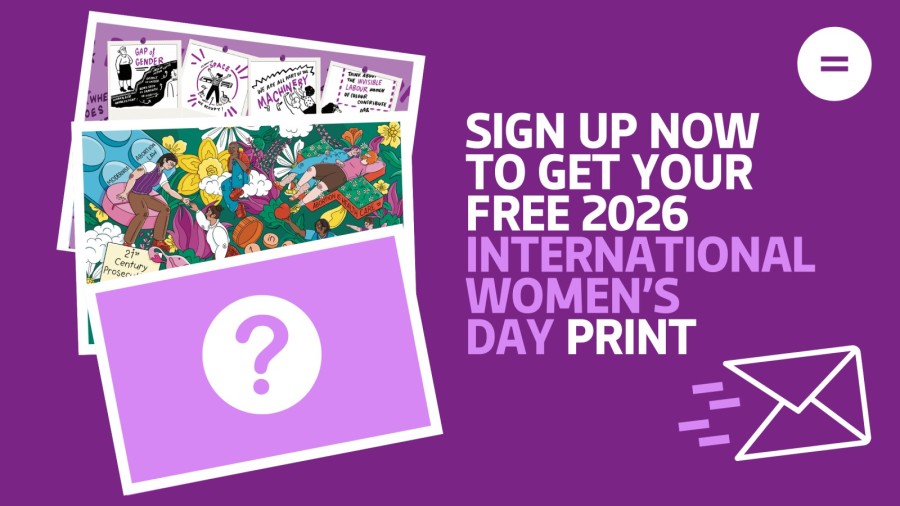
Our Free Feminist Artwork is back for 2026!
We’ve got a treat for Engender members and supporters this International Women’s Day.
We’ve got a limited number of stunning A6 prints available for Engender members and supporters to claim, created by incredible local illustrator, Heedayah Lockman.
We’ve got 250 prints to give away to Engender members, and another 100 up for grabs, so be quick to secure this excellent addition to your feminist art collection.
How to claim yours
It couldn’t be easier - just complete the form below with your details, and we’ll pop one in the post!
New report reveals stark gender divide in Scottish sports media coverage
A new report published today by the Equal Media and Culture Centre (EMCC), based at Engender, reveals a significant gender gap in how men and women athletes are covered in Scottish sports media.
GUEST POST: Critically minded? The problem of diversity in film criticism
Engender and the Equal Media and Culture Centre for Scotland have hosted student placements from the MSc in Social Research at the University of Edinburgh and the University of Strathclyde Applied Gender Studies and Research Methods course. As part of their research outputs, the students have produced a series of blogs.
In this post, Alex highlights the need for an intersectional approach to examining our cultural data and why we need more diverse voices in film criticism.

Film criticism fulfils multiple purposes. People read film reviews for suggestions on what to watch, and whether it’s worth shelling out to go to the cinema.
As a result, film reviews are also tied to a film’s financial success, its consideration for awards and whether it gets a wide release at all. Thus, critics can become “gatekeepers,” defining what counts as “good” art.
GUEST POST: Do we need diversity quotas in film?
Engender and the Equal Media and Culture Centre for Scotland have hosted student placements from the MSc in Social Research at the University of Edinburgh and the University of Strathclyde Applied Gender Studies and Research Methods course. As part of their research outputs, the students have produced a series of blogs.
In this post, Alex looks at why there's still work to do to ensure diversity behind the camera in Scotland's film industry.
The Glasgow Film Festival (GFF) is the UK’s third-largest film festival and one of Scotland’s biggest annual cultural events.
The UK Government has recognised its “significant contribution” to Scottish culture and to the careers of new filmmakers through its Audience Award. The festival’s organisers pick the nominees, but the winner is democratically elected by film-goers. Since the nominees are specifically chosen to nurture the careers of first or second-time directors, the award is a great site to foster a more diverse film industry in Scotland.
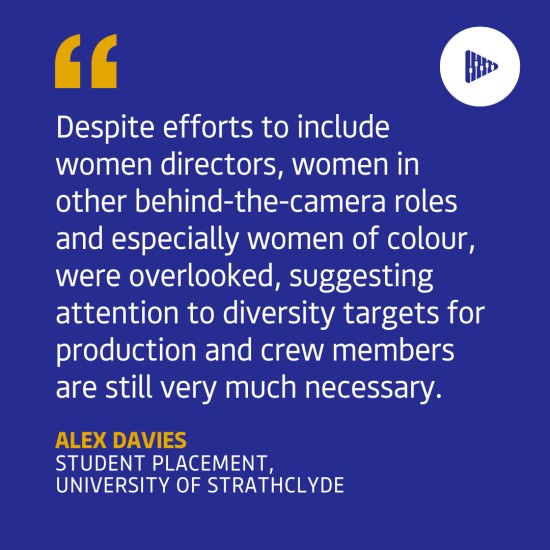
In recent years, criticism of the Oscars and BAFTA nominations drew attention to the underrepresentation of women and people of colour in the film sector. Research has demonstrated stark gender and racial disparities behind the scenes of the UK’s film industry. The Calling the Shots project studied British films produced between 2003 and 2015, finding that only 13% of their directors, 20% of their screenwriters and 27% of their producers were women. Statistics for women of colour were even worse, as 90% of the films examined did not employ any women of colour at all.
The Glasgow Film Festival’s director, Allison Gardner, has overseen GFF to go from strength to strength in terms of inclusivity, especially in its recognition of women filmmakers. In 2020, films directed by women opened and closed the festival for the first time and in 2022, 40% of all the films at GFF 2022 were directed by women.
Cinema for All?
Gardner has publicly voiced support for greater inclusivity in film, and has acknowledged that “We need to change those structures,”. Yet she has also asserted that the festival’s inclusive programming is not the result of quotas or targets but of a desire to maintain the “broadest possible appeal” to audiences. In fact, the Audience Award has consistently featured as many (if not more) women directors as men in almost every year of its history (see below), even before developments like 2017’s “Me Too” movement drew attention to gender inequality in the industry.
Where are the women? Nearly 500 women are ‘missing’ from key positions of power in Scotland
New figures from Engender show that 471 women are ‘missing’ from key positions of power in Scotland.
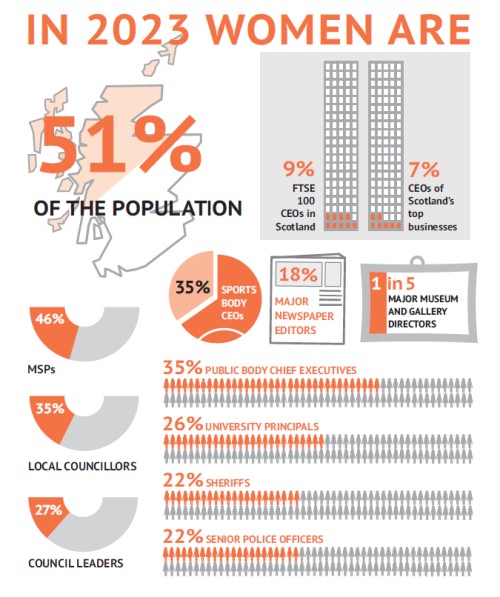
The report, which examines a range of areas across public life – including politics, health, sport and media – paints a concerning picture. The report identified 3383 positions of power in Scotland, with only 1222 (just over a third) held by women. Men continue to hold two-thirds of positions of power in Scotland and were significantly over-represented in 33 of the 38 areas of public life examined - with only 5 areas demonstrating at least 50% of women in leadership positions. This is despite women making up 51% of Scotland’s population, 49% of its labour market, and girls routinely leaving school with higher levels of educational attainment on average.
 RSS
RSSDownloads
 Engender Briefing: Pension Credit Entitlement Changes
From 15 May 2019, new changes will be introduced which will require couples where one partner has reached state pension age and one has not (‘mixed age couples’) to claim universal credit (UC) instead of Pension Credit.
Engender Briefing: Pension Credit Entitlement Changes
From 15 May 2019, new changes will be introduced which will require couples where one partner has reached state pension age and one has not (‘mixed age couples’) to claim universal credit (UC) instead of Pension Credit.
 Engender Parliamentary Briefing: Condemnation of Misogyny, Racism, Harassment and Sexism
Engender welcomes this Scottish Parliament Debate on Condemnation of Misogyny, Racism, Harassment and Sexism and the opportunity to raise awareness of the ways in which women in Scotland’s inequality contributes to gender-based violence.
Engender Parliamentary Briefing: Condemnation of Misogyny, Racism, Harassment and Sexism
Engender welcomes this Scottish Parliament Debate on Condemnation of Misogyny, Racism, Harassment and Sexism and the opportunity to raise awareness of the ways in which women in Scotland’s inequality contributes to gender-based violence.
 Gender Matters in Social Security: Individual Payments of Universal Credit
A paper calling on the Scottish Government to automatically split payments of Universal Credit between couples, once this power is devolved to the Scottish Parliament.
Gender Matters in Social Security: Individual Payments of Universal Credit
A paper calling on the Scottish Government to automatically split payments of Universal Credit between couples, once this power is devolved to the Scottish Parliament.
 Gender Matters Manifesto: Twenty for 2016
This manifesto sets out measures that, with political will, can be taken over the next parliamentary term in pursuit of these goals.
Gender Matters Manifesto: Twenty for 2016
This manifesto sets out measures that, with political will, can be taken over the next parliamentary term in pursuit of these goals.
 Scottish NGO Briefing for UN Special Rapporteur on Violence Against Women
Joint briefing paper for the UN Rapporteur on Violence Against Women.
Scottish NGO Briefing for UN Special Rapporteur on Violence Against Women
Joint briefing paper for the UN Rapporteur on Violence Against Women.

Newsletter
Sign up to receive our newsletter here:
Sign up to our mailing list
Receive key feminist updates direct to your inbox: