Engender blog
Guest Post: Why we must support women to make their own contraceptive choices
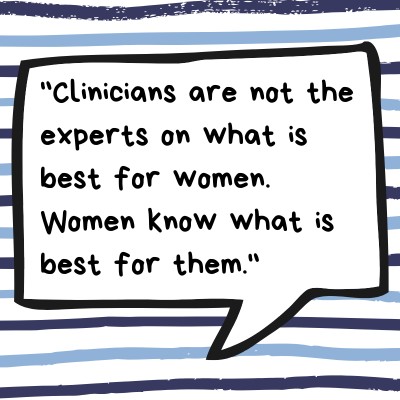
Alison Scott is a sexual health consultant with a focus on socially excluded women and chair of the Faculty of Sexual and Reproductive Healthcare (Scotland). Here, she continues our blog series looking at Long Acting Reversible Contraception (LARC) and why choice must be at the heart of women’s reproductive healthcare.
Having trained in obstetrics and gynaecology, I made the decision to move into sexual health around 18 years ago. My boss in sexual health at the time (a formidable force of nature who thought nothing of asking me if my fourth pregnancy had been planned!) was also a woman who had no tolerance of fools but advocated for those who she felt had no voice. At one of our first clinics, we were discussing contraceptive options. She gave me a phrase which I have stolen and used repeatedly when teaching others. “If she doesn’t choose it, she won’t use it”.
Guest Post: Equally Safe at Work
Women’s labour market participation experts, Close the Gap, are running an exciting employer accreditation programme called Equally Safe at Work. We asked Programme Officer Kelsey Smith to give us an update on the project so far.
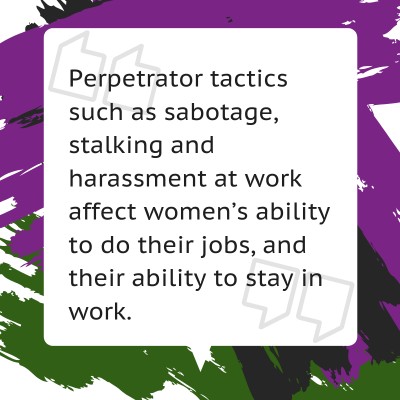
Violence against women (VAW) occurs at epidemic levels. It affects all aspects of women’s lives and the workplace is no exception.
Over 70% of women reported having experienced or witnessed sexual harassment in the workplace in Scotland. However, the vast majority (80%) of women who experience sexual harassment in the workplace will never report it due to fear of being blamed, not being believed or losing their job. Other forms of VAW, such as rape and sexual assault, can significantly impact on women's ability to hold down a job, as a result of needing to take extended periods off because of the emotional and physical impact. Victim-survivors often experience trauma which can make it increasing difficult to be in work situations which involve groups of men or being alone with men.
Guest Post: Exploring contraception as a feminist issue
As discussions around schemes which offer women support on the condition they utilise long-acting reversible contraceptives (LARC) continue, we've hosted a series of blogs by Elspeth Wilson discussing her research into how LARC has historically been - and continues to be - used to control the fertility of marginalised people. Read Elspeth's previous blogs here.
In her final blog, Elspeth explores adequate and accessible contraceptive care as a feminist issue.
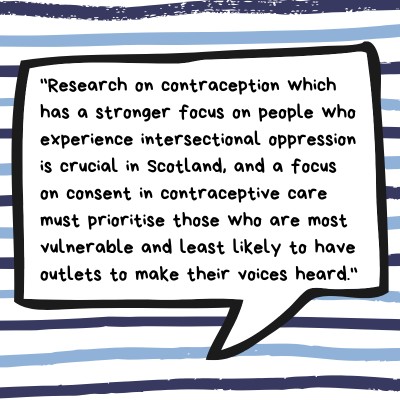
The Pause programme highlights that accessible contraception is only one part of the fight for adequate contraceptive care. Conversations on contraception frequently focus on access and whether and how people can get the kind of contraception they want to use. Obviously, this an important concern but it is only one side of the conversation. I hope that in my discussion of consent and information in the other blogs in this series I have been able to show that the question of who gets offered what contraception and why must also be central to feminist discussions of contraceptive care. If we are to approach contraception as an intersectional feminist issue the question of whose fertility is (de)valued and whose is seen as something to be controlled is imperative.
Guest Post: Contraception information and consent - two sides of the same coin?
As discussions around schemes which offer women support on the condition they utilise long-acting reversible contraceptives (LARC) continue, we'll be hosting a series of blogs by Elspeth Wilson discussing her research into how LARC has historically been - and continues to be - used to control the fertility of marginalised people. Read Elspeth's previous blog here.
In her second blog, Elspeth discusses ideas around informed consent.
-400.png)
"… they did not mention any of the side-effects nor provide any kind of informational material about what the injection does." [quote from research participant]
Guest Post: Hyper-sexualising queer women is a social injustice - it's time to change the narrative
Denisha Killoh is a proud member of the LGBT+ community with experience of fighting for change for marginalised groups. As Pride month draws to a close, she reflects on the need to take action to end discrimination against lesbians.
Follow Denisha on Twitter @denishakilloh
We live in a day and age where people are quicker than ever to call out injustices in society. Recently, we’ve seen an unprecedented rise of social activism, as a direct influence of social media, allowing anyone with a cause and a platform to fight for change.
 RSS
RSSDownloads
 Engender Briefing: Pension Credit Entitlement Changes
From 15 May 2019, new changes will be introduced which will require couples where one partner has reached state pension age and one has not (‘mixed age couples’) to claim universal credit (UC) instead of Pension Credit.
Engender Briefing: Pension Credit Entitlement Changes
From 15 May 2019, new changes will be introduced which will require couples where one partner has reached state pension age and one has not (‘mixed age couples’) to claim universal credit (UC) instead of Pension Credit.
 Engender Parliamentary Briefing: Condemnation of Misogyny, Racism, Harassment and Sexism
Engender welcomes this Scottish Parliament Debate on Condemnation of Misogyny, Racism, Harassment and Sexism and the opportunity to raise awareness of the ways in which women in Scotland’s inequality contributes to gender-based violence.
Engender Parliamentary Briefing: Condemnation of Misogyny, Racism, Harassment and Sexism
Engender welcomes this Scottish Parliament Debate on Condemnation of Misogyny, Racism, Harassment and Sexism and the opportunity to raise awareness of the ways in which women in Scotland’s inequality contributes to gender-based violence.
 Gender Matters in Social Security: Individual Payments of Universal Credit
A paper calling on the Scottish Government to automatically split payments of Universal Credit between couples, once this power is devolved to the Scottish Parliament.
Gender Matters in Social Security: Individual Payments of Universal Credit
A paper calling on the Scottish Government to automatically split payments of Universal Credit between couples, once this power is devolved to the Scottish Parliament.
 Gender Matters Manifesto: Twenty for 2016
This manifesto sets out measures that, with political will, can be taken over the next parliamentary term in pursuit of these goals.
Gender Matters Manifesto: Twenty for 2016
This manifesto sets out measures that, with political will, can be taken over the next parliamentary term in pursuit of these goals.
 Scottish NGO Briefing for UN Special Rapporteur on Violence Against Women
Joint briefing paper for the UN Rapporteur on Violence Against Women.
Scottish NGO Briefing for UN Special Rapporteur on Violence Against Women
Joint briefing paper for the UN Rapporteur on Violence Against Women.

Newsletter
Sign up to receive our newsletter here:
Sign up to our mailing list
Receive key feminist updates direct to your inbox: