Engender blog
29 Organisations Urge Police Scotland to Reject “Disgraceful” Abortion Investigation Guidelines
This week, we united with 28 other women’s rights, health, and human rights groups to condemn UK police guidance that subjects grieving women experiencing pregnancy loss to criminal investigation.
We have written to Chief Constable Jo Farrell calling on Police Scotland to publicly reject controversial new guidelines that could subject women experiencing pregnancy loss to invasive criminal investigations, under existing abortion laws.
The signatories – spanning women’s rights groups, abortion care providers and campaigners, healthcare bodies, human rights and equalities organisations and trade unions – have joined us in condemning the UK National Police Chiefs’ Council (NPCC) guidance on child death investigation as “disgraceful” and “misogynistic by design.”
The updated guidance, comes after a dramatic upswing in abortion related investigation and prosecution of women in England and Wales. Earlier this week the UK Parliament moved to halt criminal sanctions against women for terminating their own pregnancies via a successful amendment to the Crime and Policing Bill.
However, as this legislation only relates to England and Wales, a lack of clarity remains on whether these guidelines could still apply or be used in Scotland. Data published last year by Engender found that several abortion related cases have been pursued by police in Scotland in the last two decades.
Speaking about the need for action north of the border, our Executive Director of Engender, Catherine Murphy said:
“Women now find themselves in the perilous situation where the laws governing abortion in Scotland have not kept up with advancements like abortion medicines and reproductive tracking apps. Police Scotland, the Crown Office and Scottish Parliament need to act urgently to end the scope for prosecutions and bring the law into the 21st century.”
“The NPCC guidance describes women being targeted as ‘criminal suspects’ during one of the most sensitive and vulnerable experiences of their lives – pregnancy loss. It’s unconscionable.”
The controversial NPCC guidelines outline scope for highly invasive investigation techniques including:
-
Searching women’s homes and treating them as crime scenes
-
Confiscating digital devices and reviewing personal data
-
Accessing medical records and reproductive tracking apps
-
Subjecting families to criminal investigation during bereavement
Healthcare leaders have been unanimous in their opposition. The Royal College of Obstetricians and Gynaecologists described the guidance as “shocking,” and clinicians warn it creates a “climate of fear” among healthcare staff.
“Women experiencing pregnancy loss need compassionate care, not criminal investigation,” said Dr Sinead Cook, Chair of the Faculty of Sexual and Reproductive Healthcare, Scotland Committee. “These methods violate fundamental rights to dignity, privacy and healthcare.”
The letter warns that marginalised communities – including those in poverty, women of colour, disabled women, migrants, young women, LBT+ people, and those in rural areas – would be disproportionately impacted by such investigations. Evidence from England shows similar police actions have caused “life-changing harm,” resulting in severe mental health impacts, debt, and children taken into custodys.
The World Health Organisation has explicitly called on governments to stop arrests, investigations and prosecutions for abortion and to suspend the criminal law being applied to pregnancy loss – a position supported by every major UK medical body.
Signatories call on Police Scotland to:
-
Publicly clarify that NPCC recommendations on abortion and stillbirth will NOT be adopted in Scotland
-
Develop new guidance creating an effective moratorium on abortion investigations, aligned with WHO recommendations
“Police Scotland has a choice,” said Jill Wood, Policy Manager at Engender, “They can follow the lead of health experts and human rights bodies, or they can adopt guidance that will cause demonstrable harm to women in Scotland. We urge them to choose compassion over criminalisation.”
Signatories include Engender, Abortion Rights Scotland, Young Women’s Movement, Back Off Scotland, Humanist Society Scotland, Close the Gap, Scottish Women’s Convention, Scottish Women’s Budget Group, Zero Tolerance, Rape Crisis Scotland, Scottish Abortion Care Providers Network, Faculty for Sexual and Reproductive Healthcare Scotland, Amnesty International UK, Scottish Women’s Aid, Royal College of Midwives, STUC, Royal College of Obstetricians and Gynaecologists, Equality Network, Scottish Trans, Equate Scotland, Human Rights Consortium Scotland, British Pregnancy Advisory Service, Women’s Enterprise Scotland, Liberty, Coalition for Racial Equality and Rights, Amma Birth Companions, NUS Scotland, Health and Social Care Alliance Scotland (the ALLIANCE), Inclusion Scotland.
Why we need to modernise abortion law in Scotland - your questions answered
For too long women in Scotland & the UK have had to settle for a system of abortion law that doesn’t put their needs & rights first. We’re calling for modernised abortion law that works for women’s human rights & prevents further unnecessary prosecutions.
To mark International Safe Abortion Day on 28th September, we’ve got the answers to some of the most frequently asked questions about why we need to decriminalise abortion in Scotland now.
-600.png)
Wait, isn’t abortion legal in Scotland?
No. Women and pregnant people in Scotland currently do not have the legal right to make the final decision about ending a pregnancy. Instead, that power lies in the hands of doctors—two of whom must approve any request for an abortion. This adds needless complexity to the process, leading to delays and creating unnecessary barriers for those seeking care, especially for marginalised groups like disabled women, migrant women and young women.
So what is the law?
The laws that dictate when abortion is permitted in Scotland are a patchwork of outdated regulations, stemming from as far back as the 17th century. These measures largely reflect the eras in which they were introduced and the degrees of patriarchal control women were subject to at the time. To put it in perspective, one of these laws is based in legislation from when witch trials were still happening.
Why do we need decriminalisation?
The current law is disconnected from the realities of modern Scotland, where abortion is routine healthcare accessed by around one in three in their lifetimes. While most women can access services without issue, marginalised women face greater challenges due to the two-doctor approval rule. For instance, for women in rural areas, there might only be one doctor available locally, or they may have to travel long distances to a clinic where abortion services are available.
Without this authorisation, abortion remains illegal across Britain, and women, healthcare providers and people assisting someone to have an abortion can be subject to prosecution. These and other restrictions set out in the Abortion Act can impede access to reproductive healthcare in Scotland.
The sharp increase in prosecutions for abortion-related offences in England highlights how outdated laws clash with modern medical practices and commitments to public health, human rights, and gender equality. Our report explores these legal failures in Scotland, including evidence that women have been charged and prosecuted for abortion-related offences in recent years.
Would decriminalising abortion make unsafe ‘backstreet’ abortions legal?
One argument against decriminalisation claims it would ‘legalise non-medical, backstreet abortions,’ but this is misleading. The Abortion Act strictly controls when, where, and how abortions can occur. Outside of this framework, abortion remains a crime.
It’s also important to note that 99% of abortions in Scotland today are medical, induced by pills, not surgical. The unsafe ‘backstreet’ abortions that were common when the Abortion Act was enacted are simply not the threat they were in the 1960s.
Despite being one of the most common and safest healthcare procedures—accessed by one in three women - abortion is treated differently in law than almost all other medical procedures. In all other fields of healthcare, medical bodies are able to shape guidance and regulation based on best practice, rather than complex laws, including criminal law, from a bygone era.
Do people in Scotland support abortion reform?
Decriminalisation is recommended by the World Health Organization, all major UK medical bodies, UN treaty groups, trade unions, and equality advocates. While abortion is often seen as a polarising issue, especially in Scotland, the reality is much different.
Regular polling by YouGov shows that the vast majority of Scots are firmly in favour of abortion rights. In fact, as of January 2024, 93% agreed that ‘women should have the right to an abortion.’ Despite lingering stigma and uncertainty surrounding abortion, partly due to its criminalisation, social attitudes in Scotland have shifted dramatically in recent decades.
Are politicians willing to take action?
With a few high-profile exceptions, countries across the world are increasingly modernising and liberalising their legal frameworks on abortion. In contrast, the laws in Scotland, England, and Wales are falling behind more progressive approaches seen in most of Europe. Britain, including Scotland, has also not kept up with international human rights standards, which clearly state that access to safe, legal, and timely abortion is a basic human right and shouldn’t be controlled through criminal laws or punishments.
In the UK, politicians have historically avoided changing abortion laws, seeing it as a ‘controversial’ issue. As a result, decisions taken in parliament have tended to be free votes rather than along party lines. However, Northern Ireland, Scotland, and Wales have all used their devolved powers to make changes, with Northern Ireland passing laws and Scotland and Wales taking executive action. For example, Scotland has approved early medical abortion at home and updated reporting requirements. Meanwhile, support for decriminalising abortion is growing across the political spectrum in Scotland.
Would decriminalising abortion face legal challenges?
Abortion was devolved to the Scottish Parliament in 2016 and it is open to the Scottish Parliament to pass legislation that amends the Abortion Act. The UK parliament has historically avoided reforming abortion laws at Westminster.
If Scotland were to change or repeal the Abortion Act, it could face legal challenges from the UK Government, arguing that different abortion laws across the UK would cause problems. However, Northern Ireland has always had different abortion laws. At the same time, the rising number of investigations and prosecutions of women seeking abortions in England has increased calls to decriminalise abortion and repeal the Abortion Act at Westminster.
Anti-abortion groups would likely try to block progressive abortion law reform. They previously challenged Northern Ireland’s law on safe access to clinics, but the UK Supreme Court rejected that case. Similar challenges in Scotland, such as the one against early medical abortions at home, have also been unsuccessful.
Find out more and read our full report here: ‘Outdated, harmful and never in the public interest - The urgent need to modernise Scotland’s abortion law and prevent prosecutions.’
8 Steps Towards Women’s Equality in Scotland
Ahead of the next Programme for Government for 2024-25, we have outlined several important actions we want the Scottish Government to take to protect women’s rights and promote gender equality in Scotland.

Engender advocates for a Scotland where women are involved in all political and economic decisions, both as decision-makers and individuals affected by these decisions. This means recognising the diverse experiences of all women, including those facing multiple forms of discrimination, such as Black and minority ethnic women, younger and older women, disabled women, lesbian, bisexual, and trans women, women from rural areas, and those who are mothers, women who have experienced domestic abuse or men’s violence, and those experiencing poverty.
We have identified eight key actions in three main areas that need change:
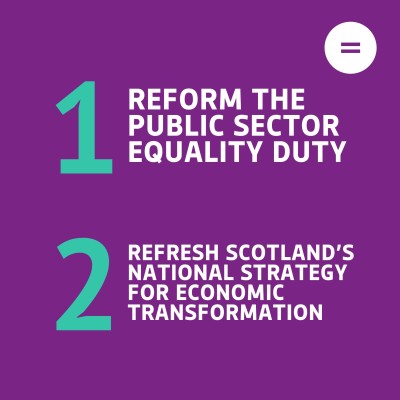 EMBED GENDER EQUALITY ACROSS ALL SCOTTISH GOVERNMENT POLICY
To achieve the Scottish Government’s main goals—eliminating child poverty, boosting the economy, addressing climate change, and improving public services—it’s crucial to improve how gender equality is considered across policymaking. These goals affect women and men differently, especially for women facing additional marginalisation. If policies don’t account for structural inequalities, their benefits for Scotland’s most disadvantaged people will be limited.
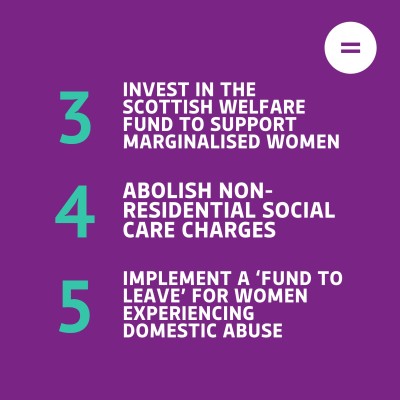 ADDRESS WOMEN’S POVERTY AND FINANCIAL INEQUALITY
Eliminating child poverty is the First Minister’s top priority. To succeed, the Programme for Government must connect women’s poverty with children’s poverty. There’s an urgent need to get financial support to the most vulnerable families in Scotland, and focusing on women’s economic inequality is often the most effective approach. This must include targeted actions which tackle the disproportionately negative impacts that the cost of living crisis is having on women’s lives, especially for women who experience other forms of marginalisation.
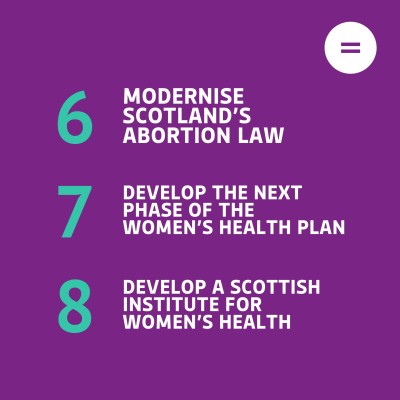 TACKLE WOMEN’S HEALTH INEQUALITIES AND PROTECT REPRODUCTIVE RIGHTS
Women and girls still face inequalities in health and wellbeing and access to services compared to men and boys, mainly due to gender inequality and “medical misogyny.” Marginalised women, including women of colour, disabled women, unpaid carers, LGBTI+ women, younger and older women, and migrant women, experience even wider disparities in health outcomes. We urgently need updated abortion laws that uphold women’s rights and action to advance Scotland’s Women’s Health Plan.
Read more about all our asks here.
General Election 2024?– What’s in it for women??
We’re calling on candidates to commit to taking action on four key areas for women if elected – and we need your help.
 Political decision-making affects women’s daily lives, yet there is a significant void in women’s representation and distribution of power in Scotland. We advocate for a Scotland where women are part of every political and economic decision, both as decision-makers and as citizens who are affected by the consequences of these decisions.
A decade of austerity policies, the pandemic, and the ongoing cost of living crisis have all impacted women disproportionately. Issues like fuel costs, unpaid care, housing, women’s safety, mental health and social security continue to impact the most marginalised women.
The General Election on 4th July is an opportunity for the next UK Government to prioritise women’s rights and equality.
We need change to make women’s voices heard.
Modernising Scotland's abortion law
Today we launch our new report, ‘Outdated, harmful and never in the public interest - The urgent need to modernise Scotland's abortion law and prevent prosecutions.’
Here’s why...
 1. The law is in urgent need of modernisation.
The legal framework which currently governs when an abortion is permitted is made up of a patchwork of laws that stem from as far back as the 17th century. These measures largely reflect the eras in which they were introduced, and the degrees of patriarchal control women were subject to at the time. Put another way, one of these laws was first introduced at a time when witch trials were still happening.
The law is therefore out of step with the experiences of women in modern Scotland for whom abortion is routine healthcare, accessed by around one in three in their lifetimes.
The report is informed by input from legal experts and medical professionals, detailing the wide-ranging support that exists for decriminalisation. It concludes with clear recommendations for Scottish Government and other key decisionmakers on what the next steps towards a modernised regulatory framework should be. These actions will be vital to support ongoing improvement in reproductive healthcare services and the safeguarding of reproductive rights for future generations of Scotland’s women and pregnant people.
 2. Prosecutions for crimes of abortion are happening in Scotland.
Under the current law women and pregnant people in Scotland have no legal right to end a pregnancy. That decision ultimately sits with doctors, two of whom must authorise the request for an abortion. This layers unnecessary complexity onto service delivery and creates delays and barriers for women. Without this permission and compliance with other rules set out in the Abortion Act 1967, abortion is illegal across Britain, and women, healthcare providers and people assisting someone to have an abortion can be subject to prosecution.
The sharp increase in prosecutions for abortion related offences in England throws into stark relief how the legal framework is increasingly working at odds with modern clinical realities, and public health, human rights and gender equality obligations.
Our report examines the shortcomings of the current legal framework in Scotland in detail, including evidence that women have been charged and prosecuted for abortion related offences in recent years.
 3. The current system in Scotland is not keeping step with international human rights standards.
With a few high-profile exceptions, countries across the world are increasingly modernising and liberalising their legal frameworks on abortion. Laws in Scotland, England and Wales now trail behind more progressive regulatory frameworks in most other European countries. Britain, including Scotland, has also failed to keep pace with international human rights standards. These are clear that access to safe, legal and timely abortion is a fundamental human right that must not be regulated using criminal law and penalties.
 4. Abortion is treated differently under the law without medical justification.
Despite being one of the most routinely used and safe forms of healthcare- accessed by one in three women in their lifetimes, abortion is treated differently in law than almost all other medical procedures. In all other fields of healthcare, medical bodies are able to shape guidance and regulation based on best practice, rather than complex laws, including criminal law, from a bygone era. Dealing with abortion in this way creates a harmful stigma around an essential health service. It also prevents the development of services that are based on the best available clinical standards. Like all other healthcare, the governance of abortion should rightfully sit with healthcare regulators and professional medical bodies, not criminal courts.
 5. Support for abortion rights is widespread
Decriminalisation is supported by the World Health Organisation, all relevant medical bodies in the UK, UN treaty bodies, trades unions and equalities advocates. In January 2024, 93% of those polled in Scotland agree that women should have the right to an abortion.
In Summary
The current legal framework in Scotland is:
-
Outdated and falling behind international human rights standards
-
Out of step with guidelines from global and national health bodies
-
Impeding access to quality abortion care for women
-
Perpetuating abortion stigma, harmful gender stereotypes and women’s inequality
-
Preventing healthcare practitioners from providing the highest standards of care
-
Causing women trauma and lasting harm, that is most pronounced for marginalised women and those in situations of vulnerability
The report sets out how:
-
Women have been charged and prosecuted for crimes related to abortion in Scotland in the 21st century.
-
Abortion is vital, routine healthcare and is one of the safest and most frequently accessed medical procedures used by women and pregnant people across the world.
-
Decriminalisation of abortion is recommended by the World Health Organisation, major international human rights mechanisms, and all relevant professional medical bodies in the UK.
-
Decriminalisation is needed for realisation of a wide range of women’s human rights and for government compliance with international human rights law.
-
Safe and legal abortion is a cornerstone of progress towards women’s equality.
-
Decriminalisation is in line with high-level commitments from Scottish Government on gender equality and would help future-proof against regression on women’s rights.
-
Decriminalisation would remove unnecessary “chilling” pressures on healthcare professionals, who are exposed to potential criminal sanctions at work.
Read the full report here.
 RSS
RSSDownloads
 Engender Briefing: Pension Credit Entitlement Changes
From 15 May 2019, new changes will be introduced which will require couples where one partner has reached state pension age and one has not (‘mixed age couples’) to claim universal credit (UC) instead of Pension Credit.
Engender Briefing: Pension Credit Entitlement Changes
From 15 May 2019, new changes will be introduced which will require couples where one partner has reached state pension age and one has not (‘mixed age couples’) to claim universal credit (UC) instead of Pension Credit.
 Engender Parliamentary Briefing: Condemnation of Misogyny, Racism, Harassment and Sexism
Engender welcomes this Scottish Parliament Debate on Condemnation of Misogyny, Racism, Harassment and Sexism and the opportunity to raise awareness of the ways in which women in Scotland’s inequality contributes to gender-based violence.
Engender Parliamentary Briefing: Condemnation of Misogyny, Racism, Harassment and Sexism
Engender welcomes this Scottish Parliament Debate on Condemnation of Misogyny, Racism, Harassment and Sexism and the opportunity to raise awareness of the ways in which women in Scotland’s inequality contributes to gender-based violence.
 Gender Matters in Social Security: Individual Payments of Universal Credit
A paper calling on the Scottish Government to automatically split payments of Universal Credit between couples, once this power is devolved to the Scottish Parliament.
Gender Matters in Social Security: Individual Payments of Universal Credit
A paper calling on the Scottish Government to automatically split payments of Universal Credit between couples, once this power is devolved to the Scottish Parliament.
 Gender Matters Manifesto: Twenty for 2016
This manifesto sets out measures that, with political will, can be taken over the next parliamentary term in pursuit of these goals.
Gender Matters Manifesto: Twenty for 2016
This manifesto sets out measures that, with political will, can be taken over the next parliamentary term in pursuit of these goals.
 Scottish NGO Briefing for UN Special Rapporteur on Violence Against Women
Joint briefing paper for the UN Rapporteur on Violence Against Women.
Scottish NGO Briefing for UN Special Rapporteur on Violence Against Women
Joint briefing paper for the UN Rapporteur on Violence Against Women.

Newsletter
Sign up to receive our newsletter here:
Sign up to our mailing list
Receive key feminist updates direct to your inbox: