Engender blog
All of Engender’s latest news. Reports, reviews, books, articles, and information from across Scotland’s women’s sector.
We would love to hear from other feminists around Scotland. Check out our guidelines for more information on how you can blog for us.
GUEST POST: Digital safety and women in politics

Engender and the Equal Media and Culture Centre for Scotland have hosted student placements from the MSc in Social Research at the University of Edinburgh and the University of Strathclyde Applied Gender Studies and Research Methods course. As part of their research outputs, the students have produced a series of blogs.
In this post, Yoke explores abuse online in the UK and beyond – with a focus on the experiences of women politicians.
In January 2023, the First Minister of the Scottish National Party, Nicola Sturgeon, resigned from her role. In her speech announcing her resignation, she described the “brutality” of public life as a politician, specifically referring to it as “hostile” for female politicians, highlighting the role that social media plays in the abuse that women politicians receive.
GUEST POST: 'Text me when you're home!'
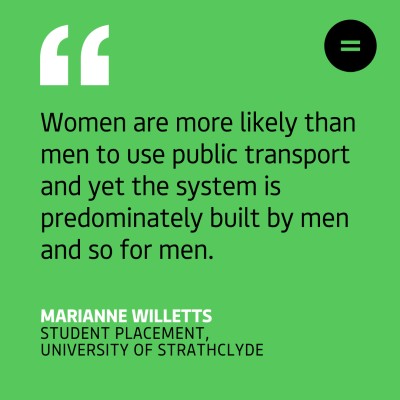
Today we're publishing the first in a series of blogs from the Spring student placements Engender hosted from the University of Strathclyde Applied Gender Studies and Research Methods course.
In this post, Marianne looks at how gender inequality and violence against women affect how women experience public spaces and public transport, and how and when these issues are recognised in the Scottish Parliament.
Keys between knuckles, hair down, earphones out. A routine all too familiar to a woman travelling home after sunset alone.
A male friend once told me that him and his flatmates had a ‘72-hour rule’; if one of them didn’t come home without telling the others where they were, they would wait 72 hours before ‘overthinking’ it and calling the police. I can’t speak for all women, but personally, if it was my female flatmate or friend, it would be at most 12 hours before the panic would set in and a further 12 before I would call the police. Women do not have the luxury of not taking precautions when commuting late at night. Travelling from A to B is necessary in many circumstances, and safety when doing so should be a given, but it is not.
Vital Voices Gather
A nationwide series of gatherings to share your ideas for a Scotland without violence against women and girls...
.png)
Almost every area of our lives is affected by public policy decisions, from our healthcare to the public transport we take. Women experience life differently to men and these differences are not always considered. Engender’s Delivering Equally Safe project is exploring the consequences of when these differences are overlooked, particularly in relation to violence against women and girls (VAWG).
We want to hear from women with lived experience of this violence, to explore how all areas of public policy can work better for women and be used to prevent VAWG before it occurs.
Cost of Living Crisis: The hidden cost of politics
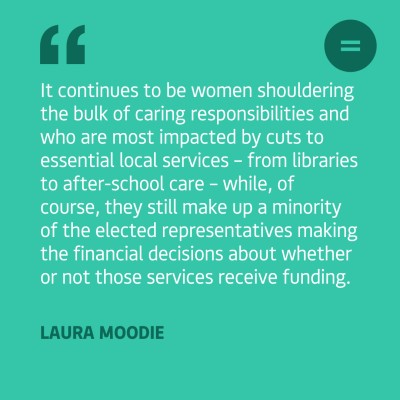
As part of our blog series on the cost of living crisis, activist and campaigner Laura Moodie explores the hidden costs of participating in politics during the cost of living crisis, and the challenges this creates for achieving equal representation for women at all levels of politics.
For International Women’s Day this year, I had the joy of meeting with a group of fantastic Green women in the amazing Ayrshire Women’s Hub. Despite the dark and chilly night - with snow hinted at by the weather forecast - by the time the meeting started in earnest, we’d had to bring in extra chairs to fit everyone in.
Women's economic, social and cultural rights in Scotland
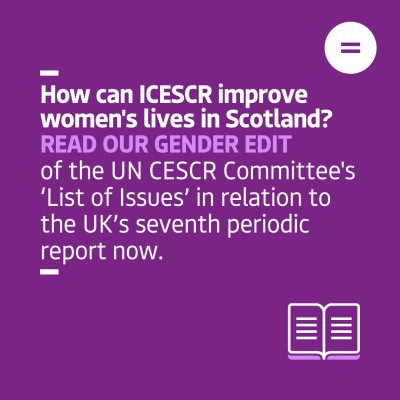
We recently submitted a shadow report, signed by 20 organisations, to the Seventh periodic report of the government of the United Kingdom on measures taken to give effect to ICESCR. In this blog, we share our gender edit of the List of Issues published by the CESCR Committee and take a look at some key issues raised.
The UN Committee on Economic Social and Cultural Rights is currently examining the UK on its performance under ICESCR (the International Covenant on Economic, Cultural, and Social rights). In 2022, the UK submitted its state party report (including input on devolved matters from Scottish Government), and the Committee received ‘shadow reports’ from civil society. Earlier this year we submitted a shadow report, co-signed by twenty organisations, which maps women’s rights in Scotland across the articles of ICESCR and highlights potential areas of focus for the Committee’s scrutiny. You can read more about our shadow report here.
 RSS
RSSDownloads
 Engender Briefing: Pension Credit Entitlement Changes
From 15 May 2019, new changes will be introduced which will require couples where one partner has reached state pension age and one has not (‘mixed age couples’) to claim universal credit (UC) instead of Pension Credit.
Engender Briefing: Pension Credit Entitlement Changes
From 15 May 2019, new changes will be introduced which will require couples where one partner has reached state pension age and one has not (‘mixed age couples’) to claim universal credit (UC) instead of Pension Credit.
 Engender Parliamentary Briefing: Condemnation of Misogyny, Racism, Harassment and Sexism
Engender welcomes this Scottish Parliament Debate on Condemnation of Misogyny, Racism, Harassment and Sexism and the opportunity to raise awareness of the ways in which women in Scotland’s inequality contributes to gender-based violence.
Engender Parliamentary Briefing: Condemnation of Misogyny, Racism, Harassment and Sexism
Engender welcomes this Scottish Parliament Debate on Condemnation of Misogyny, Racism, Harassment and Sexism and the opportunity to raise awareness of the ways in which women in Scotland’s inequality contributes to gender-based violence.
 Gender Matters in Social Security: Individual Payments of Universal Credit
A paper calling on the Scottish Government to automatically split payments of Universal Credit between couples, once this power is devolved to the Scottish Parliament.
Gender Matters in Social Security: Individual Payments of Universal Credit
A paper calling on the Scottish Government to automatically split payments of Universal Credit between couples, once this power is devolved to the Scottish Parliament.
 Gender Matters Manifesto: Twenty for 2016
This manifesto sets out measures that, with political will, can be taken over the next parliamentary term in pursuit of these goals.
Gender Matters Manifesto: Twenty for 2016
This manifesto sets out measures that, with political will, can be taken over the next parliamentary term in pursuit of these goals.
 Scottish NGO Briefing for UN Special Rapporteur on Violence Against Women
Joint briefing paper for the UN Rapporteur on Violence Against Women.
Scottish NGO Briefing for UN Special Rapporteur on Violence Against Women
Joint briefing paper for the UN Rapporteur on Violence Against Women.

Newsletter
Sign up to receive our newsletter here:
Sign up to our mailing list
Receive key feminist updates direct to your inbox: